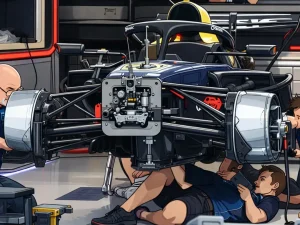
Ferrari’s early 2026 form has been solid in the way that keeps a season alive without quite making it feel dangerous. Three races, three podiums, no obvious implosion. And yet, listening to the team talk, you get the sense Maranello’s mood is less about celebrating consistency and more about chasing a missing piece.
That missing piece, according to both Lewis Hamilton and team principal Fred Vasseur, is plain enough: the SF-26 isn’t quick enough in a straight line.
Hamilton first put it bluntly in Shanghai, pointing to Mercedes as the benchmark. In his telling, the silver cars “take a huge step” on the straights, not just through drag level but through how effectively they can deploy energy without paying it back later in the straight with de-rating. That’s a modern F1 driver’s way of saying the same thing teams used to say in the V10 era: their rival is pulling away, and it’s not just DRS.
Vasseur doesn’t disagree. Asked about it ahead of Ferrari’s upcoming Monza filming day, he effectively backed his driver’s read on where the SF-26 is vulnerable.
“We know that we have a deficit of performance in the straight line and that we have to work on it,” Vasseur said, with the sort of resignation that comes when a problem is obvious on the GPS traces and stubborn in the solutions.
What’s changed in 2026 is how quickly that deficit can trap you in a race. The new overtake mode — worth an extra 0.5 megajoules of energy when you’re within a second of the car ahead at designated parts of the lap — has sharpened the incentive structure. Stay in range and you’ve got a weapon; fall out of range and you’re suddenly just another car in the queue.
Vasseur described the on-track effect neatly: miss that one-second window and the passing opportunity evaporates, creating the “train” races everyone in the paddock fears. He referenced Japan as the case study — once Ferrari lost the crucial gap to the car ahead, life got harder immediately.
That matters because Ferrari’s season so far has been built on being there, not necessarily being the quickest. Charles Leclerc’s thirds in Australia and Japan, and Hamilton’s third in China — his first Ferrari podium — are the sort of results that keep a title picture within arm’s reach early on. But if Mercedes has the cleaner energy story on the straights, Ferrari’s margin for error in race craft shrinks. You can’t afford to drift three tenths off a car ahead for a couple of laps, because the rules now punish that lapse more than before.
The timing of Ferrari’s next step is also telling. The team is heading to Monza for a filming day next Wednesday (April 22), using a slice of the 200km of private running that comes with it. Officially, these days are meant for promotional mileage. Unofficially — and everyone knows it — teams will always treat them as a chance to validate procedures and gather feel-good correlation where they can.
Ferrari, unlike most, hasn’t spent either of its two permitted filming days yet in 2026, which has left its partner content pipeline thin beyond the SF-26 launch material from January. So yes, there’s a commercial motivation. But picking Monza, of all places, doesn’t exactly scream “just shoot some footage and go home”.
This is the Temple of Speed, still the most honest circuit on the calendar if you want to understand straight-line performance and the compromises around energy management. If you’re worried about deployment and de-rating at the end of the straights — Hamilton’s specific complaint — there are few better places to stress the system in representative conditions.
Whether Ferrari can lean on regulatory help is another subplot rumbling in the background. The FIA’s Additional Development and Upgrade Opportunities (ADUO) scheme is designed to give struggling 2026 engine manufacturers a chance to claw back performance. It remains unclear if Ferrari will qualify, and there’s still uncertainty around when the first checkpoint will be applied.
Originally, a decision was expected after the sixth race — which was meant to be Miami. But with Bahrain and Saudi Arabia cancelled, Miami is now round four, and Monaco will host round six on June 7. There’s also no final word on whether the original May timing for the ADUO checkpoint will stand or slide.
What’s clear is that manufacturers want clarity sooner rather than later. Before his exit from Audi’s F1 project last month, Jonathan Wheatley openly suggested there’s little appetite to push the date back; in his view, nobody “wants to lose a month” of development time waiting for the bureaucracy to catch up.
Other manufacturers are already being talked about in that context. Honda, supplying Aston Martin, is widely expected to benefit after a start to 2026 marred by severe vibrations. Wheatley had also hinted Audi could meet the ADUO criteria.
Ferrari isn’t talking in those terms. Publicly, the message is more straightforward: there’s a deficit, it’s on the straights, and they’re going to work through it. That might sound almost too simple for the sport’s most romanticised team, but the bluntness is refreshing. There’s no virtue in pretending a weakness is a “characteristic” when everyone can see your car being mugged between apex and braking zone.
The interesting part, as Miami approaches, is what Ferrari can realistically achieve without turning the SF-26 into a different machine. Straight-line performance in this era isn’t a single dial you twist. It’s drag level, power unit behaviour, and the messy, interlinked trade-offs between how you harvest, how you deploy, and how quickly you hit the point where the system has to protect itself.
Hamilton’s comment about “eke[ing] more from our engine” was carefully phrased — more “eke” than “find”. It sounds like a team chasing optimisation rather than waiting for a magic update to fix everything.
And if Vasseur is right about how decisive overtake mode has become, Ferrari may not need to transform itself into the fastest car in a straight line to change its season. It might just need to stop being the car that slips out of the one-second window. In 2026, that’s the difference between hunting and being stuck in the train.