Max Verstappen arrived at the Nürburgring on Sunday as the headline act, but the morning began on a sombre note. In the build-up to the day’s running, the paddock paid its respects to Juha Miettinen following his death at the circuit on Saturday, ahead of the final Qualifier event that sits on the road to next month’s Nürburgring 24 Hours.
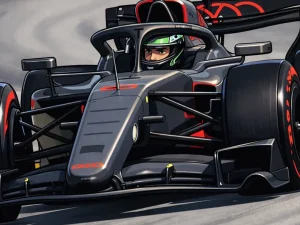
Verstappen ran a black ribbon symbol on his GT3 car in tribute, then did what he nearly always does when he’s given something with wheels and a stopwatch attached: he went to the front. After qualifying earlier in the day, the #3 entry he shares with Lucas Auer was already in a solid position, and Verstappen’s opening stint only sharpened the picture. He dragged the car from fifth to first with a handful of assertive moves in the opening hour, looking every bit like a driver treating “preparation” as something closer to a live rehearsal.
But endurance racing has a way of making even the cleanest Sundays feel provisional. The race turned on a single, ugly number: 28 minutes.
When Verstappen brought the car in to hand over to Auer, what should’ve been a routine driver change spiralled into a lengthy garage stop. The culprit, Verstappen confirmed afterwards, was a broken front splitter — the kind of under-the-nose damage that can transform a quick GT3 into something that either won’t turn or won’t stay planted, and often both.
There was a moment before the stop that summed up Verstappen’s mindset: he even pulled off a pit-lane overtake on lapped traffic on his way in, still operating in “make time wherever it exists” mode. It didn’t matter. The repairs dropped the car to 87th on the road, turning a win bid into a salvage job.
To Auer’s credit, the recovery was not insignificant. He hauled the stricken entry back to 39th by the chequered flag, which tells you plenty about the pace they had — and just how savage the time loss was. In endurance terms, 28 minutes isn’t a delay; it’s a reset.
If there’s a silver lining for Verstappen, it’s that this weekend was always supposed to be about sharpening tools for the Nürburgring 24 Hours rather than polishing trophies. The frustration is obvious — the pair “looked in a strong position” at the handover — but it’s also the kind of failure you’d rather bank now than in the big one. Splitter failures and the knock-on effect of underfloor aero sensitivity are precisely the issues you want to understand before you’re deep into the night next month.
Away from the Nordschleife, the wider F1 storylines kept ticking — and one of the more eye-catching was McLaren’s insistence that it’s becoming a destination team again. Team principal Andrea Stella described the signing of GianPiero Lambiase as “icing on the cake”, framing the move as a marker of McLaren’s growing pull.
Lambiase, long associated with Verstappen as his race engineer and more recently Red Bull’s head of racing, is set to join McLaren no later than 2027. Stella’s point wasn’t subtle: people of that calibre don’t jump unless they believe in the trajectory. What McLaren gets, beyond the obvious technical and operational heft, is institutional knowledge of how an elite front-running organisation actually behaves under pressure — how it communicates, how it decides, how it keeps its sharpest edges when the stakes are highest.
Not everyone linked to McLaren is looking at F1 through rose-tinted glasses, though. Pato O’Ward, the team’s IndyCar driver and one of its F1 reserves, admitted he’s no longer making Formula 1 the goal. Having previously been drawn by the machinery and the level of engineering, O’Ward suggested the 2026-spec direction has dulled the appeal for him, even describing it through the unflattering “Mario Kart” lens. It’s a striking thing to hear from a driver with a foot in McLaren’s F1 door: the romance of the pinnacle isn’t universal, and the new-era technical package won’t charm everyone.
Then there’s Aston Martin, where 2026 has started as bleakly as the paddock gossip suggests. Martin Brundle didn’t sugarcoat it, calling out a lack of “speed” and “reliability” and warning he can’t see a significant turnaround before 2027. His reasoning was painfully familiar: a packed calendar, the cost cap, and the simple reality that catching up isn’t just about finding performance — it’s about having the bandwidth to do it repeatedly, without breaking everything else in the process.
In other words, while Verstappen’s Nürburgring Sunday was derailed by a single broken component, the bigger F1 stories simmering in the background are about systems: how teams recruit, how regulations land with drivers, and how quickly organisations can pivot when the floor falls away.
For Verstappen, though, the immediate takeaway is more straightforward. The pace is there. The intent is there. But if he’s going to add a Nürburgring 24 Hours assault to his already crowded portfolio, the margin for mundane failures — a splitter here, a repair there — will be as decisive as any overtaking move he can pull off on the opening lap.