Miami left the paddock with that familiar hangover: half the talking points were born in the scrutineering bay, the other half in a camera angle that never made the world feed.
At Red Bull, Laurent Mekies didn’t try to dress up what happened to Isack Hadjar. The rookie’s qualifying disqualification — triggered by a floor measurement found to be two millimetres beyond the permitted maximum — was, in Mekies’ words, “painful”, and he accepted the team should have caught it before the FIA did.
It’s the sort of error that stings precisely because it isn’t glamorous. No grey-area innovation, no daring interpretation that got too cute. Just a miss on something Red Bull’s systems are built to police obsessively. Hadjar’s weekend unravelled from there, ending in a race crash-out that only amplified the sense of squandered opportunity.
The broader message from Mekies’ admission is clear enough: his Red Bull isn’t going to lean on reputation as a shield. Since succeeding Christian Horner as team principal in July 2025, Mekies has spoken like someone intent on dragging issues into the open quickly, fixing them, and moving on. That’s sensible leadership — and also a tacit acknowledgement that, in the current competitive climate, you don’t get many free passes when the margins are measured in millimetres.
Elsewhere, the other Miami moment that’s done the rounds came via untelevised footage of Lewis Hamilton’s first-lap run-in with Franco Colapinto at Turn 11. Hamilton’s Ferrari picked up damage in the clash, a hit he ultimately carried through the race, costing him roughly half a second per lap. The frustration was obvious enough in real time; the later emergence of Hamilton waving his middle finger at the Alpine only underlined how sharply he felt he’d been wronged.
Hamilton still salvaged sixth, which tells you plenty about both his stubbornness and the baseline pace Ferrari had even with a compromised car. But the incident also carried an edge because Colapinto, one spot behind in seventh, sealed his best F1 result. It’s the kind of exchange that leaves both drivers feeling they proved a point — and neither particularly inclined to yield much the next time they find themselves alongside into a braking zone.
Then there’s the bit of paddock theatre that never really stays “just a chat” for long: Zak Brown making a visit to Red Bull’s hospitality and being spotted in conversation with Mekies. Mekies played it straight, describing it as a “good chat”, and that’s probably as much as anyone should expect him to say publicly.
But context matters. McLaren has already announced the signing of Gianpiero Lambiase, Max Verstappen’s long-serving Red Bull race engineer, with the caveat that he’ll join his new team “no later” than 2028. Moves like that change the temperature between rival operations, even if everyone insists it’s business as usual. The sight of Brown dropping by Red Bull’s unit, then, read less like an escalation and more like a deliberate attempt to keep the relationship workable — the sort of soft diplomacy that can prevent small irritations turning into full-blown trench warfare.
Off-track politics widened further with FIA president Mohammed Ben Sulayem taking aim at the idea of multi-team ownership, warning it’s “not the right way” amid Mercedes’ interest in buying a stake in Alpine. Alpine adviser Flavio Briatore has already confirmed Mercedes is among the parties looking at Otro Capital’s 24 per cent holding, and Alpine revealed back in January that Horner is also interested.
Ben Sulayem’s stance is a flashing yellow for anyone thinking the commercial logic alone will carry the day. The sport may be more financially stable than it once was, but the FIA is clearly wary of blurred lines — the kind that can quickly spark suspicion about competitive independence, data flow, and political leverage. Even a minority stake comes with questions the regulator doesn’t want hanging over the grid.
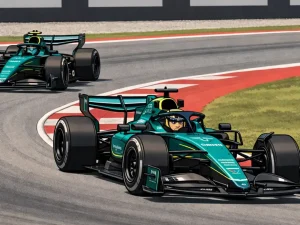
And at Aston Martin, Fernando Alonso sounded like a man done with chasing ghosts. After Miami, he insisted the vibrations that have been a talking point recently weren’t an issue there, and instead pointed squarely at the gearbox as the team’s “number one” priority before Canada.
The line that really lands, though, is where Aston Martin actually is right now: Miami delivered its first two-car finish of the 2026 season, with Alonso 15th and Lance Stroll 17th. For a team that has spent the last few years projecting ambition, those positions are sobering — and they give Alonso’s gearbox focus a sharper edge. It isn’t a driver asking for a little refinement; it’s a champion trying to pull a season back toward basic operational normality.
Miami, in other words, delivered the full modern F1 cocktail: a millimetre-scale mistake with major consequences, a first-lap clash that kept living after the chequered flag, a paddock meeting that meant more than anyone wanted to admit, a governance warning shot, and a top team reduced to treating a two-car finish as a milestone.
Canada rarely offers much time for reflection. For a few in this paddock, that might be a mercy.