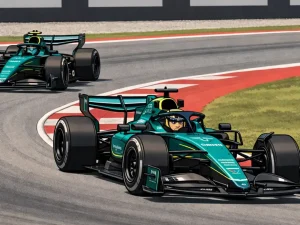
Martin Brundle reckons Formula 1 finally found the right lever to pull in Miami — and not a moment too soon.
After three rounds of the new 2026 era where the conversation was dominated less by lap times and more by energy harvesting, “super clipping”, and drivers sounding like they were negotiating with their power units, the Miami Grand Prix felt like a reset. Not a wholesale rewrite of the rules, but a reminder that this formula lives or dies on how it *behaves* in the hands of the drivers — and how it looks to the people watching.
The early-season complaints were hardly subtle. Drivers and pundits queued up to take aim at the 50/50 combustion-electric split, with the loudest criticism centred on cars backing out of it on straights to recharge, then arriving at braking zones in awkwardly staggered states of deployment. Depending on strategy, one car could look like it was anchored while another arrived with an eye-catching speed differential once boost mode was engaged. Entertaining in flashes, uncomfortable in others — and, as Brundle noted, increasingly controversial.
That discomfort wasn’t just aesthetic. The Japanese Grand Prix accident that left Oliver Bearman nursing a bruised knee after a 50G impact served as a grim punctuation mark: if the sport was going to push hard on variable power strategies, it also had to get serious about managing the closing speeds that came with them.
So during the April break — forced into the calendar by Middle East conflicts — the FIA, FOM, team principals and engine manufacturers sat down to tidy up what had become a very public problem. Brundle was careful to acknowledge the wider context of the break, but from an F1 standpoint the timing was oddly perfect: the championship needed breathing room to calibrate the show before the narrative hardened.
The agreement produced a suite of tweaks aimed at smoothing power delivery and reducing the most jarring phases of the lap. On paper, the key qualifying change was a reduction in maximum permitted recharge from 8MJ to 7MJ, designed to ease the pressure to harvest in places where it was killing performance. Alongside that, the rules increased super clips from 250kW to 350kW to shorten the time drivers were stuck in that compromised, “waiting for the battery” mode.
For the race, the direction of travel was clear too: boost mode power capped at 150kW, and MGU-K deployment restricted to 250kW in some zones. The idea wasn’t to sterilise the new system — it was to stop it feeling like a game of chicken between outright speed and energy bookkeeping.
Miami was the first live test, and it came with a bit of pragmatism. The FIA didn’t actually apply the qualifying recharge reduction there, noting that super clipping at the Miami Autodrome only totalled around two seconds per lap anyway. But it did bring in the 250kW deployment limitation in certain parts of the circuit — and Brundle’s takeaway was that it mattered.
Writing in his Sky Sports column, Brundle called the Miami weekend “an extremely important event for Formula 1” and pointed to the sport’s need to get these new cars “to gel” after a start to the season that left “key drivers and other observers” “remarkably ready to trash the show”.
His core point was simple: Miami showed the sport edging towards a more natural distribution of combined engine and battery power — less of the awkward mid-straight sagging, fewer moments where the power unit sounded and looked like it was labouring against its own energy demands.
“Drivers seemed much happier generally,” Brundle wrote, adding that the cars “looked fast and alive”, with “a decent surplus of power over grip on corner exits”. For viewers, that matters. The 2026 cars can be technically fascinating all they like, but if they’re visibly lifting early on straights — especially at circuits where fans are conditioned to see full-throttle commitment — you’re fighting your own product.
And Miami, in Brundle’s eyes, avoided that trap. “We were spared much of the labouring of engines losing the battle to a kinetic motor busy charging the battery well before the end of the straights,” he said — a neat encapsulation of what’s been bothering people since Melbourne.
As for the sporting picture, the race itself landed with a jolt. Mercedes’ Kimi Antonelli took the win ahead of McLaren’s Lando Norris and Oscar Piastri, while the points swing carried its own subtext: it was the first weekend this year that Mercedes was outscored by a rival, with the team dropping three points to McLaren.
Mercedes still left Miami with 180 points, 70 clear of Ferrari, but McLaren’s move to within 16 points of the Scuderia keeps the constructors’ fight simmering nicely behind the headline act. If the energy management controversy is beginning to cool, F1 can get back to the kind of tension it actually wants: performance trends, development races, and pressure building across a long season.
Miami won’t be the final verdict — Brundle himself noted the circuit would always be “easier than some” in terms of recharging. But as a proof of concept, it did its job. The cars looked less like they were being told “no” by their own systems, and more like they were being driven the way F1 cars are meant to be driven.
In 2026, that’s progress. And for a championship that was starting to feel the heat from its own regulations, Miami might end up being remembered as the weekend the sport blinked — and got better for it.