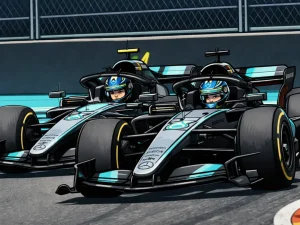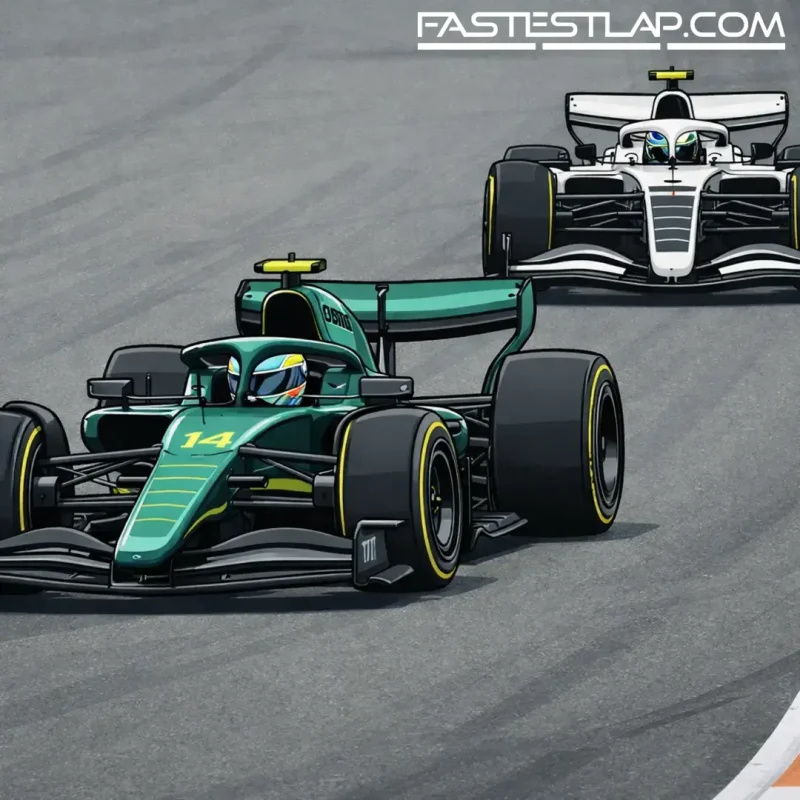
Cadillac’s early-season scrap with Aston Martin was never supposed to be glamorous, but it’s quickly becoming instructive — a straight read on how two very different projects cope when the stopwatch starts asking awkward questions.
Sergio Perez didn’t dress it up after Miami. Cadillac, he said, is in “a massive hurry” to find performance, not because the team’s panicking, but because it can see what’s coming. Aston Martin’s opening to 2026 has been underwhelming, yet the paddock expectation is that the real car is still in the pipeline. Fernando Alonso has already made it clear there are “no upgrades until after summer”, which in itself tells you plenty: they’re not interested in nibbling around the edges.
Cadillac can’t afford to wait and see.
Through the first phase of the season, the two have been locked in a slightly odd battle: not quite midfield, not quite the back. On paper it’s Cadillac with the upper hand, helped by Valtteri Bottas’ 13th place in China that’s nudged the American outfit to 10th in the constructors’ standings, just ahead of Aston Martin. That’s a small margin, but in this part of the grid it’s the difference between “promising start” and “long year”.
Perez’s worry is less about where Cadillac is now, and more about what happens when Aston’s big swing finally lands.
“I can see at times, as soon as the degradation starts to kick enough, we can be with the midfield, but they are just able to pick up the pace quite a lot,” Perez said after the Miami weekend. “Still a long season, but obviously we are in a massive hurry to find performance, because we know Aston is going to be improving, and we don’t want to be left behind.”
That line — *left behind* — is the bit worth underlining. For a new team, it’s easy to measure progress against your own baseline: build better parts, sharpen operations, reduce errors. The more uncomfortable yardstick is the one next to you in the garage lane. If Aston Martin really is skipping the incremental stuff to focus on a transformative AMR26 package, the risk for Cadillac is obvious: you can spend two months perfecting steady gains only to watch a rival jump half a second in one hit and reset the whole conversation.
Asked whether having Aston Martin as a clear target is a useful motivator, Perez didn’t hesitate. “Definitely it’s a great motivation,” he said. But he also pushed the point back onto Cadillac itself: “Not only them, it’s just about improving ourselves, weekend after weekend, in all areas.”
Miami was supposed to be one of those steps. Cadillac brought its first upgrade package for the MAC-26 there, with more expected for Montreal. Bottas’ assessment was cautiously positive — the kind of measured optimism you tend to get from a driver who’s seen enough development programmes to know the difference between a genuine direction change and a flattering track effect.
“I think there’s many hidden areas where we are improving,” Bottas said. “Maybe the pace sometimes it seemed a bit better this weekend, sometimes not.
“I think the upgrades worked. Still not every part is the same that we put in the car. So there’s a bit of lack of consistency in there. But overall, it’s getting better. Hopefully we’ll make another step in Montreal.”
The “not every part is the same” comment is revealing. It speaks to a team still building the muscle memory of modern F1 development: designing components, manufacturing them, getting enough of them produced on time, and then understanding them quickly enough at the circuit to avoid wasting a Friday. Bottas put it bluntly — Cadillac is “new at designing stuff, making it, bringing it to the track, optimising it”. In other words: the gains aren’t only on the car, they’re in the process, and that’s harder to see from the outside.
There’s also a practical competitive angle to the next stop. Bottas admitted Cadillac’s weakness remains high-speed corners, a trait that tends to expose a car’s aerodynamic platform and how well it holds itself together when the loads build. Montreal, by contrast, can be kinder if you’re strong in traction zones and slower changes of direction, and the shorter lap length reduces the number of places where a persistent weakness gets to hurt you.
That doesn’t guarantee anything — Montreal’s still a place where kerb usage, ride compliance and confidence on the brakes can make you look clever one session and silly the next — but it does at least offer Cadillac a chance to turn a “generally worked” upgrade into something more tangible in the results.
The subtext to all of this is that Cadillac’s first season is already moving from the honeymoon phase into the grind: the phase where everyone is working flat-out, yet the gaps don’t necessarily shrink unless your decisions are sharp. Perez’s “massive hurry” isn’t a cry of desperation; it’s an acknowledgement that, in this fight, timing matters as much as raw development rate. If Aston Martin really is winding up for a major reset later in the year, Cadillac’s job between now and then is simple to describe and brutally hard to execute: arrive in the same window with momentum, not damage limitation.