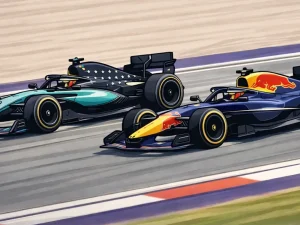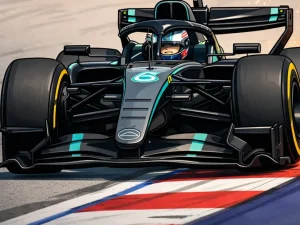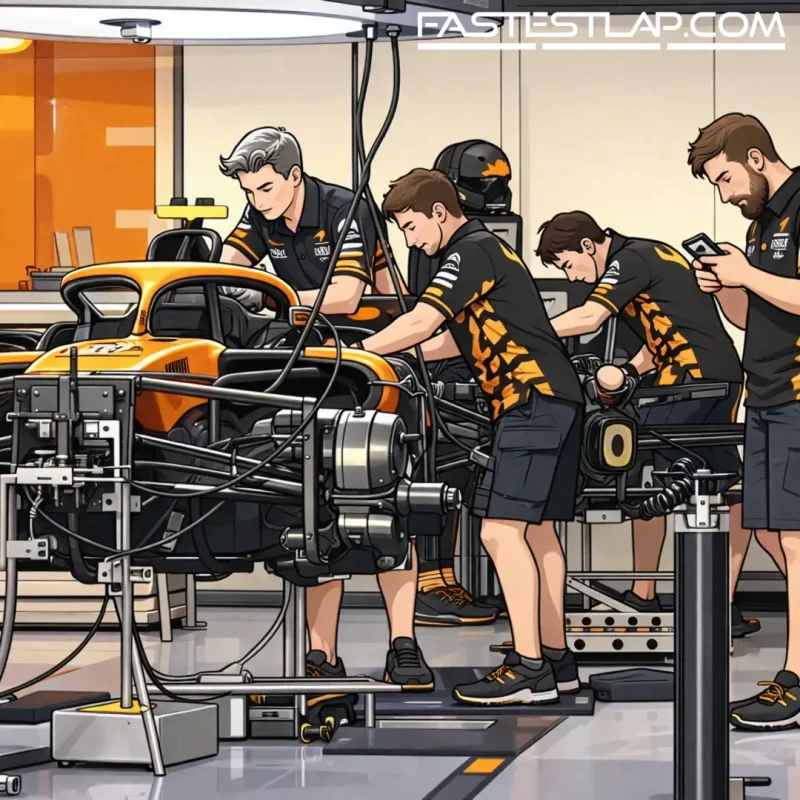
McLaren will spend Friday at the Red Bull Ring poking at one of 2026’s more intriguing grey areas: how far you can push active aero before you start tripping over your own complexity.
The team has confirmed it’ll run what it’s calling an “experimental rear wing” through both practice sessions in Austria, effectively joining Ferrari and Red Bull in evaluating the rotating rear-wing concept that’s already picked up the paddock nickname “Macarena”. It’s the sort of upgrade that looks dramatic in photographs but, in reality, lives or dies on the most unglamorous question in modern F1: can you make the aero map behave across a lap without upsetting everything else?
With DRS gone and active aerodynamics now baked into the regulations, the rear wing’s job has changed. Teams are no longer just hunting a big straight-line delta in a defined zone; they’re trying to manage drag and load states in a way that plays nicely with tyre energy, braking stability and corner entry balance. In that context, the appeal of a wing that “rotates” between distinct attitudes is obvious — it’s another lever to pull — but it’s also another opportunity to create a car that feels brilliant in one phase and edgy in the next.
McLaren’s Neil Houldey, technical director for applied engineering, framed the Austrian package as deliberately small-bore, the sort of incremental work that teams now rely on because the big gains are harder to prise out of these cars.
“We’re always looking to make refinements that add performance and lap time to the car,” Houldey said. “For this event, we’ve focused on minor detail updates around the car’s rear corners, as well as an experimental rear wing that will run throughout Friday’s sessions.
“While the overall package is lighter than some of our recent updates, these developments are all part of our season-long development pathway, and we’re continuing to look for every lap time opportunity wherever we can.”
That “rear corners” reference is worth clocking. On a track like Austria — short lap, lots of traction zones, plenty of time spent either accelerating or braking in a straight line — the rear of the car is asked to do everything. It needs to bite on exits, remain calm under braking into downhill corners, and not punish the rear tyres when the car is light on fuel and the pace ramps up. A new wing concept doesn’t exist in isolation; it changes the demands on the whole platform, and the quickest way to make a clever idea look silly is to bolt it on without giving the rest of the car the support it needs.
Ferrari were first to show the concept publicly during pre-season running in Bahrain, with more mileage in practice in China, before committing to racing it in Miami — where Red Bull also arrived with its own take. Even then, it wasn’t presented as a slam-dunk “this is the future” moment so much as another fork in the development road. Active aero has opened up multiple ways of arriving at roughly the same lap time, and teams are still finding out which philosophy best suits their chassis and mechanical package.
McLaren’s own chief designer Rob Marshall made that point earlier in the season when asked about rivals’ solutions. The team will analyse almost everything it sees, he said, but not every idea automatically becomes a McLaren idea.
“Ultimately, we do analyse everything to a certain extent. Some things go as far as being wind tunnel tested or CFD tested,” Marshall explained back in April. “Others are more kind of thought experiments we do on them to see whether we think that they would be good or bad for us.
“It is a common phrase in F1 that basically copying stuff doesn’t work because what works on one car doesn’t work on another. Actually, that’s not necessarily true. Some things work on other people’s cars. Remember with double diffusers. It worked on one person’s car. Everyone copied it. And you know what? It worked on those as well.”
That’s the subtext to McLaren’s Austria test: this isn’t a case of blindly chasing Ferrari or Red Bull, but neither is it an academic exercise. If the concept offers a repeatable gain — even a small one — it’s the kind of thing that can shift a weekend when the midfield-to-front gaps are measured in hundredths rather than tenths.
The timing also tells its own story. McLaren arrive as the defending Austrian Grand Prix winners after Lando Norris took victory here in 2025, but the tone from within the team is realistic rather than romantic. Houldey admitted repeating that result won’t be straightforward, even if the circuit has traditionally been a happy hunting ground for the team.
“Austria has historically been a strong track for us, and while we take nothing for granted in such a tight field, we are optimistic that the car and driver characteristics will again suit the circuit, putting us in the fight at the front,” he said.
So far in 2026, the headlines have been written mostly in silver. Mercedes have controlled the early rounds, and even though Lewis Hamilton snapped that streak with a win in Barcelona, the Brackley squad still lead the constructors’ championship on 262 points. Ferrari sit second, 72 points back, with McLaren third — a further 49 adrift of Ferrari.
That’s not a chasm, but it’s big enough that McLaren can’t rely on “normal” upgrades alone if it wants to turn podium pace into regular wins. An experimental wing run on a Friday is exactly the kind of low-risk, high-upside probe you make when you know the season won’t come to you unless you go and take it.
Whether the rotating wing becomes a McLaren staple or ends up filed under “interesting, but not for us” should become clearer once the Friday data is in. Either way, Austria is shaping up as another small snapshot of 2026’s bigger truth: the new aero rules haven’t just changed how cars look — they’ve changed how teams think.