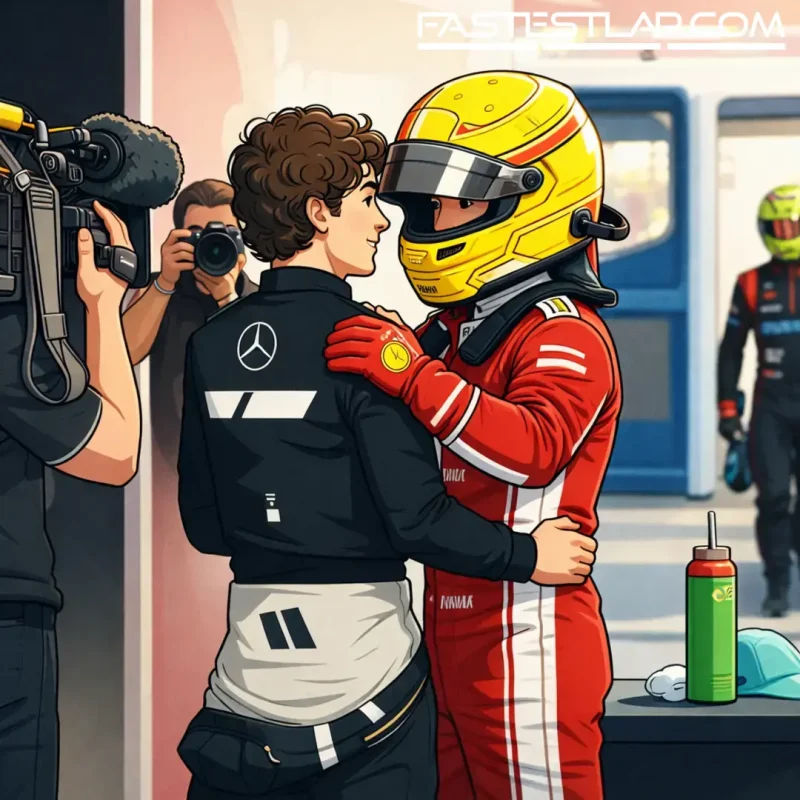
Mercedes has spent the early stretch of 2026 doing what dominant teams do: winning, often with enough margin that the only real jeopardy comes from inside the garage. But the tone has shifted over the last two rounds. A retirement in Canada, another in Barcelona, and a suddenly resurgent Ferrari – led by a newly-winning Lewis Hamilton – have forced Brackley to confront an old problem with fresh consequences: how hard do you let your own drivers race when the rest of the paddock can smell an opening?
George Russell and Kimi Antonelli’s scrap at the front in Canada was the kind of fight Mercedes will happily show in glossy season highlight reels: clean, committed, and unapologetically competitive. The crucial detail, as Russell admitted, is that it worked because they had the luxury of space. When you’re pulling away from everyone else, a bit of time lost to wheel-to-wheel theatre is more a stylistic choice than a strategic error.
Barcelona changed the context. Hamilton’s first Ferrari win wasn’t just a big headline – it was a reminder that the chasing pack won’t always need Mercedes to be slow; it may simply need Mercedes to be busy. Russell’s point was blunt: even if the safety car played a role, the mere presence of another car in the fight changes what’s acceptable between teammates.
“You saw in Canada,” Russell said. “Kimi and I fought really hard, but we were pulling away from everybody else, so the win for the team was not under threat.
“But, then you look in Barcelona, and suddenly you have another driver who’s in the fight… Without the safety car, Kimi and I were losing time together, and it would have given the opportunity to Ferrari to win, and that is when we need to be smart as teammates.”
That’s the crux of Mercedes’ mid-season pivot: the team isn’t trying to stop Russell and Antonelli racing each other, it’s trying to stop them racing each other at the wrong time.
Antonelli, still leading the championship, put it in similarly pragmatic terms. The days of treating a Russell-versus-Antonelli duel as a self-contained event are over – at least for now. “From now on it’s going to be important to race even more wisely,” he said, “because it’s not just about me and George anymore, but the others are coming.”
There’s a telling maturity in how he framed it, too. It’s not a pledge to back out of every marginal move; it’s a promise to read the room. If the only cars that matter are silver, he’ll fight Russell one way. If Ferrari – or anyone else – is close enough to capitalise, the approach changes. That’s a championship leader talking like someone who understands how quickly “letting them race” becomes “explaining it afterwards”.
For Mercedes, the balancing act is familiar but newly delicate. The team has two drivers who can win on merit and who have already shown they’re happy to lean into proper combat. That’s healthy, until it isn’t. Even when it stays clean, it costs tyre life, energy management, and lap time at exactly the moments rivals are praying for. And as soon as one external threat becomes real, the internal fight stops being a romantic problem and starts being an operational one.
Hamilton’s rise in the standings has given that operational question teeth. Heading into Austria, Antonelli is 41 points clear of Hamilton, with Russell another nine back. That’s not a points gap that demands panic, but it’s also not the kind of cushion Mercedes can assume will only ever move one way—especially if Ferrari has found a baseline it understands and a driver who knows exactly how to turn momentum into a run.
Toto Wolff has already labelled Hamilton “absolutely” a title threat, and you don’t say that unless you mean it. Not because Wolff needs more plot for the cameras, but because teams don’t get to choose when a season becomes complicated.
Hamilton, for his part, is playing the public-facing game you’d expect: he’s enjoying the SF-26 and talking about execution rather than eighth titles. “We’re moving… and collaborating really well, and I love driving this car,” he said. “The car’s finally got things that I’d asked for in it… I’m just really not thinking about that I’m competing for a championship. I’m thinking about arriving, [and] I want to win this weekend.”
That’s classic Hamilton in June: present tense, narrow focus, no dramatic declarations. But Mercedes won’t be fooled by the modesty. They’ve been on the other side of that slow-building pressure before. They know what it looks like when Hamilton finds a car that talks back in the right language.
So Austria arrives with an edge that hasn’t been there for much of this season. Mercedes still holds the cards, but it’s no longer a private game between Russell and Antonelli. When the margins tighten, “team priority” stops being something you say in interviews and becomes something you have to live on track, in real time, with a championship on the line and a Ferrari in the mirrors.