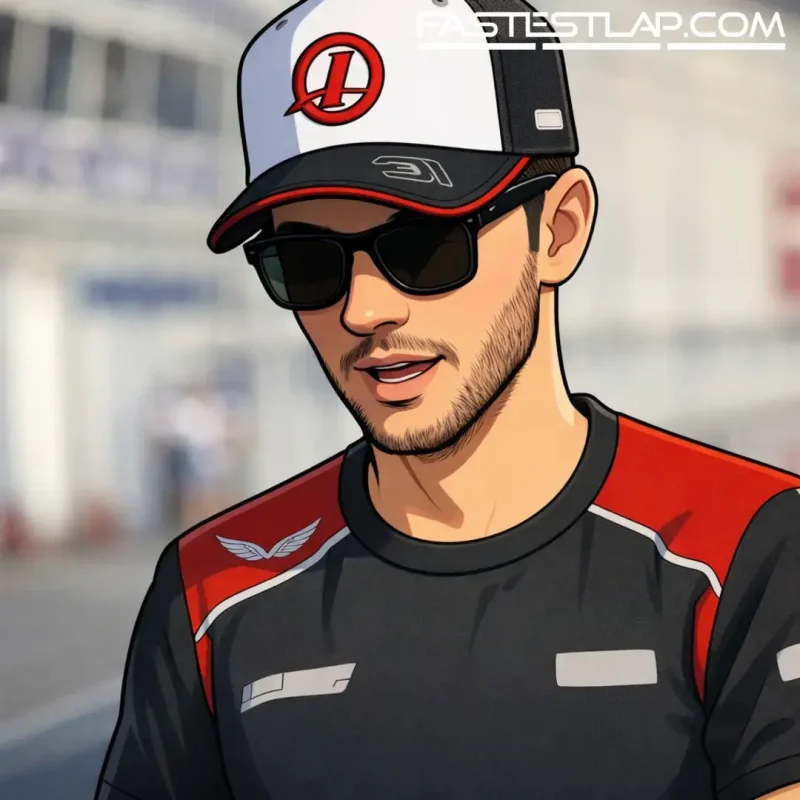
If you want a snapshot of how quickly the mood can shift around a midfield team, look no further than Haas right now. Esteban Ocon has arrived with the kind of CV that normally buys you time and trust, yet seven or eight races into 2026 he’s already being treated like a short-term placeholder — not because Haas has publicly lost faith, but because the numbers next to his name don’t look pretty alongside Oliver Bearman’s.
That’s the uncomfortable reality of this end of the grid: context gets whispered inside the engineering office, while the championship table does the shouting outside.
Bearman is ahead on points, 18 to Ocon’s three, and he’s also got the upper hand in the qualifying head-to-head. It’s enough of a gap to give the rumour mill something to chew on, even after team principal Ayao Komatsu angrily batted away the idea that there’s been any kind of rupture between him and Ocon. That particular flare-up began with a mistranslation of a Brazilian journalist’s social media post, which then snowballed into the familiar paddock parlour game: “Is this driver in trouble?”
Komatsu’s stance has been unequivocal: there’s no story there. But the sport rarely waits for a clean factual line when performance trends create a convenient narrative.
Karun Chandhok has now added fresh oxygen to the conversation, suggesting Ocon “will be feeling twitchy” as the comparisons with Bearman stack up. Speaking on Sky Sports’ F1 Show, Chandhok pointed to the qualifying deficit — “down 8-3” in sessions that can be directly compared — and didn’t sugar-coat how it reads from the outside: “That’s not a good score. Even at the weekend, he was a long way behind in the race.”
The more interesting part wasn’t the critique, though. It was the proposed solution.
Where some chatter has lazily linked Haas to the usual available names, Chandhok swerved in a different direction: Ferrari junior Rafael Câmara. The 21-year-old is competing in Formula 2 with Invicta Racing, has already taken his first F2 feature race win in Barcelona, and sits third in the standings — 22 points behind Alpine junior Gabriele Minì. In Chandhok’s view, if Haas is going to make a change, it should be a bet on upside rather than a reshuffle of familiar faces.
“Is [Yuki Tsunoda] an upgrade?” Chandhok asked, before answering his own question by pitching Câmara instead. “If they were going to change it, go for a young hotshot. Bearman’s got experience now. By the time we get to next season, he would be in his third year. They’ve got an experienced number one driver. If Ollie does get promoted down the line, they’ve got Câmara to step into that role.”
It’s a neat theory, and it fits the broader logic of the current Haas-Ferrari alignment: if you’re going to lean on Maranello for technical support and you’re already running one Ferrari-backed driver, why not structure the whole line-up around that pipeline?
But it also brushes past a few inconvenient truths about how teams like Haas actually operate. They don’t have the luxury of carrying a rookie purely for future value unless the deal is financially and politically irresistible — and even then, the timing has to match the team’s own competitive cycle. The brutal bit for Ocon is that he’s the one who gets squeezed when that conversation starts, because he’s the experienced hire on an expiring contract, not the long-term development project.
Ocon, for his part, is not playing along with the theatre. Asked about 2027 prospects (with his Haas deal ending after this season), he kept his answer blunt and focused on the immediate work.
“I don’t know,” he said in Austria. “We are into race, what, seven, eight?”
Then came the key line — the one that tells you what Haas is arguing internally, even if we’re not privy to the full detail. “There will always be talks when people look at the picture, [but] when you look deep inside, and knowing why I don’t have many points this year, and all of these things, well it gets more clear,” Ocon insisted. “The real reasons we know deep inside, the team and the people close around, so that’s the most important.”
That’s a driver saying: judge me if you want, but don’t pretend you’ve seen the full data set.
He also didn’t hide that Haas has bigger issues than a contract narrative. “Obviously, we have bigger problems with the car at the moment than that,” Ocon said. “So this is what we need to sort out first. If you sort out the car issues and get more performance out of it, everything will go easier, obviously.”
That framing matters. In the midfield, points are often a function of timing as much as talent: when your car is on the wrong side of a narrow operating window, the gap between “solid weekend” and “anonymous” can be one ill-suited set-up direction or one missed opportunity in a chaotic race. Add in that Bearman is settling into the team quickly, and it’s easy for the outside world to compress a complicated engineering story into a simple driver one.
Still, Ocon won’t need reminding that F1 contracts aren’t renewed on vibes. With every race that ends with Bearman in the points and Ocon outside them, the political maths gets easier for Haas if it ever decides to go shopping — whether that means a Ferrari-backed youngster like Câmara, or any other option that comes with leverage.
For now, Haas is publicly unified, Ocon is publicly calm, and Komatsu has already called one round of speculation exactly what he thinks it is. But the stopwatch has a habit of turning “bulls**t” into “worth discussing” quicker than anyone in the paddock would like to admit.