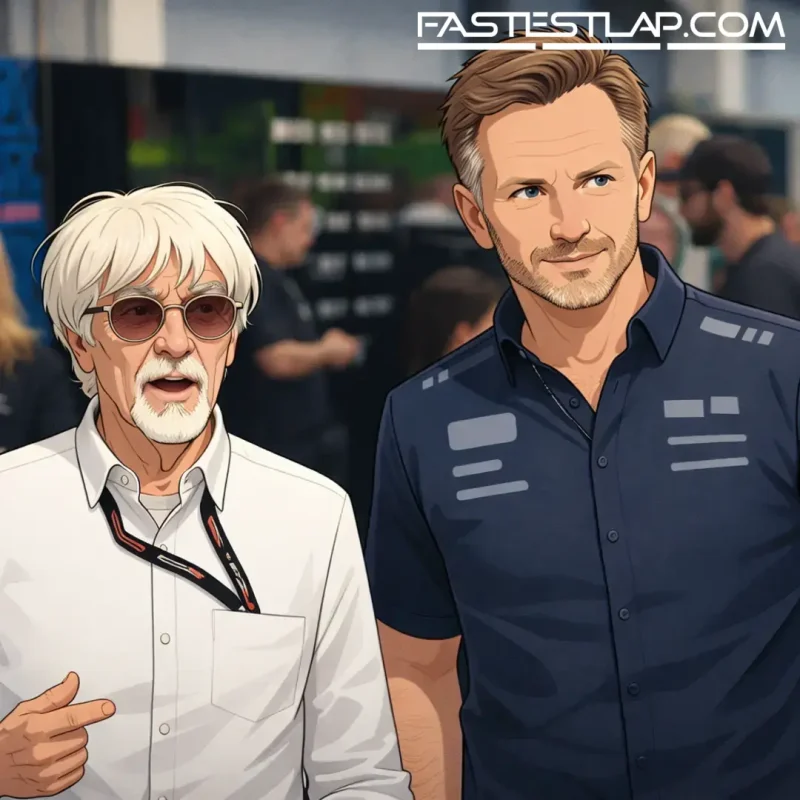
Bernie Ecclestone rarely bothers with sugar-coating, and his read on Christian Horner’s comeback plans is as blunt as you’d expect: the former Red Bull boss is walking into a trap of expectations largely of his own making.
Ecclestone, speaking ahead of the Austrian Grand Prix, described Horner as being in a “difficult position” as he plots a return to the paddock after Red Bull removed him as team principal and CEO just under a year ago.
The problem, in Ecclestone’s view, isn’t whether Horner can do the job. It’s that the job will now come with an asterisk, wherever it is. “Wherever he goes, if he doesn’t succeed successfully, people will say, ‘Ah Christian, you were very good when you were with Red Bull and budgets and things like that, and then now you’re not winning because of that,’” Ecclestone said.
It’s a neat summary of the narrative waiting around the corner: Horner, the proven builder of a dynasty, will be judged not on competence but on whether he can replicate Red Bull’s most golden years without Red Bull’s full machinery behind him. In Formula 1, reputations don’t fade gently — they get stress-tested in public.
Horner’s CV, of course, invites those tests. He took Red Bull from new entrant in 2005 to its first title double in 2010, then steered the team through two distinct stretches of supremacy — first with Sebastian Vettel, later with Max Verstappen — stacking up six Constructors’ Championships and eight Drivers’ Championships along the way. That’s not a résumé; it’s a statement.
Which is why his sudden exit after last year’s British Grand Prix landed like a thunderclap. Red Bull offered no official explanation when it removed him “with immediate effect”, but the timing aligned with a difficult run of performance and an increasingly loud conversation about Verstappen’s future, with Mercedes rumours in full swing. The belief in the paddock has been that Red Bull GmbH ultimately wanted to reassert control of its marketing — a corporate lever that matters more than most fans would like to admit.
Horner, having negotiated a full exit to become a free agent, made it clear back in January that he wants back in — but only if it’s the right challenge. That line was telling. After 20 years in one structure where he held the keys to almost everything under Red Bull’s F1 umbrella, it’s hard to imagine him signing up for a role that feels like “team principal, but not really”.
Ecclestone says he remains in frequent contact with Horner and admitted he tried, early on, to steer him towards Ferrari. “I speak to him quite regularly,” he said. “And, early on, I was trying to convince him to try and be at Ferrari.”
That avenue now looks closed. Ferrari has confirmed Fred Vasseur on an extension that keeps him in charge until at least the end of 2027. Even by Ferrari standards, that’s a clear vote of confidence — and it removes one of the few seats with the scale, budget and political latitude that might have genuinely matched what Horner is said to be looking for next.
Pressed on where his friend might land, Ecclestone offered a rare shrug. “I’ve no idea.”
The uncertainty has only fuelled a carousel of plausible options — each with its own complications.
One is Alpine, where Horner is known to have explored purchasing the 24 per cent stake currently held by Otro Capital. The detail that matters is governance: from September 2026, the American investment company can make decisions regarding its stake without Renault oversight. In other words, it’s a doorway to influence in a team that has often looked like it has too many hands on the wheel.
But even if there’s a financial route in, you don’t buy your way to stability overnight in this sport. Alpine is still, at its core, a works team tied to a major manufacturer’s priorities, and those priorities can change fast.
Then there’s the BYD thread — the one that has the paddock raising eyebrows because it hints at something bigger than a standard hire. BYD’s vice-president Stella Li attended the Monaco Grand Prix to meet the FIA and FOM about possibilities, and she’s understood to have held talks with Horner as well. Li has described Horner as a “good friend”, and the implication is obvious: if a serious new project is ever going to tempt him, it might be one where he helps write the rules rather than simply operate within them.
And yet, the most persistent rumour remains Aston Martin, where Lawrence Stroll has shown he’s willing to pay for heavyweight credibility — even offering equity to Adrian Newey to secure his services as managing technical partner. Horner, who is known to be seeking equity or an ownership position, fits the same pattern: not just hired help, but a stake in the story.
The complication is that Aston Martin already has its own internal politics. Newey is thought to have been reluctant about Horner joining, mindful of the optics of needing to be “rescued” by his old Red Bull boss at a time when Aston Martin has endured a performance slump amid significant change. Jonathan Wheatley is also expected to arrive as team principal, though that isn’t believed to be a deal-breaker on its own.
Stroll is understood to have made an offer to Horner at the start of the season, and while there’s been talk this week of a renewed approach, sources suggest there hasn’t been fresh contact since those earlier discussions.
All of which leaves Horner in the uncomfortable space Ecclestone outlined: famous enough that every move becomes a referendum, and successful enough that anything short of immediate progress will be framed as failure.
That’s the real sting of stepping away from a superteam. At Red Bull, Horner didn’t just win — he won in eras, and he did it loudly, politically, with total command of the narrative. The next act won’t give him that luxury. It will demand patience, compromise and, most painfully, time.
And time is the one commodity Formula 1 rarely grants to people with Horner’s track record.