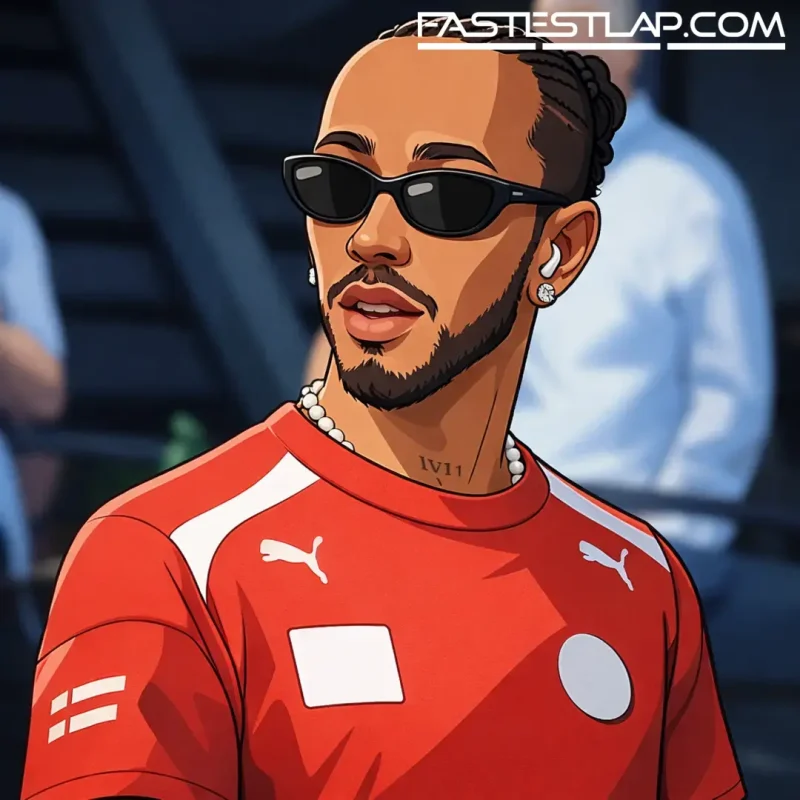
Lewis Hamilton didn’t need a debrief full of telemetry overlays to land on the key takeaway from Austria: Red Bull has moved. Properly.
Ferrari arrived at the Red Bull Ring buoyed by Hamilton’s first grand prix win in red in Barcelona, with the sense that the SF-26 was finally giving him a platform rather than a project. By Sunday evening in Spielberg, that glow had been replaced by something sharper — the feeling you get when a rival has quietly corrected its biggest weaknesses and suddenly the margins you’d been living off don’t look so comfortable.
Red Bull’s headline in Austria wasn’t just Max Verstappen’s season-best second place, 1.6 seconds shy of George Russell’s winning Mercedes. It was the manner of it: Verstappen fighting Hamilton hard on track, asking (unsuccessfully) for a penalty in the middle of it all, and then simply driving away from the skirmish and into a result that, until this weekend, had felt out of reach.
Hamilton finished fifth. Charles Leclerc, nursing front-wing damage, came home eighth. For Ferrari, it was one of those races where the numbers look blunt, but the subtext stings a bit more. They weren’t only beaten — they were disrupted, and by a Red Bull that, on recent form, hadn’t consistently had the tools to do that over a full grand prix.
Afterwards, Hamilton was unusually specific about what he thinks Red Bull has found.
“They made a huge step this weekend,” he said. “I think they must have brought a three to four tenths upgrade.”
That’s a big claim in a cost-cap era where teams rarely admit to gains in anything other than coy adjectives. But Hamilton went further, pointing to something that tends to separate the best-run operations from the rest: getting the weight out.
“Three tenths was just from the weight that they dropped from the car, which is huge,” he said, adding that Red Bull had been “nine kilos overweight”.
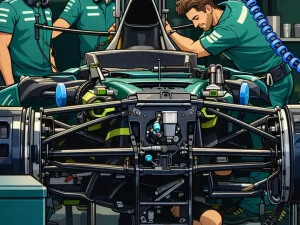
Nine kilos is a number that will make engineers wince — and rivals pay attention. In a rules set where the cars are relentlessly optimised, being that far north of the limit isn’t just leaving performance on the table, it’s letting others eat it. If Red Bull has genuinely pulled that mass out and paired it with a broad aerodynamic update, it explains why the RB22 suddenly looked like a car that could lean on the tyres, carry speed, and still fight in traffic without immediately falling out of its own performance window.
The Milton Keynes squad brought what was described as a seven-part upgrade package to Austria — the biggest haul among the front-runners. Team principal Laurent Mekies had talked beforehand about hoping it would bring Red Bull within three tenths of the ultimate pace. Hamilton’s estimate essentially says they’ve done it, and maybe a bit more.
“It’s showing that they’ve got a good car and that they’ve lost that weight, and then they brought lots of upgrades,” Hamilton said. “So they’re going to be a force to be reckoned with in the following races.”
The timing matters too. Red Bull is still trying to secure Verstappen’s long-term commitment, and nothing answers paddock noise like lap time. A season-best P2 doesn’t just shift the points picture; it changes the mood inside a garage — and the tone of every conversation around a driver’s future.
Verstappen, for his part, sounded like a driver who’d finally been given something he could properly lean on. His post-race reflections were telling because they weren’t wrapped in consolation. He wasn’t celebrating “maximising what we had” — he was annoyed not to have more.
“I think what was satisfying is that this was the first time I felt like actually I could fight for the win,” Verstappen said.
There was a complication, though, and it stopped the story being a clean upward curve. Verstappen pointed to a shift in behaviour from the rear of the RB22 that took the edge off his pace in the second half of the race.
“For whatever reason in the second half, something felt off on the rear of the car… from bumps, kerbs, traction, it was just completely gone,” he explained. “That’s something that we need to understand again, what went wrong there.”
What makes that intriguing — and potentially ominous for everyone else — is that even with that issue hanging around until the flag, Verstappen still finished within two seconds of the win. The upgrade has clearly given Red Bull a performance floor it didn’t have earlier in the year, and once they understand the rear-axle drop-off he described, there’s an obvious suspicion in the paddock: Austria might be the start of something, not a one-off spike.
Asked where the RB22 had improved, Verstappen kept it simple, as he often does when he doesn’t want to over-sell a development curve.
“It’s a bit more grip,” he said. “Just goes a bit faster around the corner.”
That understatement is classic Verstappen — but the implications are anything but small. If Red Bull’s new baseline really is three to four tenths stronger, and if a chunk of that has come from weight reduction (which tends to be a gift that keeps giving across different tracks), then Silverstone arrives at an awkward moment for everyone who’d started to believe Red Bull was going to spend 2026 fighting uphill.
For Ferrari, the Austrian weekend will feel like a reminder that momentum in this era is fragile. Barcelona suggested Hamilton and the SF-26 were beginning to sync; Spielberg suggested the competitive order hasn’t settled, it’s still shifting under their feet. And for Hamilton, who’s fought Verstappen through enough title-defining phases to recognise the early signs, the warning was delivered without drama — just the tone of a driver who’s seen this movie before and knows how quickly the plot can turn.
Formula 1 heads straight to the British Grand Prix next — and after Austria, it’s hard to shake the sense that Red Bull has just reinserted itself into the argument.