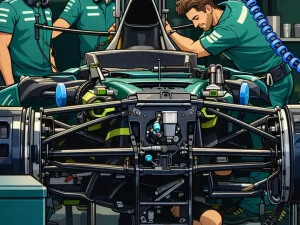
Aston Martin has spent the early part of 2026 trying to keep two conversations going at once: the one happening on the timing screens, and the one swirling around Adrian Newey’s absence.
This week, on the eve of the British Grand Prix, the team finally tried to join the dots in public. Newey — now Aston Martin’s design chief and team principal — appeared in an in-house interview that was notably more candid than the closed-door approach that’s characterised his first months in green. It followed a long stretch where, even when he was back in the paddock, he was effectively invisible to the media.
Mike Krack, Aston Martin’s chief trackside officer, didn’t pretend it was some grand comms strategy when asked why the tone suddenly changed.
“Because you will keep asking the same questions, and we thought we need to be a bit more open,” he said, smiling, before laughing.
It was a throwaway line, but it landed because it’s true. Newey’s story at Aston Martin has become as much about the gaps as the work: he attended the season-opening Australian Grand Prix, then didn’t return until Monaco after a period of illness. Even then, there was no real engagement with reporters and no appetite to feed a narrative that was running without them.
Now, the team has opened up — at least partially — on what’s been going on behind the scenes: Newey’s health struggles, the scale of Aston Martin’s on-track problems, and the looming AMR26 upgrade that’s been framed internally as the point at which the real project starts.
That last part is the key. Aston Martin has consciously chosen to sit on its hands with the current AMR26 specification while it prepares a more substantial ‘B-spec’ package. The cost of that choice has been brutally visible in recent rounds. In Barcelona and Austria the car was, by the team’s own formbook, comfortably the slowest in the field — a tough reality to swallow in a championship that doesn’t give you time to be patient.
And yet Aston Martin is still backing the gamble. That tells you two things. First, that they believe the current car is a dead end and not worth incremental spending. Second, that the upgrade is not just a new floor and a bit of aero housekeeping — it’s being treated like a reset button.
Silverstone, though, has a habit of exposing everyone’s weaknesses before upgrades can come to the rescue.
One of the more intriguing subplots this weekend is energy management. It’s cropped up in the paddock chatter and, notably, both Max Verstappen and Lewis Hamilton have raised concerns about how the high-speed nature of Silverstone can stress energy harvesting and deployment. If you’re having to compromise through Copse and the Maggotts-Becketts sequence — not because of grip, but because of energy — you’re fighting the circuit with one hand tied behind your back.
Krack didn’t deny the possibility that drivers may need to lift to get the numbers to work, though he framed it as a moving target rather than a fixed limitation.
“It depends on the conditions, on the fuel, and then also on how you optimise your energy,” he said. “You might see that lifting in some places is more beneficial for overall lap time, although the corner could go faster.
“So all you have to look at is that you manage your energy the most lap-time efficient, and there are easier tracks than this one for that.”
It’s a very 2026 problem: not “can you take it flat?”, but “is flat actually fast once you’ve paid the bill later in the lap?” If the answer is no, the compromise gets particularly painful at Silverstone because the corners you’d instinctively want to attack are exactly the ones that invite the biggest penalty when you can’t deploy as you’d like on the exits.
For Aston Martin, that matters because when you’re already nursing a car that’s been at the wrong end of the grid, you don’t have much margin for strategic trade-offs. If the team ends up in a weekend where energy optimisation becomes a headline, it risks becoming one more layer of limitation on top of a package that’s already been short of pace.
The irony is that Aston Martin does at least arrive at its home race with something tangible in the points column — Fernando Alonso’s Monaco point is the reason the team isn’t staring at a completely blank page. But that also underlines how narrow the window has been. Heading into Silverstone, Aston Martin sits 10th in the Constructors’ standings, and the gap between nicking a point on a chaotic Sunday and being routinely competitive has rarely felt wider.
The Newey interview, and Krack’s frankness about why it happened, won’t change the car’s speed on Friday. But it does reset the tone. Aston Martin is effectively asking to be judged on what it believes is coming next, not what has been trundling around in recent races.
That’s a risky ask in Formula 1, where “wait for the upgrade” can become a season-long refrain if it doesn’t land. Silverstone, with all its energy-management questions and its unforgiving nature, is unlikely to offer much cover. If Aston Martin is going to keep betting on the AMR26’s ‘B-spec’ as the turning point, it’s going to need that bet to start paying out soon — because right now, the sport isn’t waiting for anyone.