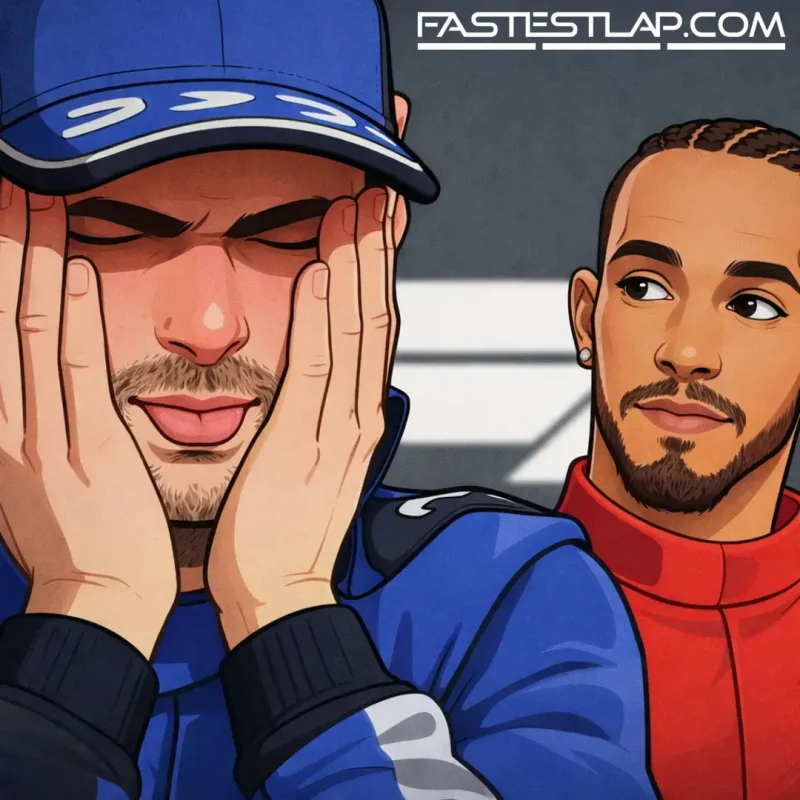
Max Verstappen and Lewis Hamilton don’t agree on much these days, but Silverstone has found a way to get them singing from the same hymn sheet — and it isn’t about set-up, tyres or stewarding.
Formula 1’s decision to bring back the LEGO-themed drivers’ parade for Sunday’s British Grand Prix has landed with a thud among parts of the grid, with both Verstappen and Hamilton questioning what, exactly, the sport is trying to achieve by turning the pre-race formalities into a low-speed demolition derby.
The concept isn’t new. F1 trialled the “LEGO race” at the 2025 Miami Grand Prix, where drivers were sent out in brick-built minicars rather than doing the usual slow tour of the circuit on a flatbed. It went down well in the grandstands and on social media, and the championship has doubled down for Silverstone: 22 minicars this time, one for every driver, rather than the limited run used in Miami.
But the paddock’s tolerance for gimmicks tends to be inversely proportional to how busy — and how exposed — drivers feel. Hamilton, speaking in Thursday’s FIA press conference, didn’t hide his suspicion that the whole thing is a solution in search of a problem.
“It’s the most dangerous part of the weekend,” he said, before recalling Miami with a grin that didn’t really soften the point. “I let Charles [Leclerc] drive last time and it was just hilarious watching everyone crashing into each other. So I don’t know whether or not I’ll be in the LEGO car this year.”
When pressed on whether he was genuinely worried about injury, Hamilton kept it brief. “There’s not really much to say on that car thing. That’s something I need to take offline.”
Verstappen, unsurprisingly, was less diplomatic — and, in typical Verstappen fashion, cut straight to the subtext: this isn’t what Formula 1 should look like.
He’s not objecting to the idea of giving fans a closer look — he’s objecting to the presentation. The traditional parade, with drivers grouped together on a truck, does the job. It’s quick, it’s visible, and it doesn’t involve 20 of the most competitive people on the planet being placed in slow machinery with just enough steering angle to create chaos.
“I just get it over with as quickly as possible, wave to the fans because they deserve that,” Verstappen said. “Of course, if it’s up to me I would just like a normal driver parade. What is wrong with an electric truck or whatever driving us around? I think that’s fine. But it is what it is, it’s not in my control.”
Later, Verstappen sharpened the argument further: the optics matter, and the sport shouldn’t be in the business of undermining its own image.
“I prefer to play with LEGO at home with the kids,” he said. “I prefer to stand on a truck with everyone together. That is more fun and it looks more professional. We are F1 drivers. We should not look like kids and clowns trying to ram into each other. That’s not what F1 needs.”
It’s hard to miss what’s happening here. F1 is clearly leaning into spectacle, and it’s doing it in ways that play well on a Sunday afternoon when the camera wants colour and the promoters want noise. The drivers, meanwhile, tend to be protective of anything that blurs the line between “show” and “circus” — especially when it puts their hands, backs and necks anywhere near unnecessary risk. You don’t need to be travelling fast for a silly impact to become an annoying injury, and nobody wants to explain to their team why they’re carrying a sore wrist into a race weekend because of a pre-race parade.
Not everyone is wound up about it, though — which is part of why F1 feels comfortable pushing ahead.
Lance Stroll shrugged the whole thing off with the kind of deadpan indifference you’d expect. “I’m not going to lose sleep over it,” he said. “I’m not going to wake up super early in the morning excited about it. It’s just another one of those drivers’ parades.” Then, inevitably, came the Stroll punchline: “I think if they had another 600 horsepower, then it would be interesting and we’d be more excited!”
Valtteri Bottas, now at Cadillac, came at it from the other direction entirely. Having missed the Miami edition last year while he was a Mercedes reserve, Bottas sounded like someone who’d watched the mayhem on TV and thought: finally, a contest where being sensible might actually be a weapon.
“I’m actually really excited because I missed it in Miami last year when I was watching it and it looked so fun,” he said. “Everyone is capped to 25kph, so I think saving distance is probably the key [to winning]. I’m excited. Saving distance is my strategy – and using tow!”
That last line — “using tow” in a LEGO minicar — probably tells you everything you need to know about how drivers’ brains work, even when the sport is trying to put them in a novelty box.
As for the cars themselves, they’re not a token effort. Each minicar is built from 28,000 LEGO bricks, produced by a team of 20 designers, engineers and LEGO specialists at the company’s Kladno factory in the Czech Republic. The full set of 22 took more than 6,400 hours to complete.
So yes, the craftsmanship is real. The question Verstappen and Hamilton are poking at is whether the theatre matches what Formula 1 wants to sell about itself in 2026: the pinnacle of the sport, or a travelling show that occasionally squeezes a grand prix in between activations.
Silverstone, of all places, doesn’t need help creating atmosphere. The crowd will do its job whether the drivers arrive on a truck, in a minicar, or on foot. But if the aim is to keep the drivers onside while dressing the grid up for a modern audience, F1 may want to remember there’s a line between bringing fans closer and making the main characters feel like props.