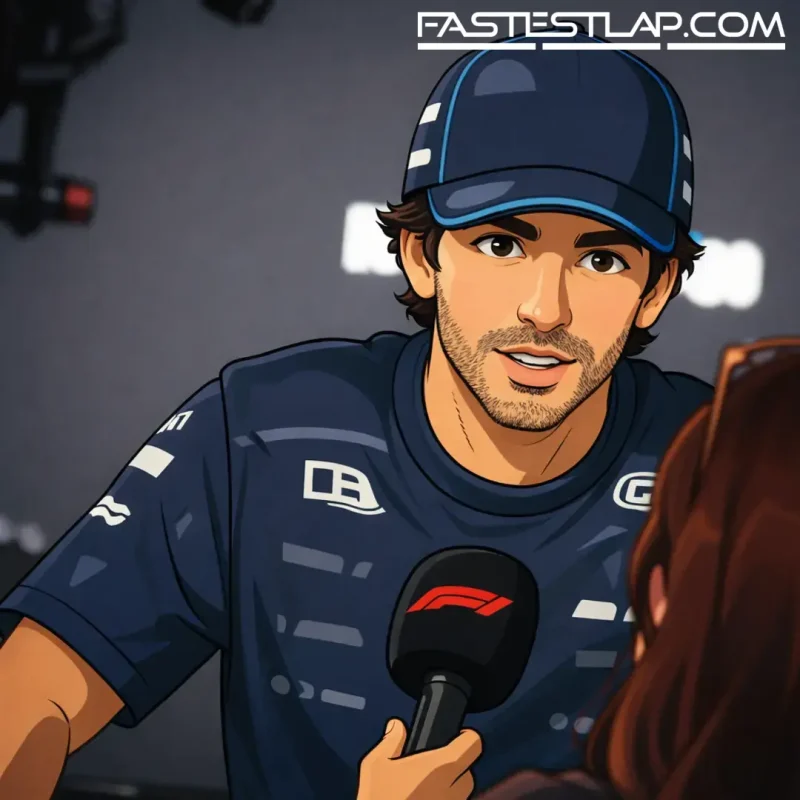
Carlos Sainz isn’t usually the loudest voice in the room, but when he does push an idea into the paddock’s bloodstream it tends to come with a driver’s instinct for where the sport can be gamed — and where it’s leaving itself exposed.
Ahead of the British Grand Prix at Silverstone, the Williams driver floated a properly punchy fix for a recurring qualifying headache: if you’re the one who causes a yellow or red flag in qualifying, you should take an automatic three-place grid drop.
It’s a proposal born directly out of the messiness we saw in Austria, where Max Verstappen crashed late in the lap and the incident was covered by single yellows. That distinction mattered. Under a single yellow, a driver can continue and even improve provided they clearly acknowledge the flag zone. George Russell did exactly that — he lifted — but he’d banked enough time earlier in the lap that the lap still stood up for pole.
Russell’s team-mate Kimi Antonelli, meanwhile, abandoned his attempt after reading it as a double-waved yellow. Under double yellows, it’s not a “lift a bit and crack on” situation; you’re expected to slow significantly and be prepared to stop, which effectively kills any lap.
Then came the post-session fog: timing screens, deletions, reinstatements, and the kind of uncertainty that makes everyone feel slightly cheated even when the rulebook says everything’s technically fine. Russell later acknowledged at Silverstone that the situation “probably” warranted double yellows — but he also hadn’t done anything wrong given what was actually shown.
Sainz’s point isn’t really about Russell. In fact, he was careful to credit him.
“It’s clear to me, at least, that that situation should have been a double yellow or a red [flag],” Sainz said. “The way George handled it… was perfect for what the rule book allows you to do, and he deserved that pole position because he played the rules to perfection.
“But he should have never been, I think, allowed to finish that lap or to close a lap in that kind of dangerous situation.”
The tension is obvious. Throw a red flag and you protect drivers, but you can also freeze the order in a way that rewards whoever happened to have a lap in the bag. Keep it to single yellows and you preserve a “keep going” flow — but risk creating exactly the kind of grey area where one driver is allowed to complete a lap through a compromised sector while another bails because he’s interpreted the information differently.
Sainz’s suggestion tries to attack the problem from a different direction: don’t obsess solely over how race control grades every incident in the heat of the moment; reduce the incentive for anyone to “benefit” from triggering a disruption in the first place.
And Sainz didn’t dress it up as a theoretical concern. He was blunt about the uncomfortable thoughts drivers can have when the margins are tight and the stakes are high.
“I could have done last year in Baku when I was on pole and I was the first car out of the pits,” he said. “I said, if I crash now, I’m on pole. We all have these thoughts, and we all have these second thoughts and we all know how the rule book works.
“For that, I think that anyone who generates a yellow flag or a red flag in a qualifying should be three place grid drop, so at least you get penalised and you get disincentivised.”
It’s not hard to see why the idea has traction. The sport has lived through the ugly version of this movie before — Michael Schumacher’s infamous 2006 Monaco qualifying moment remains the cautionary tale, when he was judged to have deliberately stopped his Ferrari at Rascasse and was sent to the back. The stewards dealt with that case, but it required intent to be argued, inferred, and ultimately ruled upon — always a messy business in real time, and always contentious after the fact.
Sainz is essentially arguing for a cleaner deterrent: remove the upside, make the risk immediate, and you cut out a whole category of “was that on purpose?” theatre.
But the proposal brings its own complications, and the paddock will pick at them instantly. A blanket penalty puts enormous weight on how an incident is classified. Was it a genuine mechanical failure? Was it a brush of the kerb that snapped the rear? Was there any impact on a rival lap at all?
Sainz acknowledged that nuance, pointing out the Austria scenario was particularly unfair because there were cars behind Verstappen when he crashed in the final corners — drivers arriving at full commitment into a sector that can change in a heartbeat. If the crash happens earlier in the lap with nobody directly affected, should the same penalty apply?
“As there’s one guy behind you, it’s unfair, because that guy doesn’t get a chance to finish the lap,” Sainz said, before also turning the lens back onto the teams’ own habits. If everyone insists on leaving their best attempts until the final moments, they’re inviting chaos — and then acting shocked when chaos arrives.
He also made clear he wasn’t accusing Verstappen of anything in Austria, stressing the context: Verstappen wasn’t even on pole and, in Sainz’s view, had “zero incentive” to trigger a stoppage. The concern is the system itself — and how hard it is to police when it’s being nudged.
As a director of the Grand Prix Drivers’ Association, Sainz is in a position to float it more formally, though he noted the British GP being a Sprint weekend means there may not be time for a full sit-down. Even then, the GPDA’s influence is indirect. It can shape the conversation; it can’t change the rulebook on its own.
Still, in a season where qualifying sessions increasingly feel like a high-speed negotiation with risk — between drivers, teams, and race control — Sainz has put a simple question on the table: if the sport doesn’t want qualifying to be decided by who benefits most from a disruption, why not make disruptions expensive for whoever causes them?
It’s a tidy idea, the kind that sounds obvious right up until you try to write the exceptions. And that’s probably why it’s worth debating now, before the next yellow flag doesn’t just decide a pole — it decides a championship story.