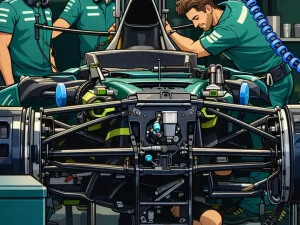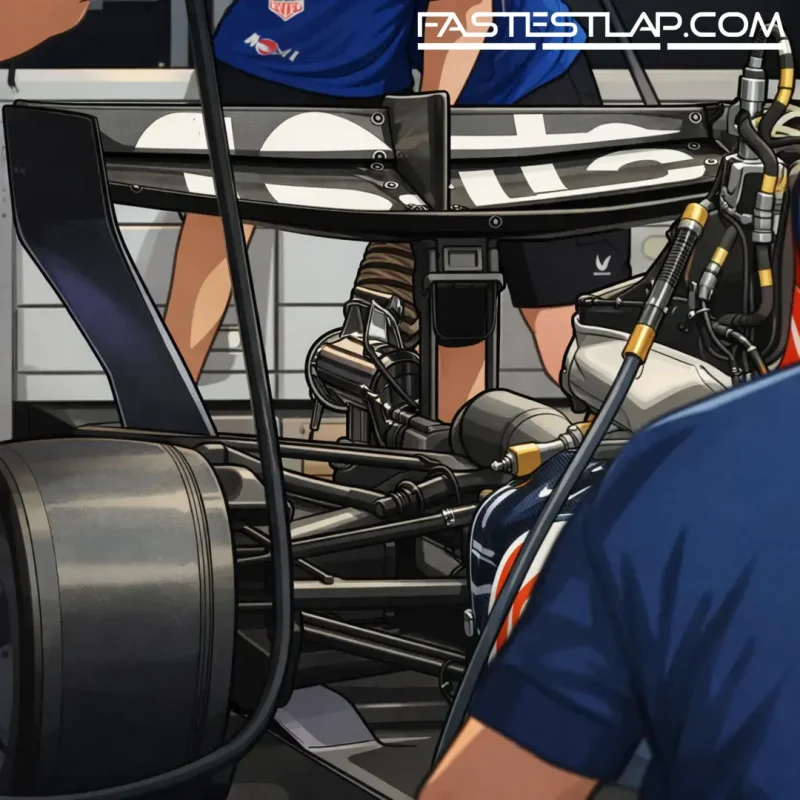
Silverstone has a habit of triggering the biggest engineering flexes of the year, but this weekend the upgrade sheet reads more like a mid-season exhale than an arms race. Only six of the 11 teams have declared new parts for the British Grand Prix, and even then the busiest operations — McLaren, Racing Bulls and Haas — have brought just two items apiece.
That’s a marked change of pace after the first wave of 2026 development, when update packages were arriving with the regularity of freight flights. The subtext here isn’t that teams have suddenly lost interest; it’s that the paddock is starting to behave like it’s feeling the squeeze. Between cost cap discipline, manufacturing capacity and the simple reality that each new part has to justify itself in lap time, Silverstone looks like the point where several teams have decided to bank what they’ve got rather than keep swinging.
McLaren, fresh off a sizeable Miami package that included a revised floor, is still pushing on the MCL40’s underbody — because that’s where the performance is. The team has reworked the floorboard and a number of the floor’s “furniture” elements to improve the flow structures and overall efficiency, and it’s paired that with a new front brake duct. On a circuit that punishes instability and rewards aero consistency through long, loaded corners, it’s a very McLaren-like choice: keep chiselling away at the platform that unlocks everything else.
Racing Bulls has also gone straight for the rear-end aero ecosystem, introducing a new floor edge and diffuser package aimed at cleaning up and optimising flow around the back of the floor. There’s a rear-corner alteration as well — the sort of change that tends to be about getting the diffuser and rear tyre wake to stop fighting each other. Silverstone is a stress test for that: if your flow structures are fragile, you find out quickly in the wind and the rapid direction changes.
Haas, meanwhile, has concentrated its effort where it can most directly tune drag versus downforce at a track that offers both extremes. A revised rear wing and rear wing endplate are intended to lift the performance of the VF-26, and you can read that two ways. Either Haas likes the baseline car and is now fine-tuning its circuit-specific range, or it’s searching for a more efficient aero balance to stop paying such a penalty down the straights when it dials in enough load for the fast stuff.
Ferrari’s declared update is more targeted: a revised rear corner designed to hit two objectives at once — cooling and local load. That’s the kind of language teams use when they’re trying to tidy up a known weakness without turning the whole car upside down. Cooling changes are rarely “just” cooling changes, of course; they typically open up bodywork options, influence how aggressively you can run set-ups, and can change how stable the car remains over a stint.
Red Bull has a new rear-corner package too, centred on tweaks to the inboard area of the rear rims and the cascade wings. The stated aim is improved load characteristics and stability on the RB22 — an interesting clue in itself. Stability is the currency at Silverstone: if the rear isn’t giving the driver confidence through the high-speed sequences, it doesn’t matter what the peak downforce figure looks like on a CFD plot. These are the kind of detailed, highly specific changes that suggest Red Bull is in refinement mode rather than chasing a wholesale shift in concept.
Williams rounds out the upgrade list with a new front wing for the FW48, another classic Silverstone move. If you’re trying to correct balance traits without re-homologating half the car, the front wing is still your most immediate lever — and a fresh geometry can be the difference between a car that bites into the first apex and one that washes wide and overheats its fronts over a lap.
The louder story might be who’s done nothing. Mercedes, Aston Martin, Audi, Alpine and Cadillac have all arrived at Silverstone without a single declared new part. It’s possible some are saving their next steps for a later round, or that they’re simply taking stock after an intense early development push. But it’s hard not to read this as the first visible sign that the season’s development war is starting to slow — or at least becoming more selective.
And there’s an edge of politics to it, too, because the cost-cap conversation is never far away when one team looks busier than the rest. Mercedes boss Toto Wolff has already raised an eyebrow at the volume of Ferrari’s earlier upgrade work, wondering out loud whether rivals can keep spending at that rate without hitting the budget ceiling.
“We’re always bringing small enhancements here and there,” Wolff said recently, “because simply we’re always a little bit surprised that Ferrari can throw these huge updates at the car in the way they do.”
His point wasn’t subtle: Mercedes doesn’t believe it has the buffer to keep shipping major packages, and Wolff’s working assumption is that those playing the big-update game will eventually have to stop. “In my opinion, they need to be running out of money soon… so hopefully that’s going to change towards the end of the season, when they won’t be able to bring any parts anymore,” he added.
Silverstone’s quieter upgrade ledger doesn’t prove Wolff right — not yet. But it does underline the direction the championship always drifts toward under a cap: fewer moonshot packages, more incremental tuning, and a growing emphasis on whether teams have developed the car they *actually want* before the spending taper forces them to live with it.
This weekend, the stopwatch will still settle the arguments. But the paddock’s body language is changing. For the first time this year, it looks like not everyone believes the next new part is worth the bill.