Adrian Newey doesn’t do subtle for long, even when he’s trying to.
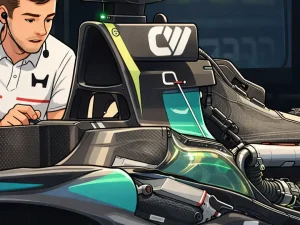
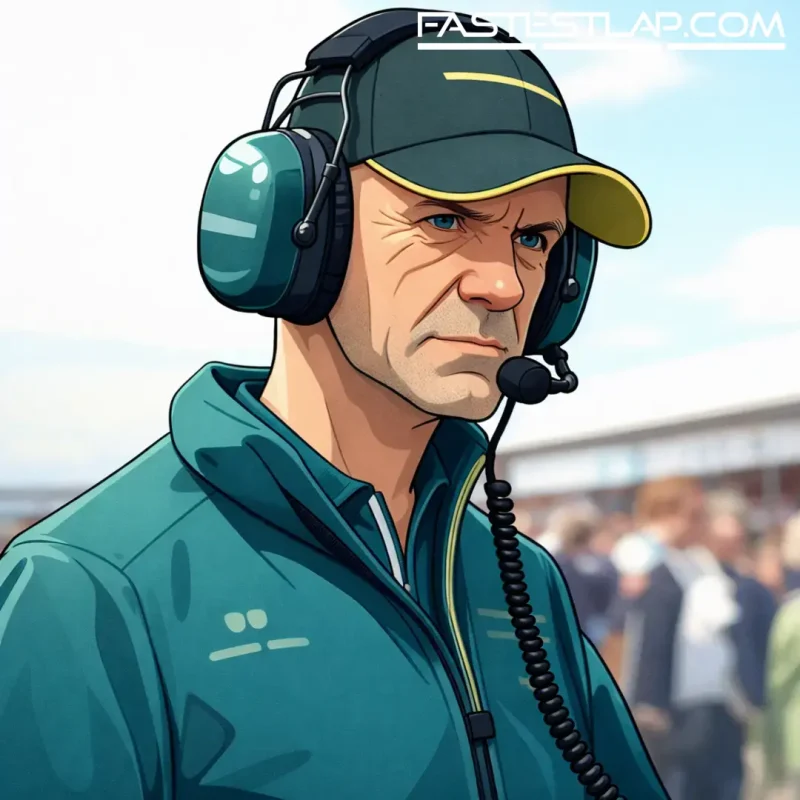
On the Silverstone grid ahead of the British Grand Prix Sprint, Aston Martin’s team principal and chief design brain was filmed doing the most Newey thing imaginable: notebook in hand, quietly orbiting the cars and stopping for a proper look at the rear end of Mercedes’ W17 — the benchmark machine of 2026, with all but one of the season’s grand prix wins already banked.
Sky F1’s Simon Lazenby clocked him and wandered over, asking what, exactly, had caught his eye.
“There’s lots of carbon!” Newey deadpanned, before conceding the real point. For all the endless photography and paddock intel-swapping, he still values the old-fashioned walkaround. Seeing shapes in three dimensions, he explained, gives you a feel that pictures don’t.
It was a throwaway moment on camera, but it speaks to where Aston Martin finds itself right now: not in the fight, not even close, and urgently looking for a way out of a hole it didn’t expect to be this deep.
The start to 2026 has been bruising for Aston Martin, and the much-hyped first year of its Honda alliance has so far produced a lonely point — Fernando Alonso’s P10 in Monaco. Newey has been candid about the team’s response, too. Rather than chase the early-season development arms race with incremental parts, Aston Martin essentially stepped back after Melbourne to focus on a single, substantial reset.
“We took the decision after Melbourne that there’s no point in introducing small changes that would still leave us with no real chance of scoring points,” Newey said at Silverstone. “So, we’ll take a bit of pressure off ourselves, regroup, put systems in place for the future, and work on a proper upgrade.”
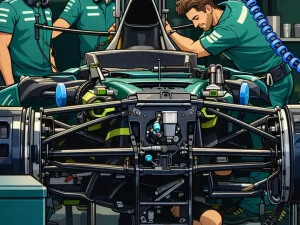
That’s the subtext behind the Silverstone stroll. If you’re about to roll out a “B-spec” car — and Aston is, with the revamped AMR26 currently scheduled to debut in Hungary before the summer break — you’d be foolish not to keep your eyes open. The W17 has become the reference for how to make these 2026 cars work, and Newey’s never been precious about learning from what’s in front of him. The paddock likes to pretend it’s all smoke and mirrors, but the truth is that great designers have always borrowed, adapted and improved. The only sin is being late.
Aston Martin’s chief trackside officer Mike Krack didn’t try to downplay the scale of what’s coming. He described it as a significant aerodynamic upgrade paired with a weight reduction push — the sort of double-hit that implies wholesale change rather than a new front wing and a few fiddly flicks.
“It’s a significant aero upgrade and weight reduction,” Krack said. “Obviously you need to attack a lot of parts to achieve that, but if I would have to list all the parts, I think I would not even know all the parts that have changed.”
That line tells you plenty: this isn’t a tweak, it’s a rework. And it’s not hard to see why Aston has chosen this path. When you’re starting weekends already half a step away from the points, nibbling at tenths with minor updates just burns money and morale. A bigger swing is riskier, but at least it offers the possibility of changing the conversation.
The catch, as Krack also admitted, is that big swings rarely land perfectly on Friday morning.
“It will need a bit of time,” he said. “I don’t think that we will be spot on straight away, because the new parts will also create new characteristics… I do not expect that we are straight away on it in FP1, and it might take us even a couple of sessions to get the maximum out of it.”
In other words: don’t expect Hungary to be some instant fairy tale, especially in a season where the pecking order has been so unforgiving. A large package changes balance, ride characteristics, driver confidence on entry — the whole feel of the car. Even if the numbers in simulation look encouraging, the real world has a habit of asking awkward questions.
And that’s before Honda’s side of the equation gets its own shake-up. An upgraded engine is due after the summer break at the Dutch Grand Prix, giving Aston a second major inflection point in quick succession. The team is effectively staging a two-part rescue plan: first the chassis and aero reset, then extra power and whatever knock-on benefits come with it.
Taken together, it’s a fascinating statement of intent — and of patience. Aston Martin isn’t pretending it can win its way out of trouble with clever weekends or bold strategy calls. It’s betting that the only meaningful route back is through hard engineering, a calmer internal rhythm, and a properly integrated upgrade path rather than scattergun development.
Still, the image of Newey hunched at the back of the W17 matters because it’s a reminder that even the sport’s most celebrated technical minds are, at heart, relentless observers. Mercedes has given everyone a target in 2026. Aston’s job now is to stop admiring it and start hurting it — but first, it needs to build something worth bringing to the fight.