
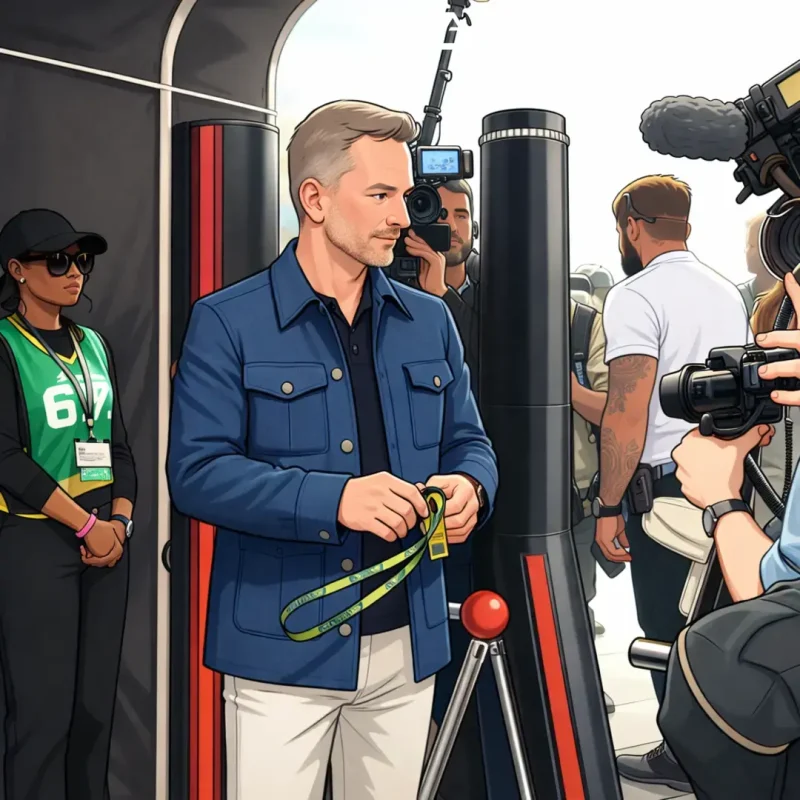
Christian Horner was back inside the Silverstone paddock on Sunday morning, his first appearance at a grand prix since his split with Red Bull brought a 20-year reign to a sudden end.
There was no new job title on a lanyard and no grand reintroduction planned. Horner arrived as a guest, understood to have been invited by both the FIA and Formula One Management, and he was quickly swallowed by the familiar rhythm of race day: a few double-takes from people who haven’t seen him trackside in months, a small pocket of fans leaning in for a photo, and the quiet realisation that his name is still one of the grid’s most potent currencies.
It’s hard to overstate how unusual Horner’s position is in 2026. He’s no longer the ever-present Red Bull ringmaster, no longer the man who could turn a throwaway paddock comment into a week-long storyline. Yet he’s also not “ex” in the way Formula 1 usually means it — tucked away in historic racing or turning up once a year at Goodwood. His visit at Silverstone landed in the middle of persistent speculation that he’s plotting a full return, and not as a bit-part cameo.
Horner’s Red Bull departure last season remains one of the sport’s biggest aftershocks. Removed from operational duties and then formally separated from the team in September, he ended an era that delivered eight drivers’ championships — split between Sebastian Vettel and Max Verstappen — and six constructors’ titles. The settlement agreed at the time was widely believed to be around the $100 million mark, and crucially, he’s now free to work in the paddock again should the right door open.
The obvious question, of course, is which door.
Alpine has been the loudest rumour for months, with Horner linked to a bid for the 24 per cent minority stake held by investment company Otro Capital. But that avenue appears to have been blocked off, at least publicly, after Renault Group CEO Francois Provost insisted there are “no discussion today with Christian”.
That’s pushed the conversation towards a different sort of project: BYD. Horner is understood to have met BYD vice-president Stella Li several times in Cannes, as the Chinese EV and hybrid manufacturer continues to explore what a grand prix entry could look like. BYD has also held talks with F1 CEO Stefano Domenicali about the possibility of joining the grid as what would be the sport’s 12th team.
Whether that ever becomes more than exploratory remains to be seen — the politics and logistics of a new entry are never straightforward — but Horner’s interest is telling. For all the noise that follows him, he’s never sounded like someone eager to simply take any available chair. He’s been consistent, at least in public, that he’s only interested in returning if it’s a serious play.
“I don’t want to go back into the paddock unless I have something to do,” Horner said earlier this year at the European Motor Show. He spoke then with the air of someone who’d had time to recalibrate after living at 200mph for two decades.
“I miss the sport, I miss the people, I miss the team that I built… But I’ve enjoyed this period of time out and having time. I’m sure there’s going to be loads of speculation, but I’m peaceful in myself at the moment, where, if there’s the right opportunity, then I definitely will have a good look at it.”
The key line was the one he didn’t dress up: “I feel like I’ve got unfinished business in Formula 1. It didn’t finish the way that I would have liked it to have finished. But I’m not going to come back for just anything. I’m only going to come back for something that can win.”
That’s the Horner dilemma in a sentence. He’s one of the few team principals of the modern era who can credibly argue he’s done the full arc: built a team, managed megastar drivers, won titles in different regulations, and survived more political knife-fights than most. But in 2026, the grid is tighter, the rules are less forgiving, and the “something that can win” list is shorter than it’s been for years. If he’s eyeing Alpine, BYD, or any other ambitious project, he’s effectively betting that his own presence can compress a five-year plan into something sharper.
Silverstone, then, mattered less for what it was — a guest pass, a walk through the paddock, a few conversations away from microphones — and more for what it signalled. Horner didn’t drift in quietly from the outside. He was invited by the sport’s power centres, and he showed up. That’s not an appointment, but it’s not nothing either.
In the meantime, Horner’s next formal re-entry into public view is already scheduled. He’s set to release a memoir, *DRIVE*, on October 22, a “tell-all” reflection on his first 20 years in charge of Red Bull Racing. He’s framed it as a book about people rather than trophies, though in Formula 1 those two things are never truly separable.
“Formula One is ultimately a people business,” Horner said. “While the sport is often defined by the cars, the victories and the championships, what stays with me most are the people, the decisions, the challenges and the extraordinary cast of characters I encountered along the way.”
If Horner does return, it won’t just be another executive hire. It’ll be a power shift — the kind that changes how teams talk to each other in the margins, how drivers position themselves, how the FIA and FOM read the political weather. Sunday at Silverstone didn’t answer the big questions. It simply underlined that Horner hasn’t gone away — and, perhaps more importantly, that Formula 1 hasn’t quite let him.









