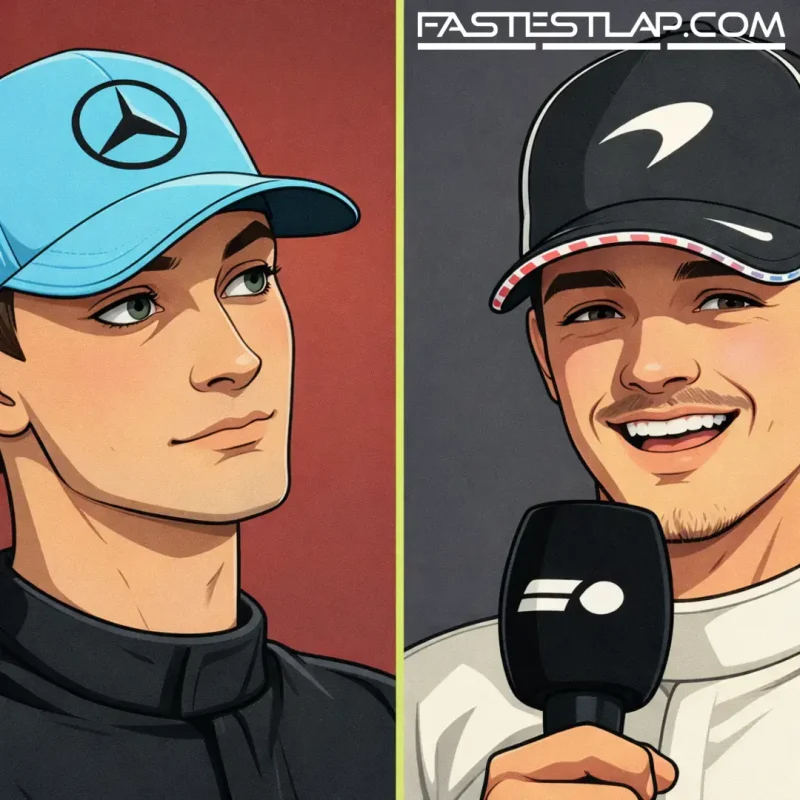
Lando Norris wasn’t about to play along with George Russell’s Silverstone daydreaming.
Russell had wandered into the lighter end of pre-British Grand Prix media chat by admitting he’d like a grandstand in his own name — and, with a grin, suggested the prime real estate would be the one currently draped in Norris’s dayglo yellow on the outside of Stowe.
“I would like it, to be honest,” Russell said on Thursday. “It’s something we’ve spoken about with the team in the past and it’s probably something we’re working towards for next year. Where I’d like to put it, probably Lando’s got quite a good spot on the outside of Stowe, so I’ll try and steal it off him.”
Norris’s answer, delivered without much interest in keeping the bit going, was essentially: good luck with that.
“Good luck,” he replied when the comments were put to him. “He can do whatever he wants. I just have more passionate fans and a better fanbase, I think.
“Mine was more wanted from a public point of view, which is a great thing.”
It’s a slightly sharper edge than you often get when drivers are asked about the commercial trimmings around them, but it speaks to how the modern F1 popularity contest is now part of the job description — and, clearly, part of the paddock’s internal banter too. In 2026, the grandstand isn’t just a nice touch for the home race; it’s branding, identity, and proof-of-life that you can shift tickets as well as lap time.
The Norris stand has been a fixture for two seasons and has expanded for this year’s British Grand Prix, turning that Stowe section into a splash of fluorescent support. It’s also become one of those Silverstone landmarks you clock on the first Friday of the weekend: an obvious visual reminder of where F1’s fan energy has drifted in recent seasons, and who the sport’s promoters are happy to lean into.
Norris, though, was at pains to puncture the idea that it’s some kind of closed shop for McLaren diehards.
“But thing is, even in my grandstand, there’s a good mix of all fans,” he said. “It’s not just simply fans who are here to support me. It’s a grandstand, it’s my grandstand, but at the same time it’s full of sadly some other teams and also other drivers — which I’ve got nothing against.
“He can just do whatever he wants, but he’s certainly not taking any of my seats.”
That last line is the point, really. Russell can talk about “stealing” the spot, but Norris’s presence there is now part of the event’s furniture — and Silverstone has never been shy about monetising the emotional pull of a British driver with a serious following. If a Russell grandstand materialises in the coming years, it’ll almost certainly be an addition, not a hostile takeover.
Still, the exchange landed because it plays into a real undercurrent. Britain has two front-line, high-profile drivers from rival teams, both with legitimate claims to being the standard-bearer for the next era. Norris is the established fan magnet, with a public profile that’s grown into something bigger than results alone. Russell, meanwhile, has built his own base and clearly fancies formalising it in the same way. In a sport that now tracks “reach” and “engagement” as closely as sector times, that’s not trivial.
For Norris, there’s also an unmistakable confidence in how he handled it — the kind you tend to hear from someone who knows his corner of the sport is secure. He didn’t need to dress it up as a rivalry or pretend it mattered, but he also didn’t hesitate to claim the upper hand in the only currency this particular conversation was about: who turns up, who pays, who cares loudest.
And if Russell genuinely wants his own patch of Silverstone painted in Mercedes colours and his name, he’s probably not going to get there by trying to muscle in on Stowe. The smarter play is to find his own corner and make it his — because Norris’s message was blunt, but also accurate: that space is taken, and he’s not moving.