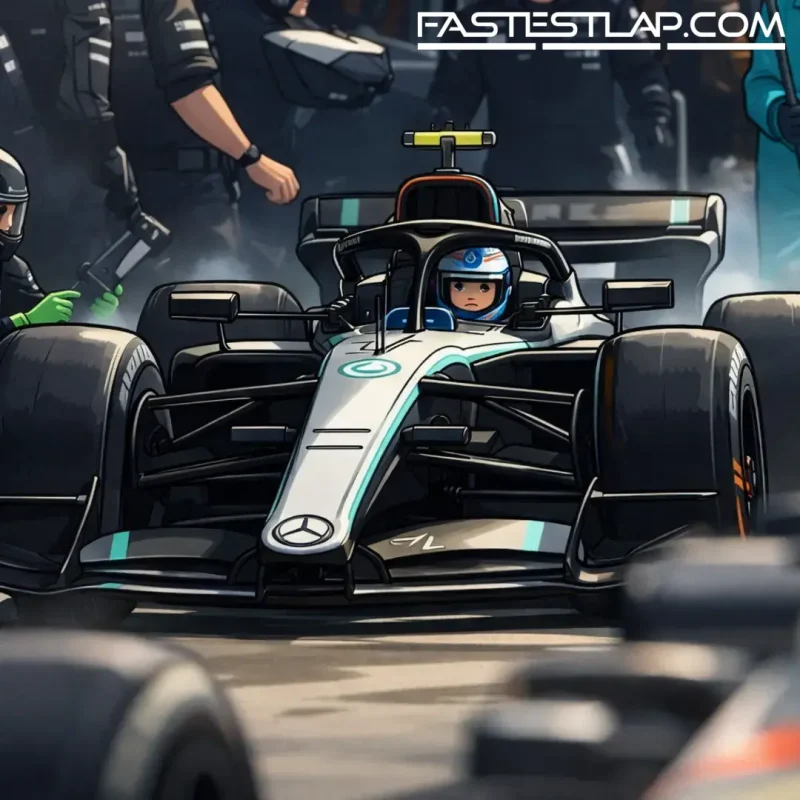
Mercedes will take Kimi Antonelli’s W17 back to Brackley for a full strip-down after a Silverstone afternoon that flipped from “this is happening” to “how did we get here?” in the space of a handful of laps.
For most of the closing stint of the 2026 British Grand Prix, Antonelli looked like the driver with the momentum — and the tyres — to decide the race. With rubber around 10 laps fresher, he was reeling in Charles Leclerc’s Ferrari and, by the pitwall’s own admission, the picture was starting to look uncomfortably promising. Then the Mercedes suddenly lost its willingness to change direction, and Antonelli’s chase dissolved into damage limitation.
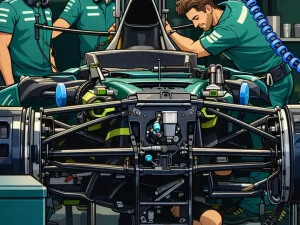
Toto Wolff confirmed post-race that the initial suspicion centres on the front-left corner, where something appears to have collapsed or jammed in a way that made the car almost impossible to place through Silverstone’s faster sequences.
“It looks like it’s a brake duct with caved in wheel shield,” Wolff said. “But something got stuck in there, and that’s why he wasn’t able to turn out.”
Antonelli did pit for running repairs, but the underlying problem didn’t go away. Instead, it turned the W17 into something that required constant negotiation — not a car you attacked Silverstone with, but one you simply tried to keep between the white lines. And that, inevitably, invited the stewards into the story.
Mercedes’ plan now is to take the car back to base and properly forensically examine what failed and why the consequences were so dramatic.
“I’ve seen the car, but it’s not yet clear, really,” Wolff said. “We’re going to take the whole car back to the factory in order to take it apart there to really see where it happened, how it happened, and why we had so severe consequences of him not being able to drive.”
The key word there is “severe”. These sorts of front-corner issues can be anything from minor nuisance to instant retirement depending on what’s come loose, what’s rubbing, and what it’s doing to airflow and steering feel. In Antonelli’s case, it wasn’t a straightforward “box, retire, done” situation — the suspension looked intact enough to keep going, and the driver kept insisting he could nurse it home.
Wolff admitted that, from a purely conservative standpoint, he’d have pulled the plug late on for safety reasons.
“Yeah, and if it was me, only about me, I would have made the call 10 laps to the end because of safety issues,” he said. “But then suspension looked okay. That’s the biggest issue.
“He was just basically surviving from lap to lap and saying that he could do that, and at the end, if we are able to get rid of that penalty, if, these points could be decisive in the championship.”
That comment inevitably raised eyebrows in the paddock, because it sounded like the opening note of an appeal. But it’s understood Mercedes has no intention of challenging the five-second penalty Antonelli received for multiple track limits violations as he fought a car that didn’t want to turn.
The penalty, combined with the pace loss and the late Safety Car, left Antonelli classified 15th and — far more painfully — out of the points altogether. For a driver who arrived at Silverstone as the championship leader and left it having watched a likely win evaporate, it was the sort of swing that changes the feel of a title fight.
Wolff was asked whether the FIA should show more leniency when it’s obvious a car is wounded and the driver is effectively wrestling it rather than gaining an advantage. His answer was sympathetic to the difficulty of policing it, but also framed Antonelli’s situation as one where the car was fundamentally safe enough to continue — just compromised in a very specific way.
“Yeah, I think for the FIA certainly, it’s always difficult to judge is the car so damaged that it should actually come in, and in that case, I think the car was fine,” Wolff said. “It was just this one feature that it was really difficult to turn.
“So I hope that they accept that situation, but I don’t know what the outcome is.”
There was no outcome to wait for in the end: the penalty stands, the result is locked, and the championship picture has tightened. Antonelli’s advantage over George Russell has been cut to 25 points after Russell finished second at Silverstone, while Lewis Hamilton — third in the standings — is now 32 points off Antonelli.
The bigger concern for Mercedes, though, isn’t the stewards’ decision. It’s the “why” behind a failure that turned a race-winning car into a passenger. Silverstone has a habit of exposing weak links, and when a car suddenly loses front-corner compliance and steering authority, teams don’t treat it as a one-off annoyance — they treat it as a potential pattern.
Antonelli’s job now is straightforward: reset and move on. Mercedes’ job is less forgiving. If they’re going to close out a championship with two cars at the sharp end, they can’t afford another afternoon where the difference between winning and anonymous is whatever decided to “get stuck in there” on the front-left.