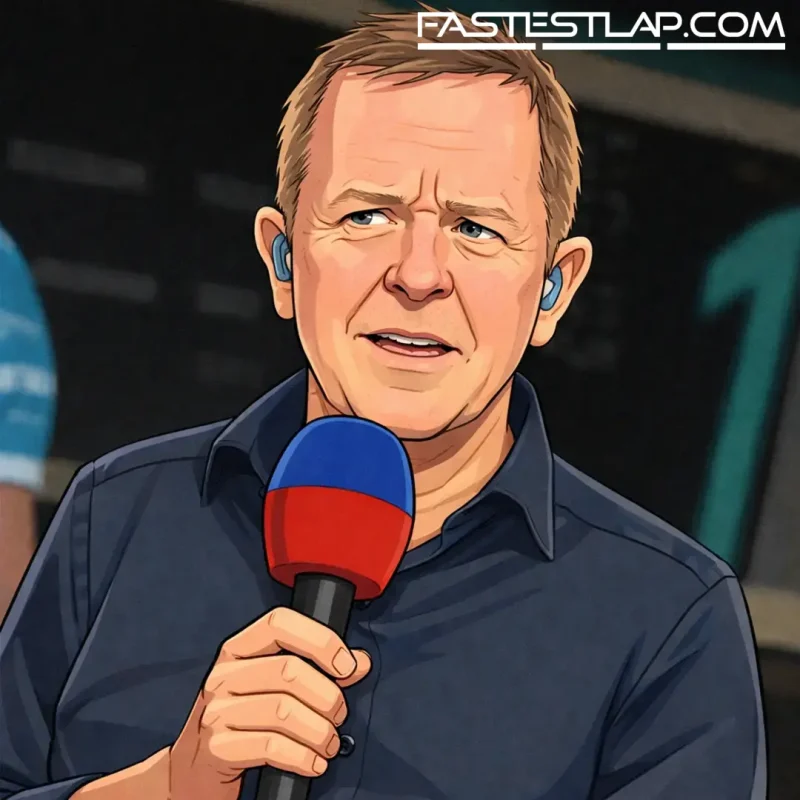
Martin Brundle doesn’t usually need much encouragement to say what everyone in the paddock is thinking. But even by his standards, the finish to the 2026 British Grand Prix pushed him into full, exasperated disbelief on live TV.
What should’ve been a clean, late-race reset after Max Verstappen’s spin at Stowe instead ended with Silverstone stuck in neutral — the “Safety Car in this lap” cue flashed up, strategy calls were made off it, and then… nothing. No restart. No one-lap shootout. Just Charles Leclerc calmly shepherding the field to the flag behind the Safety Car to take his first win of the season, while a grandstand primed for fireworks got a whimper.
The FIA has since confirmed what many suspected within minutes: the message was wrong.
“The ‘Safety Car In This Lap’ message was displayed erroneously due to a software error,” the governing body said, adding that Race Operations followed the Safety Car period regulation and that “one lap must be completed following the unlapping procedure.”
That explanation might tick the procedural boxes, but it didn’t touch the nerve Brundle was prodding at: the sport keeps tripping over its own mechanics at exactly the moment it’s trying to create clarity — and a proper finish — for fans and teams alike.
From the commentary box, Brundle’s reaction was immediate and pointed, joking that the bleep machine might be required for him as he tried to keep his language broadcast-friendly. The core of his complaint wasn’t that Leclerc “shouldn’t” have won — the Ferrari driver did what the circumstances demanded — but that the process is still too slow, too messy, and too easily derailed when the track is long and the clock is tight.
“Whatever the regulations say, it’s not right,” Brundle argued, zeroing in on the unlapping procedure and how it can stretch out a Safety Car period. He referenced Spa as the obvious example: when you’re dealing with big lap lengths, waiting for lapped cars to stream around can feel like watching sand drain from an hourglass. Silverstone isn’t Spa, but the principle is the same — and the end result on Sunday was the worst-case scenario: a crowd set up for a restart that never came.
The frustrating part, from Brundle’s perspective, is that the intent behind these rules is perfectly clear. Unlapping exists to stop backmarkers becoming rolling chicanes in the first corners after a restart and to avoid the farce of leaders fighting through traffic that shouldn’t be in that fight. It’s meant to tidy up the race so the actual contest can resume.
Instead, it can do the opposite. It prolongs the neutralisation, squeezes out the laps that matter, and — when something as basic as a software glitch muddies the message — it throws teams and viewers into a confusion that the sport can’t really afford in 2026.
Sunday’s timing made it especially sharp. With the late Safety Car, the pit lane roulette wheel had spun: Leclerc and Lewis Hamilton, running third at the time, had bolted on soft tyres via what Brundle called the “cheap” stop. George Russell stayed out and moved up to second on mediums, gambling on track position and hoping the race would actually resume.
That’s the sort of endgame that sells itself: mixed tyres, drivers in different risk profiles, and a single-lap sprint that can flip a podium in two corners. The message suggested that was exactly what was coming. Then the Safety Car stayed out, the field stayed bunched, and the tyre choices became irrelevant.
Brundle’s broader argument was simple: even if the regulations are being followed to the letter, the letter isn’t good enough — and the system shouldn’t depend on a slow-moving administrative loop when the track is clear and the race is ready to go.
He also took issue with the premise that the unlapped cars must physically rejoin the back of the queue before the Safety Car can peel in — a point he said he couldn’t find explicitly supported in what he’d read of the regulations. Brundle’s contention was that there are other ways to achieve the same safety outcome without burning the remaining laps: let lapped cars drop back, manage them differently, or, if necessary, accept that the current method is too blunt an instrument for modern F1’s need to finish races under green when it’s feasible.
And that’s really what this comes down to. The FIA’s statement frames it as a software glitch — unfortunate, but explainable. Brundle’s fury suggests something deeper: the sport’s operational tools still leave it vulnerable to anticlimax, and when the public-facing messaging is wrong at the critical moment, it doesn’t just irritate the commentators. It undermines confidence in the race direction process itself.
“We’ve got a fantastic crowd,” Brundle said, pointing out the thousands at the track and the huge audience watching at home. In his view, they were effectively sold a restart, because that’s what the system signalled, and the sport has to be better at delivering on those moments — or at least better at not promising them by mistake.
He even floated the nuclear option: if the only way to guarantee a proper finish is a red flag and restart, then maybe that’s where the conversation ends up. But he acknowledged the obvious drawback — it comes with extra procedure and delay — and his preference was clear. Fix the unlapping process on long circuits, reduce the built-in drag on Safety Car periods, and stop letting races die in the final minutes.
Leclerc will happily take the win. Ferrari won’t apologise for a correctly managed race. But the post-race debate won’t be about his drive; it’ll be about how Formula 1, with all its technology and layers of governance, still occasionally can’t do the simple thing: communicate what’s happening, then make it happen.