
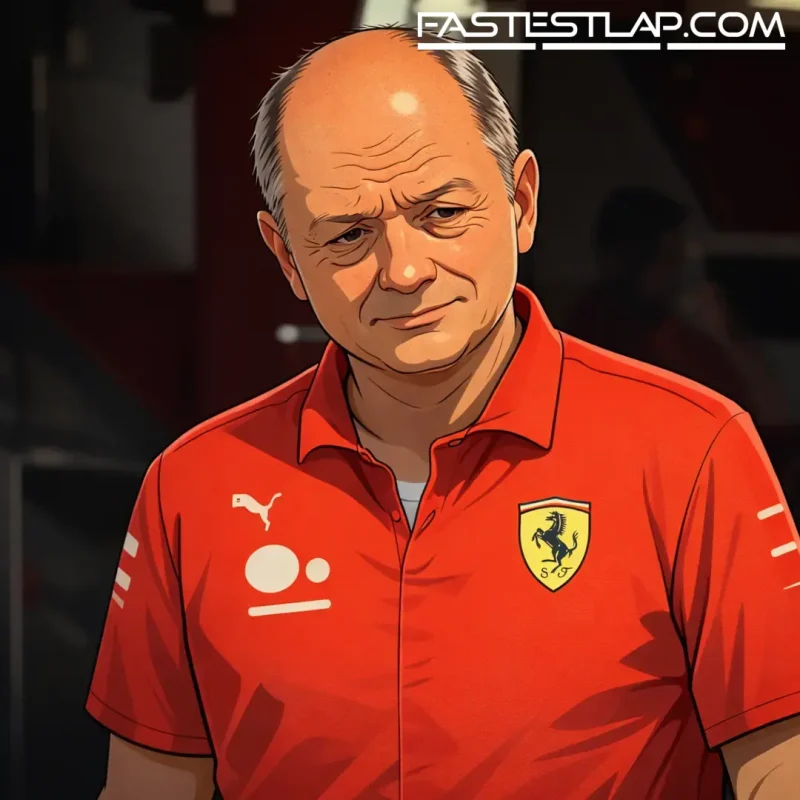
Ferrari’s done the one thing it hadn’t managed for a while in this early stretch of 2026: it’s made Mercedes look over its shoulder.
Two wins in three races will do that, even if both of Ferrari’s recent victories came in grands prix where the safety car turned the usual rhythms inside out. Spain and Great Britain weren’t flukes, though. When the race was there to be won, Ferrari executed, and the car has looked like the only package with the underlying pace to keep Mercedes honest across a weekend.
And yet, inside the team, the message remains almost aggressively unromantic.
Fred Vasseur was keen at Silverstone to put a lid on the narrative swings that follow every big Ferrari result — the pendulum that goes from “they’re back” to “they’re finished” depending on what happened in the last 90 minutes of racing.
“After Barcelona, we had the comment Ferrari is back in the championship, I said no,” Vasseur told reporters at Silverstone. “The week after, they told me Ferrari is nowhere. I said, no.
“We have exactly the same approach with everybody at home tomorrow morning to say ‘guys, we did a good weekend. Now let’s be focused on Spa.’
“It’s not that we are champions, we are not nowhere. I never try to draw a conclusion after one race to race after a good result or bad result, and just focus to do more and to do better, and I think it’s true for me, it’s true for everybody at the factory.”
There’s a practical reason for that restraint beyond the usual team boss instinct to keep everyone from reading their own headlines. Ferrari did claw 20 points back over the Silverstone weekend, but the broader picture is still a sizeable one: Mercedes remains 78 points clear. In other words, the chase has shape now, but it isn’t yet a shootout.
Vasseur’s other point, delivered with the bluntness of someone who has sat through enough debriefs to know what matters, was that Mercedes still looks like the benchmark in the bulk of the sessions.
“They have still an advantage, six, seven sessions that we did this weekend, they are probably five times ahead,” he said. “We had a good race. But we wanted to be realistic, overall they still have small advantage in terms of pure performance.”
That’s the nuance that tends to get lost when momentum becomes the story. Ferrari has been superb when the grand prix turns into a moving-target exercise — restarts, tyre calls under pressure, and the small operational moments that swing big outcomes. But over a clean weekend, with minimal interruption, Vasseur is effectively arguing that Mercedes still owns the baseline.
The next test comes quickly at Spa, and it’s an intriguing one for a few reasons. For starters, Ferrari hasn’t won the Belgian Grand Prix since Charles Leclerc’s first F1 victory back in 2019, a stat that hangs around the team in the way Spa’s weather does — always lurking, always ready to turn a narrative.
More importantly, Spa arrives in the wake of Silverstone exposing the sensitivities of Formula 1’s current battery behaviour. Silverstone’s long, fast lap already dragged that conversation into the open; Spa’s seven kilometres will do it again, only louder. If there are any weak points in how a car manages its energy across a lap that long and that full-throttle, you don’t really get to hide them in the Ardennes.
Vasseur sounded cautiously upbeat about what Ferrari learned in Britain, but he was careful not to sell it as a guarantee that Spa will be kind.
“I think for sure it’s much more engine related in Silverstone than Spain two weeks ago, but it was also the first time that we had windy conditions,” he said. “The characteristic of the track is completely functioning just about the engine, and I think we did pretty well with all these topics.
“But next week will be another challenge. We have to start from scratch over the weekend. Now there is no single magic. We don’t imagine to make a step of five, six tenths in one weekend. It’s the addition of small gains everywhere.”
That last line is classic Vasseur: no drama, no promised breakthroughs, just the insistence that Ferrari’s route back is incremental rather than cinematic. It also hints at the internal discipline Ferrari has tried to build under him — an acknowledgement that the sport is less about declaring “we’ve arrived” and more about quietly arriving again and again.
The bigger shift, though, is that Ferrari can now talk about “small gains everywhere” without it sounding like a euphemism. Two wins in three races changes the tone of the paddock. It forces rivals to take the red cars seriously when they show up with a new part, or when a strategy call looks slightly left-field. And it changes the pressure inside Mercedes, too — because a season that began with dominance has, at the very least, become a season that requires vigilance.
Spa will tell us how robust Ferrari’s new-found threat really is. If Mercedes retains that “small advantage” Vasseur keeps pointing to, Ferrari needs another weekend of sharp execution just to keep nibbling into that 78-point gap. If the Ardennes expose a genuine performance shift — especially with the battery and energy management under the microscope — then Vasseur is going to have a harder time convincing anyone that Ferrari isn’t in the fight.
He’ll probably try anyway. That’s the point.









