Carlos Sainz didn’t need a stopwatch to tell him how Silverstone had gone. The numbers only confirmed the feeling: Williams has been chipping away at the car — lighter here, new parts there — and yet the picture relative to everyone else is getting worse, not better.
That’s the bit that’s really gnawing at him. Not the inevitable pain of a tough weekend, not even the familiar midfield knife fight. It’s the sense that the direction of travel is wrong at a time when 2026’s new regulations were supposed to reward the teams that learn fastest.
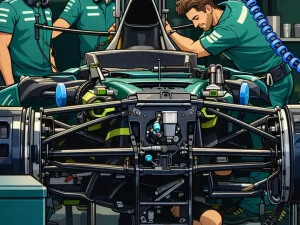
Williams arrived at the British Grand Prix with the sort of updates you’d normally point to as progress. Weight has come off the car since the start of the season, and there was even a new front wing that, by Sainz’s telling, had been pencilled in for a later debut but was pushed forward. The team’s clearly trying to move quickly — and in this era, speed of iteration can matter as much as the size of the upgrade itself.
But the harsh reality is that neither Sainz nor Alex Albon has been a reliable top-10 threat for a while now. Sainz has gone four races without a point, while Albon’s last score came in Monaco in June. At Silverstone, Sainz briefly offered a snapshot of what Williams wants its Sundays to look like: a strong launch, up to 10th on lap one, elbows out. Then the familiar slide began, and he ended the afternoon 17th.
Afterwards, Sainz didn’t dress it up.
“Concerning and frustrating, because it starts to be a bad trend this year that we don’t seem to really find a lot of lap time when the upgrades are coming,” he said. The gap to Audi and Alpine ahead, he admitted, was “simply too big” to live with over a stint.
There’s an important nuance in what Sainz is saying. This isn’t a driver asking for upgrades; it’s a driver looking at the upgrades that *have* arrived — plus the weight reduction Williams has worked hard to deliver — and questioning why the car’s relative performance has still drifted backwards. That’s a more uncomfortable conversation, because it points to correlation, understanding, and whether the team is extracting what it thinks it’s adding.
“We need to have a good sit down now this week, analyse what’s happening,” Sainz said. “Unfortunately we’ve shed a lot of weight out of the car by now, but the gap to the front is increasing and the gap to the rear of the midfield keeps increasing, so we don’t seem to be finding the lap-by-lap [pace] we expected.”
If you want the human read of it, Sainz didn’t try to hide that this one got under his skin. “Obviously, I’m not happy. Today, I’m very obviously upset… worried, maybe, is the right word,” he said. And the frustration is compounded by the way Williams’ races have tended to play out: good openings, then being swallowed up.
“No-one likes getting overtaken,” he added, “especially after so many good starts that we’re doing this year, and getting ourselves in the points because dropping back has been a pattern this season.”
That pattern is what turns a single bad Sunday into something heavier. Drivers can accept a car being slow — that’s the job sometimes — but it’s far harder to accept the sensation of spending the first phase of a race executing well, only for the underlying pace to evaporate and the inevitable train to form behind.
Sainz also put a sharper technical edge on his concern. He floated the idea that Williams might not be reading the new rules’ aerodynamic behaviour correctly — not in the sense of blaming one area, but in acknowledging that something fundamental isn’t landing.
“I don’t know if that, with this set of regulations, we’re not understanding the flow dynamics and the flow aerodynamics well, or what is happening,” he said. “But my feeling is that at Suzuka, we were 1.6, 1.8 seconds [behind] with a very overweight car. Here, we’re two seconds off with a much better weight, and it means that something is not going into the car.
“There’s some load there missing somewhere. We need to go find why.”
That “missing load” line is the one to underline. Weight comes off, lap time should follow — maybe not perfectly linearly, and maybe not equally everywhere, but the direction should be clear. When it isn’t, teams start asking whether the upgrade package is delivering what the tunnel, CFD and simulation promised, or whether trackside limitations — including limited running across a Sprint weekend — are stopping them from properly understanding what they’ve bolted on.
Williams is eighth in the Constructors’ Championship on 11 points, which isn’t catastrophic, but it’s also not what you’d call safe. In a cost-cap world where every development decision has an opportunity cost, losing the arms race early can trap you in it all year.
Sainz tried to strike the balance between honesty and leadership. He sounded flat immediately after the race, but he also pointed to the fact he’ll go back to Grove and push.
“Today was a frustrating day, so you will not see me very cheerful,” he said. “But when I wake up and I go to a factory in the morning, I will be smiling again and trying to put my energy to try and improve the situation… because it’s clear to me now that we’re having serious issues with developing this car, and we are not bringing the performance that we thought we were.”
That’s the warning shot — not at any individual, but at the situation. Williams has brought parts; Williams has taken weight out; and yet Sainz is staring at the timing screens and seeing the midfield stretching away. If the team doesn’t find the why quickly, the season risks becoming an exercise in damage limitation rather than a genuine build under new regulations.