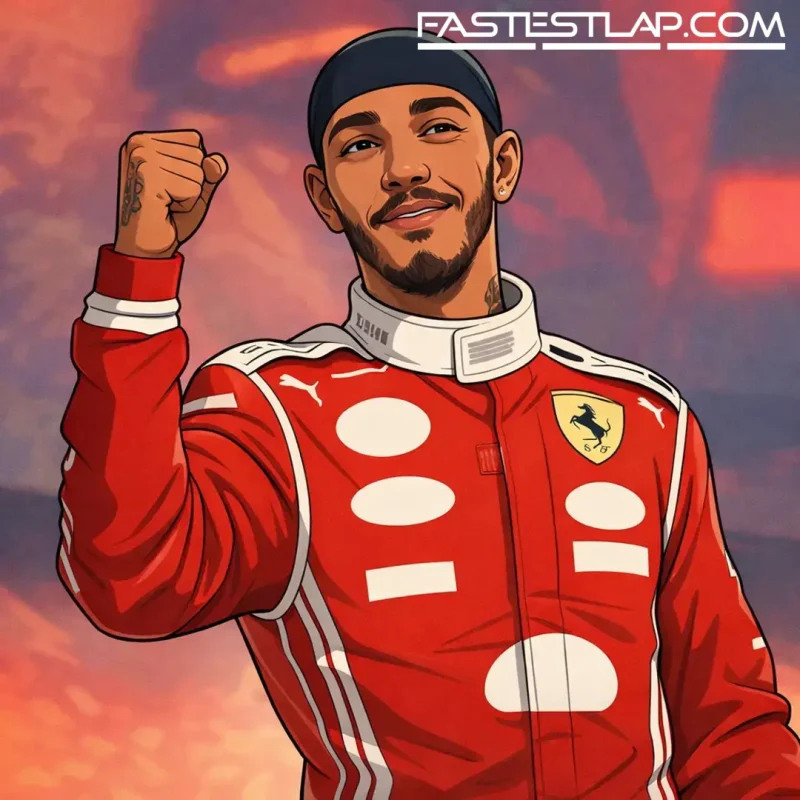
Lewis Hamilton didn’t turn up to Silverstone talking like a man clinging to a romantic end-of-career chapter. He sounded like someone who’s finally got a serious operation underneath him — and, crucially, a team that’s started treating him as part of the engineering loop rather than a celebrity driver to be managed.
That distinction matters, because Hamilton’s first half-season in red was messy enough that even Ferrari’s leadership felt the need to publicly put him and Charles Leclerc back in their box. After a winless 2025 and too many weekends spent firefighting, the message from chairman John Elkann to “focus on driving, talk less” captured the mood: Ferrari wanted results, not direction.
Twelve months later, Hamilton is a race winner again — his first for Ferrari coming in Barcelona — and he’s doing what great drivers do when the car’s finally moving their way: he’s telling you exactly where the shift happened. Not in vague “we’ve unlocked potential” platitudes, but in the kind of nuts-and-bolts detail you only bother sharing when you feel you’ve got real influence.
Asked ahead of his home grand prix what’s changed in 2026, Hamilton didn’t hesitate. The biggest factor, he said, is that “the collaboration” is now there.
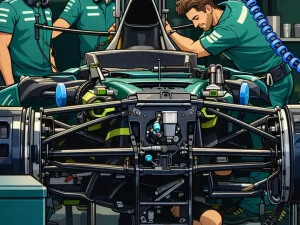
He framed it around a car he’s genuinely had a hand in shaping, pointing to specific items he’d pushed for last year — including front suspension changes that were built for the simulator and evaluated there — and then finally made it onto the real machine. He also flagged brakes as a major win, something he’d been pushing hard to get signed off.
Those details, in isolation, are just parts. In Ferrari’s context, they’re politics.
Ferrari has never lacked for clever people; what it’s lacked, at times, is alignment — the ability to get the right technical instincts, the right driver feedback and the right decision-makers pulling in the same direction quickly enough for modern F1. Hamilton more or less admitted that was the core problem in 2025: without results, he wasn’t being listened to, and without being listened to, it became harder to generate the results that would earn him that trust.
“So naturally when you’re having that, people tend to listen to you less,” he said, describing last year’s spiral. “Why are we going to listen to you when you’re getting these results?”
That’s the line that gives the game away. This wasn’t just a car that didn’t suit Hamilton; it was a relationship that hadn’t found its working rhythm. He talked about changes within his personal engineering group, and about “readjusting” how his side connects with Ferrari’s broader structure. Most revealing was his description of “realigning” himself with the “higher powers” so that Ferrari and Hamilton are “allies rather than foes”.
In other words: Hamilton didn’t just need a faster Ferrari. He needed Ferrari to stop behaving like Ferrari when the pressure rises — to stop turning every disagreement into a referendum on authority.
Now, Hamilton says, the trust is there, and when he asks for things, they happen. He called it a two-way street, with both sides “pushing each other along”. It’s the sort of language drivers use when the internal friction has eased and the feedback loop has started paying off in lap time.
The timing couldn’t be more significant. With new regulations in play for 2026, Hamilton wanted Ferrari to be the outfit setting the trend — the team others are forced to copy. He believes that’s what’s happened, pointing to Ferrari’s rear wing solution and an exhaust element he says has since been adopted across the grid.
Ferrari, in his telling, isn’t just recovering. It’s behaving like a team that expects to lead.
“To be back up competing in the front, from where we were last year, it’s a remarkable turnaround for us as a team,” Hamilton said, crediting the relentlessness of the development push and the steady stream of parts arriving each weekend.
It’s not hard to see why he’s leaning into that narrative now. Hamilton sits third in the drivers’ standings, 32 points behind championship leader Kimi Antonelli, and the shape of the season has changed. A year ago, the questions were about whether Ferrari had misjudged the Hamilton move. Now they’re about how quickly Ferrari can keep evolving — and whether this newly functional partnership can turn a comeback into a title fight.
For Hamilton, there’s an edge to it, too. The win in Barcelona didn’t just end a drought; it validated an approach. It proved that the input he was insisting on — the brake feel, the suspension direction, the internal restructuring — wasn’t noise. It was the groundwork.
And if Ferrari has finally decided to treat one of the smartest, most experienced drivers the sport’s ever had as an asset to be used rather than a reputation to be protected, that might be the most “Ferrari” innovation of all in 2026.