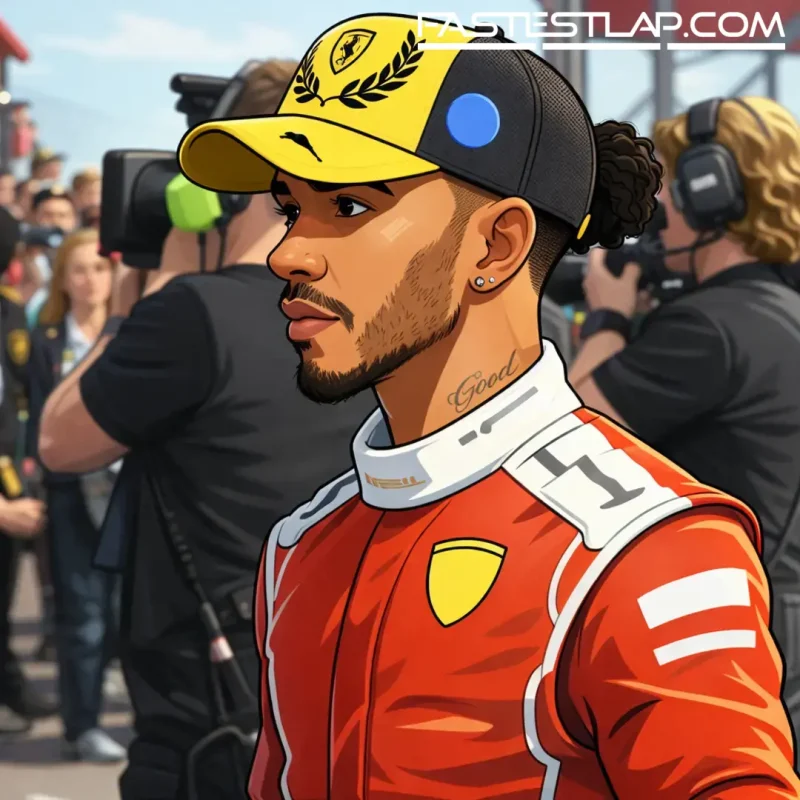
Lewis Hamilton left Silverstone with a podium, a time penalty, a reprimand and — perhaps most tellingly — a reminder of how narrow the margins get when Max Verstappen is in your mirrors.
The Ferrari driver finished third at the 2026 British Grand Prix, but his Sunday was busy even by modern F1 standards. First came a five-second penalty for a false start. Then, after the chequered flag, the stewards took a look at a potential yellow-flag infringement triggered by Nico Hulkenberg’s stranded Audi. Hamilton escaped the latter with a reprimand, the FIA noting mitigating factors — including the small matter of being mid-fight with Verstappen.
Hamilton didn’t try to dress it up. If anything, he painted a picture any driver recognises: that claustrophobic, high-alert moment after you’ve just made a pass and your entire world becomes the mirror.
“I literally just got past Max,” Hamilton explained. “So, I’d come through Turn 9 and I was literally staring in the mirror because I was thinking he’s going to come in a bit like George coming back past me, and that’s where I was looking, and I didn’t see the flag.
“So that’s why later on, if you hear the radio, I asked if there was a yellow flag, because I didn’t see one. That was it.”
It’s a useful window into how these incidents actually happen. Yellow flags aren’t ignored because drivers don’t care; they’re missed because the sport has engineered racing so close that attention becomes a finite resource. When Verstappen is looming, that resource gets spent fast.
The stewards ultimately accepted Hamilton’s account as part of their assessment, and the reprimand reflected that they weren’t convinced it rose to the level of a harsher sanction. But it still goes on the record — and in a season where Hamilton is trying to turn Ferrari weekends into title momentum, the last thing he needs is a growing folder of “avoidable” paperwork.
Earlier, the punishment was more tangible. Hamilton’s Ferrari crept forward before the lights went out, earning him a five-second penalty — a rare error by his standards, and one that inevitably sparked paddock debate about proportionality. David Coulthard labelled the sanction harsh, only for former F1 presenter Will Buxton to dismiss that view in less-than-diplomatic terms.
Hamilton, for his part, sounded more baffled than defensive when he described what happened.
“I jumped the start, which I have done very few times in the 380-odd races that I’ve done,” he said. “My hand just moved just like that. Don’t really know where it went. I didn’t mean to do it. I didn’t even tell my hand to do it. But anyway, it happens.”
That line will make engineers wince and psychologists nod: sometimes your body simply reacts before your brain has finished negotiating with it. And at Silverstone, with a home crowd urging him on and Verstappen as the immediate reference point, Hamilton’s day had that slight edge of tension where the little things start to creep in.
Still, the bigger picture for Hamilton is that the points mattered. With Kimi Antonelli’s victory bid unravelling at Silverstone, Hamilton trimmed the Mercedes driver’s championship lead to 32 points. In a long season under the 2026 ruleset, that’s not a swing you ignore — even if it arrived in a weekend that occasionally looked like it was trying to trip him up.
From Ferrari’s perspective, P3 plus a points gain on the championship leader is a solid return — but the manner of it will be what they review. The false start cost time they didn’t need to lose, and the yellow-flag moment underlines how exposed you are when you’re racing wheel-to-wheel and managing the basics at the same time. That’s not a criticism of Hamilton so much as a reality check: the Verstappen effect is as much about what it makes you do as what he does himself.
Hamilton called it as he saw it — he was expecting the counterpunch, and his eyes followed the threat. At Silverstone, that instinct nearly bought him more than a reprimand.