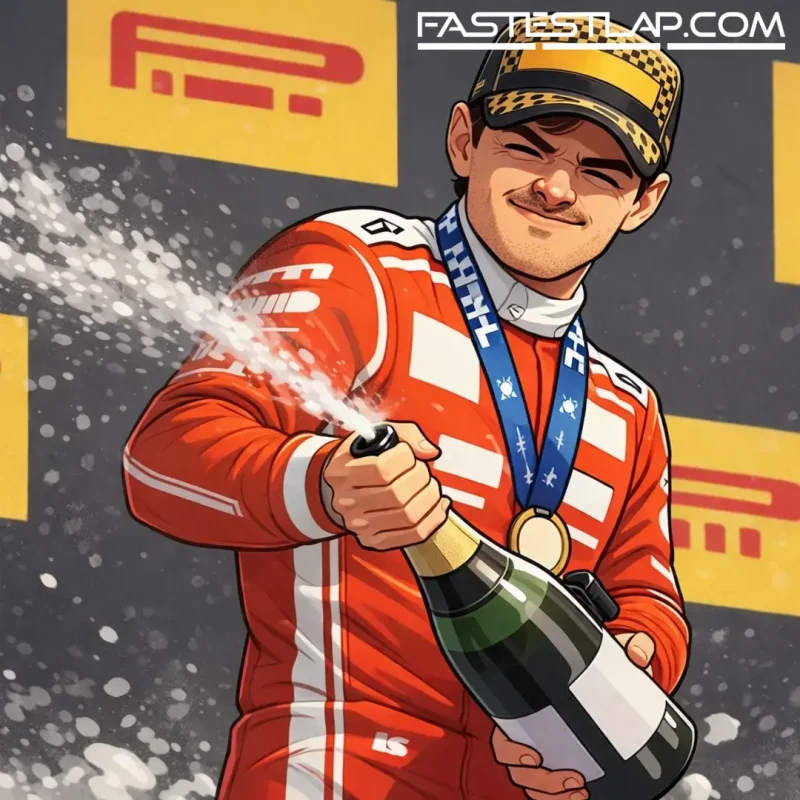
Charles Leclerc didn’t just win the 2026 British Grand Prix — he stopped a narrative that was beginning to harden around him.
For weeks, the story had been neat and brutal: Lewis Hamilton arrives at Ferrari, loses the internal fight in 2025, then flips the dynamic in 2026 as Leclerc’s form frays under the weight of errors and missed points. Monaco and Barcelona, in particular, had left Leclerc looking like a driver second-guessing both himself and the SF-26. Silverstone was different. The lap time was back, the feel was back, and — crucially for a driver who’d been chasing reassurance — the weekend finally stitched itself together.
Ferrari’s own read on the situation never matched the noise outside the team. Fred Vasseur admitted there’d been concern, but not the kind that makes a team start treating its lead driver like a problem to be managed. Internally, the argument was simple: the data said Leclerc was still there.
“I was not fully aligned with the question that I had for the weekend, and even last weekend,” Vasseur said after the race. “For us, his data, we were not negative.
“What was tough for him was the lack of points, the lack of results. We had the reliability issue in Barcelona. He had the poor start yesterday [in the Sprint]. It means that you are not putting things together and the others are scoring points.
“But in terms of performance… I was still optimistic with Charles, because we saw in the data that he was there. He was always there in the overlaps, and it’s paying off today.”
That last line mattered. “Overlaps” is paddock shorthand for the uncomfortable truth that can exist when a driver’s results don’t reflect their speed: in comparable parts of the lap, or comparable phases of a run, the numbers still stack up. Ferrari didn’t need to guess whether Leclerc had lost it. They could see he hadn’t. What he’d lost was the final few percent that turns “quick” into “ruthless” — the part that comes from certainty.
And that’s where Silverstone functioned as more than a trophy. It was a psychological reset.
Leclerc had effectively framed his own crossroads ahead of the weekend. One route was to follow Hamilton’s direction with the car — lean into what the seven-time world champion was doing and hope the comfort would come. The other was to stick with what he knew could work, and dig himself out with his own tools and his own references inside the cockpit. He chose the second option, and by Sunday evening it looked like the right kind of stubborn.
He started from the front row, then turned the race into something that’s been missing from his season: controlled, repeatable pace. Not a weekend of heroics, not a messy redemption drive, but a clean Ferrari win built on consistency — exactly what you’d expect from a driver who’d been told the performance was never the issue.
Vasseur’s interpretation was pointed: it wasn’t lap time Ferrari doubted, it was confidence that had been eroded by the season’s stops and starts.
“I think the result of today is the best boost of confidence that he can have at first,” Vasseur said. “It was not just a matter of performance, the performance was there. I think it was more a matter of confidence.
“He found the confidence that each step of setup is not making a proper difference in terms of lap time, but sometimes it’s giving them confidence to push a bit more. For race pace, it’s crucial. Today he was very consistent.”
That’s a very Vasseur way of describing it — not romantic, not dramatic, but painfully accurate. Set-up changes don’t always buy you lap time directly; sometimes they buy you belief on entry, or a fraction more commitment on traction, and over a stint that becomes the lap time. A driver who’s doubting will leave margin everywhere. A driver who trusts what the car will do stops bargaining with it.
The timing couldn’t be better for Leclerc. Hamilton had been “turning the tide” within Ferrari this year, and Leclerc needed something tangible before the internal balance hardened into something more permanent — not in terms of politics, but in terms of momentum. A team doesn’t have to choose a number one on paper for a season to start feeling like it’s tilting.
Silverstone doesn’t erase the rough patches — the errors still happened, and the points dropped still count — but it does change the tone of the next phase. Leclerc now has his first win of 2026 on the board, and he leaves the British Grand Prix up to fourth in the Drivers’ Championship. The deficit to Hamilton has been cut to 39 points.
Ferrari, unsurprisingly, sound like a team that never stopped believing it would come. The more interesting question is what Leclerc does with it now. Because in a year where Hamilton has been the steadier scorer, Leclerc doesn’t just need flashes — he needs this version of himself to show up every weekend.
At Silverstone, it finally did.