Carlos Sainz isn’t short of options in Formula 1 — and everyone in the paddock knows it. That’s precisely why Williams is working overtime to keep its newest cornerstone convinced the long game at Grove is still worth playing, even as 2026 has turned from promise to frustration.
James Vowles doesn’t deny the obvious: a driver of Sainz’s calibre will always attract interest elsewhere. But speaking around the British Grand Prix, the Williams team principal sounded more irritated by the team’s own form than anxious about rival suitors. The message, in essence, was that the relationship remains solid — and that the proof Sainz wants is performance, not sentiment.
“He and I talk, not daily, but probably every two days,” Vowles said. “He came out and said, ‘This is where he wants to be, this is where he wants his career to be.’ So he and I are aligned on it.
“Is he frustrated by where we are today? Yes. Being candid, I’m frustrated as well, at the same time.”
That alignment matters because the context has changed quickly. Sainz arrived at Williams in 2025 as the headline act of Vowles’ rebuild and, for a while, it looked like a masterstroke. Two podiums and fifth in the Constructors’ Championship wasn’t just respectable; it hinted at a team rediscovering competence and direction. With Williams having positioned itself early for the 2026 regulation reset, there was a sense through the winter that the curve could steepen.
Instead, the first half of 2026 has been a grind. Williams has gone three consecutive race weekends without scoring, and Sainz personally hasn’t registered points in four. Even the much-anticipated upgrade package introduced at Silverstone failed to produce the step the team needed — the sort of weekend where you arrive expecting to stop the bleeding and leave realising the cut’s deeper than you thought.
And it’s in that gap between expectation and reality where the market noise gets loud.
Sainz has been linked with Audi as a potential destination for 2027 — a story with added bite given Audi was a route he turned down before committing to Williams. Audi’s ambition is no secret either: it wants to climb quickly and has its sights set on becoming a title contender by 2030. For a driver who’s spent his prime years bouncing between long-term projects, the appeal of backing the “right” one at the right time is obvious.
What’s interesting, though, is how deliberately Sainz is trying to shut the door on the chatter — at least for now. He’s asked his management not to feed him driver-market updates before the summer break. The intention is clear: stay focused on the job in front of him, then reassess during the pause with a cooler head and the season’s evidence laid out properly.
From Williams’ side, Vowles is framing this less as a recruitment battle and more as a delivery challenge. He accepts Sainz can realistically land elsewhere, but insists the driver’s motivation is to build something with his imprint on it — not simply jump to the next shiny object.
“He has the ability to go, not anywhere necessarily on the grid, but to a number of other locations,” Vowles said. “He wants this to be his, because he wants to put his DNA into it, the same way I do as well, and make it his own.
“My job in this is just to demonstrate to him some basic elements, which we’re nearly there on.”
The subtext is telling. This isn’t about convincing Sainz with speeches; it’s about demonstrating a pathway to improvement — the kind you can see in the wind tunnel correlation, in the upgrade cadence, and in whether the team can identify what went wrong quickly enough to stop it becoming structural.
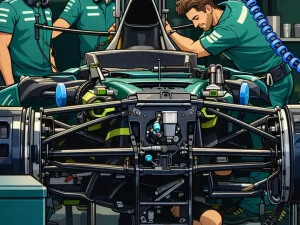
Sainz, for his part, hasn’t been dressing it up. After Silverstone extended his scoreless run, he spoke of “serious issues with developing” the FW48. That’s not a throwaway line from a driver having a bad Sunday; it’s the type of comment that lands internally like a challenge to the whole technical chain. Vowles subsequently confirmed Williams has launched a review into the car’s development cycle — an acknowledgement that this isn’t being treated as a run of bad luck.
In many ways, this is the real stress test of the Sainz-Williams marriage. It’s easy to talk about “the project” when the points are flowing and the narrative writes itself. It gets more complicated when the car stalls, a major upgrade underwhelms, and the sport’s ever-present alternative futures start whispering again.
Williams’ task now is brutally simple to describe and painfully hard to execute: show Sainz tangible progress before he reaches that summer-break moment of clarity with a list of possibilities in front of him. Vowles can be confident about alignment and DNA and shared intent — but in modern F1, the only language that truly keeps a top driver from listening elsewhere is lap time.