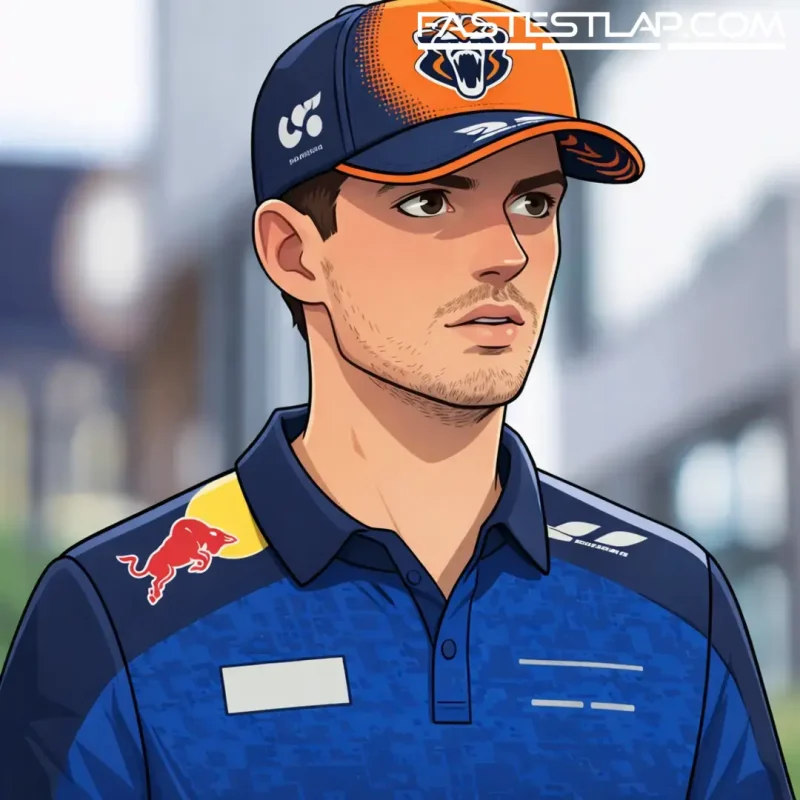
Max Verstappen doesn’t need to see a wind-tunnel chart to spot when the competitive order is being tugged around by development. Two weekends were enough: Red Bull looked like a win threat in Austria, then found itself watching the British Grand Prix fight from the wrong side of the fence. In Verstappen’s eyes, that swing wasn’t some mystery of track characteristics so much as the new reality of 2026 — a development race where one well-timed package can buy you a weekend.
And he’s put a price on it.
Asked after Silverstone whether Austria had flattered Red Bull’s hand, Verstappen pointed straight at Ferrari’s latest step, introduced at the Red Bull Ring, as a reminder that the grid is now living upgrade-to-upgrade.
“Yeah, but everyone keeps bringing upgrades,” he said. “Ferrari had a big performance upgrade [in Austria] with, I think, power related mainly, so it just shifts all the time with whoever brings an upgrade.
“Because I guess most of the upgrades that are brought all the time is two to three tenths, which, of course, is quite big.”
Two to three tenths doesn’t sound like a revolution until you remember how this season has been decided: margins are tight enough that a couple of tenths can move you from pole contention to being the best of the rest, and from controlling your race to reacting to someone else’s.
Ferrari’s change was tied to the ADUO (Additional Development and Upgrade Opportunities) checkpoint system and focused specifically on internal combustion engine power. The team moved to upgrade the ICE ahead of Austria — a significant moment, because 2026’s development pathways are narrower and the windows to make meaningful power unit progress are more clearly defined.
The immediate optics in Spielberg didn’t scream “game-changer”. Ferrari underwhelmed at the Red Bull Ring and questions resurfaced around electrical deployment. Silverstone, with its high-speed load and long stints at full commitment, was also framed as a potential headache.
Then Charles Leclerc went and won the British Grand Prix — his first victory of the season — and delivered Ferrari’s second win of 2026.
In the paddock, the simplest explanation has been the most persuasive: Austria’s altitude and heat may have masked what Ferrari had brought. Silverstone’s conditions allowed that upgraded engine to show itself more cleanly, and suddenly the story looked less like Ferrari “catching a break” and more like Ferrari executing a well-timed development step.
From Red Bull’s perspective, the frustration is obvious. The RB22 “shone” in Austria with Verstappen in the mix for victory; at Silverstone the team wasn’t in the lead battle. Verstappen didn’t dress it up as a crisis, but he didn’t wave it away either. The point he made is the one engineers and strategists are already living with: in this cycle, the lap time you had last week isn’t an asset unless you keep feeding it.
That matters because F1 now heads to Spa-Francorchamps, and Verstappen is already bracing himself for a different kind of pain — not balance, not tyre life, but energy.
Spa shares some of Silverstone’s personality: long, fast corners and limited heavy braking zones to refill the battery. Fernando Alonso has warned of a “less power than F2” feel when it comes to energy management at the Belgian Grand Prix, and Verstappen isn’t arguing.
“I love Spa, but Spa is going to be another painful one, just because of the energy,” he said.
It’s a telling line. In 2026, even drivers who relish Spa’s rhythm are talking about it like a compromise exercise: how much lap time do you surrender to stay within your deployment limits, and where do you choose to spend what you’ve saved? If Ferrari’s Austria upgrade really is worth what Verstappen suggests — and if it’s as power-related as he believes — then Spa becomes a particularly sharp test of who can turn that extra combustion performance into usable, repeatable lap time when the electrical side is under stress.
For Verstappen, Spa should be a home-style weekend — born in Hasselt, and a three-time Belgian Grand Prix winner, most recently in 2023 — but sentiment won’t carry the RB22 through an energy-sensitive race. If anything, it raises the stakes: Spa is the sort of circuit where a two- or three-tenth gain doesn’t just help in qualifying, it can change the entire shape of your Sunday, because it gives you options. You can defend with less deployment, attack with more, or simply survive the management phase with fewer compromises.
That’s why Verstappen’s “two to three tenths” comment lands. It’s not a throwaway number. It’s the size of the steps teams are now capable of making inside a season, and the size of the steps that can make a confident weekend look like an outlier.
The uncomfortable truth for everyone, Red Bull included, is that 2026 isn’t waiting for anyone to “find a direction”. It’s moving in increments, and the teams that time those increments best are the ones setting the narrative. Spa will be the next check: not just who’s quickest, but who’s brought the last meaningful slice of lap time — and who’s still chasing it.