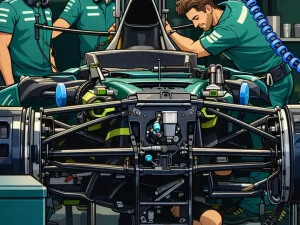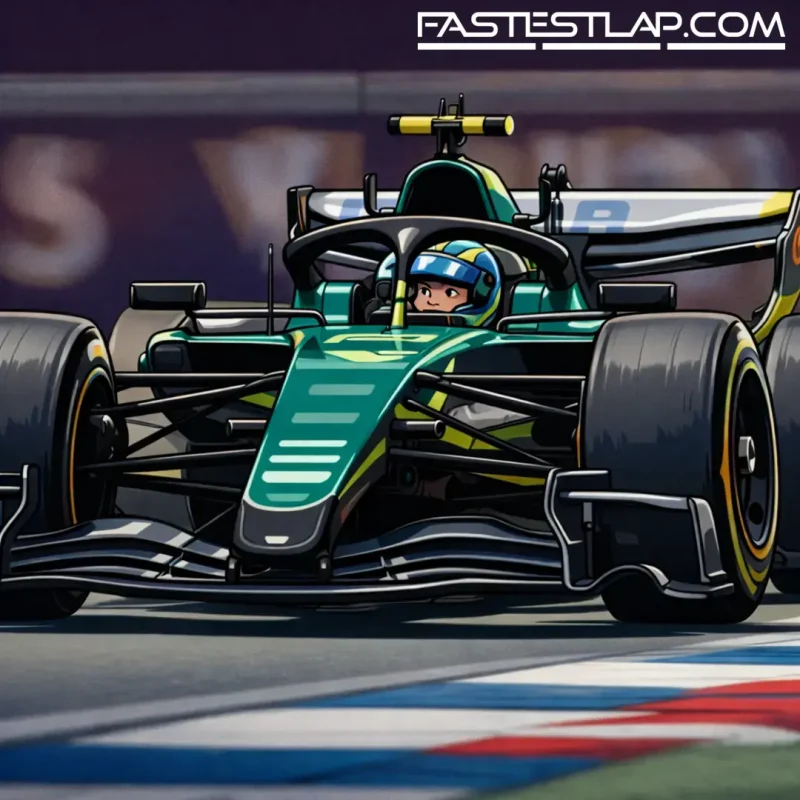
Honda has pinned its next meaningful move in 2026 to Zandvoort, confirming the Dutch Grand Prix as the intended arrival point for a heavily revised power unit in Aston Martin’s AMR26. The message from the trackside leadership, though, is pointedly grown-up: expect a decent gain, don’t expect a miracle.
Shintaro Orihara, Honda’s trackside general manager and chief engineer, says the revised engine should deliver what he called a “reasonably big step” — but he’s also been clear that one upgrade won’t suddenly put Aston Martin on Mercedes or Red Bull Powertrains-Ford’s level.
“Our target is Netherlands,” Orihara said. “We are working hard to complete our job list to achieve bringing the new power to the Netherlands, that is our target.”
It matters because Aston Martin’s early-season reality has been brutal. The Honda tie-up has produced a single point so far — Fernando Alonso’s P10 in Monaco — and the team sits 10th in the Constructors’ Championship. That’s not a position anyone in Silverstone signed up for when this partnership was announced, and it’s why every update now arrives loaded with expectation, fair or not.
The timeline is already set: Aston Martin plans to debut a B-spec AMR26 at the Hungarian Grand Prix, with Honda’s new engine slated to follow one race later. It’s a staggered approach that tells you plenty about the internal logic at both ends of the partnership — fix the platform, then feed it more power — but also underlines just how much needs doing.
What’s interesting about Honda’s description is how old-school it sounds. No smoke and mirrors, no talk of “operating windows” or “system optimisation”. Orihara confirmed the changes are “purely” internal, with a focus on combustion, friction reduction, and the unglamorous but essential step of shoring up durability as performance goes up.
“Yes, purely we focused on internal,” he said. “Our focus point is to improve engine performance, so we are working on the combustion chamber shape, and also we modified the chamber. We will change the combustion chamber shape to improve combustion performance.
“Also, we are working to reduce friction by modifying the lubrication system. And also, of course, to improve reliability, because if we increase performance, we need to increase reliability.”
He added that driveability is also a priority — a key detail given how sensitive these cars are to power delivery, especially in transient phases. If the goal is to give Alonso and his team-mate something they can actually lean on through corner entry and traction, a raw horsepower number alone won’t do it.
Honda won’t put a figure on the gain. Orihara said he knows “the number from the dyno” but wouldn’t share it, stressing instead that this is intended to be a proper step rather than a token update.
That “reasonably big” phrasing is doing a lot of work, and Honda knows it. The manufacturer also has extra development latitude via the ADUO system (Additional Development and Upgrade Opportunities) after being assessed at the back at the first checkpoint — a grading based solely on internal combustion engine performance. Orihara outlined the process: single-cylinder testing first, then V6 dyno work, durability running, and transient testing to understand behaviour in the real world, not just at steady state.
It’s a reminder that this isn’t simply about finding more peak power. It’s about delivering it in a way that doesn’t create new headaches: temperatures, wear, driveability, and the inevitable knock-on effects for how Aston Martin packages and cools the car.
And then there’s the competitive context. Red Bull Powertrains-Ford being rated top on ICE — a surprise even to the manufacturer itself, by Orihara’s admission — changes the benchmark. Mercedes sits behind it, and Honda is playing catch-up.
Orihara didn’t pretend otherwise.
“What I would say is there is no magic in Formula 1,” he said, “so I don’t think we’re going to catch up with, let’s say, Mercedes or RBPT by one step.
“The performance development is step by step, so Netherlands is a first step, to do a reasonable step, but we need another further step for the future.”
That’s the most important line in all of this. Zandvoort isn’t being sold as a silver bullet; it’s being framed as the beginning of the climb. For Aston Martin, that’s both sobering and oddly encouraging. Sobering because it confirms there’s no quick fix to a season that’s slipped away early. Encouraging because it signals a programme with structure — and, crucially, honesty — rather than desperate, scattergun change.
Still, the sport doesn’t grade on sincerity. If Aston Martin’s B-spec car in Hungary doesn’t move the needle, and if the Honda upgrade in the Netherlands isn’t immediately felt in lap time and race flexibility, the pressure will spike again — not least because, in 2026, the midfield is ruthless and the back of the grid is an unforgiving place to try and develop your way out of trouble.
For now, Honda’s stance is clear: progress is coming, but if Aston Martin wants to fight the front-runner power units, it’ll take more than one Sunday at the seaside.