Ferrari didn’t set out to build a car that would sharpen the contrast between its two stars, but that’s exactly what the SF-26 has done. In the opening chunk of 2026, it’s become increasingly hard to ignore how differently Lewis Hamilton and Charles Leclerc are living with the same set of traits — and how quickly that divergence has flipped the internal story at Maranello.
Hamilton has now moved ahead of Leclerc in the Drivers’ Championship, a swing that would’ve sounded fanciful a year ago given how comfortably Leclerc shaded their first season together. Back then, Leclerc won the intra-team fight by 86 points. This season began with a more even rhythm — and a few wheel-to-wheel moments that hinted Hamilton wasn’t going to play the supporting role quietly — but Leclerc still had the early momentum.
Then Ferrari’s upgrade push arrived, and the balance of the partnership tilted.
From Canada through to Barcelona, Hamilton stitched together a three-race run of podiums and capped it with victory at the Circuit de Catalunya. The result didn’t just elevate him above Leclerc in the standings; it reframed Hamilton as a genuine threat in the title picture — and, in Jolyon Palmer’s view, made him the rival the leading contenders now have to take most seriously.
For Leclerc, the same period has been messy in every sense. He’s gone five race weekends without a podium, and the setbacks haven’t been of one neat type that can be shrugged off as “one of those spells”. There have been reliability hits — notably a brake issue that ended his Monaco weekend and a hydraulics problem that stopped him reaching the chequered flag more recently — but there have also been costly moments of his own, including a qualifying crash in Barcelona.
Leclerc has acknowledged the churn himself, admitting there’s been “always one reason or another” behind his struggles across qualifying and race days. Palmer, though, argues the bigger problem is that Leclerc’s instinctive style is currently rubbing against the SF-26’s personality — and the harder Leclerc leans on it, the more it bites back.
“Charles is a generational talent,” Palmer said in comments carried by F1.com, pointing to the way Leclerc has long driven on feel and impulse, producing laps and races that look like they’re guided by instinct rather than calculation. But Palmer’s point is that the same flamboyance has always carried a small error tax — and in 2026 that tax is being levied more often.
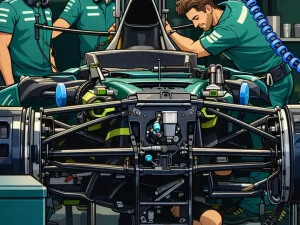
The SF-26, as Palmer describes it, is “snappy”: strong at the front, but with a rear that wants to move around. That’s not automatically a Leclerc-unfriendly platform. Historically, a sharp front-end car sounds like a gift for a driver who likes to attack entries and rotate the car aggressively. Yet Palmer believes Leclerc’s natural tendency to push past the limit is provoking the Ferrari into that snappiness more frequently, exaggerating the instability rather than exploiting the rotation.
Hamilton, by contrast, is finding performance in restraint. Palmer frames it as a calmer approach that’s currently better suited to a car whose rear “dances behind” a responsive front. Where Leclerc’s peak speed often comes from asking the car a question it can’t quite answer, Hamilton is maximising what’s available, banking results, and — crucially — doing it in a way that tightens the psychological vice on the other side of the garage.
That’s the bit Ferrari will be watching most closely. It’s one thing for Leclerc to have a rough run because of mechanical failures, or for a set-up direction to be slightly off. It’s another when the margins start to compound: a car trait that punishes aggression, a driver trying to bully it back into line, and a teammate with seven world titles quietly turning consistency into pressure.
Palmer called this “the toughest moment” of Leclerc’s career and suggested Hamilton’s presence is amplifying the strain because he “knows how to put championship campaigns together” and is “maximising each result”. In plain terms: Leclerc isn’t only fighting the SF-26’s twitchiness, he’s fighting the weekly reminder that the other Ferrari is turning the same tool into points.
None of it reads like panic stations, and Palmer is adamant the pendulum will swing again. The prescription is simple, if not easy: clean weekends, fewer self-inflicted wounds, and a rebuild of the confidence and swagger that have always made Leclerc such an uncompromising benchmark over one lap.
The calendar may not offer instant relief. Austria was already labelled a difficult weekend for Ferrari, and Silverstone’s long straights could be similarly awkward. Palmer, however, points to Budapest as a more natural opportunity for Leclerc to reset — a track where he took pole last year, and one where this season’s Ferrari is considered a stronger overall package.
In the meantime, the numbers are stark. Leclerc sits sixth in the championship on 79 points, with Hamilton third, 46 points up the road. For a team that started this era hoping its driver pairing would be a strength, Ferrari has ended up with a different kind of advantage: two elite operators revealing, in real time, exactly what sort of car the SF-26 is — and what it demands from the person holding the steering wheel.