
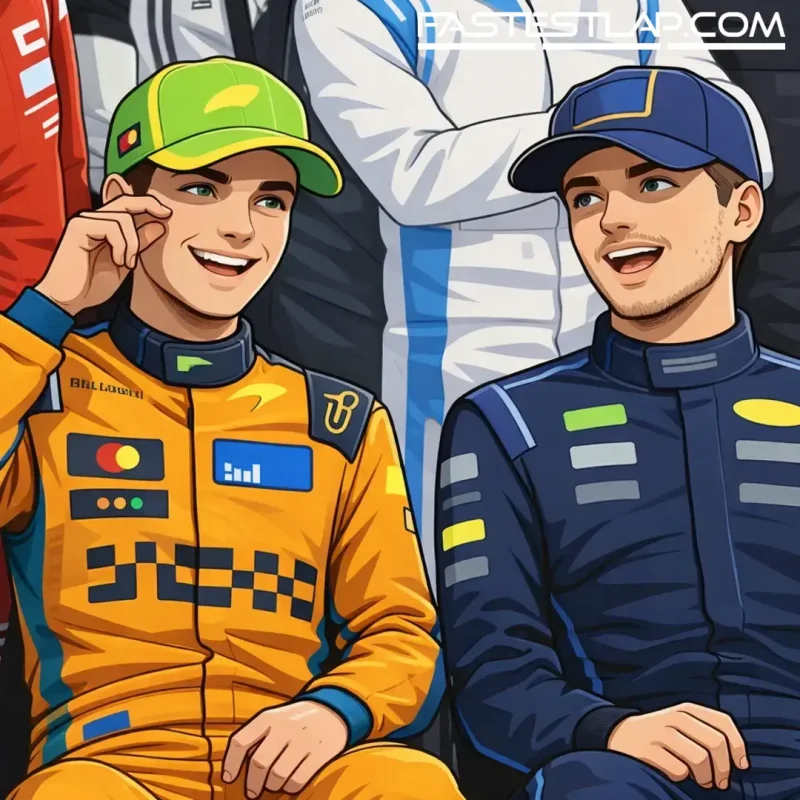
McLaren have spent the first half of 2026 insisting they’re not in the business of distractions. But the paddock’s favourite parlour game right now isn’t about upgrades or tyre life — it’s about contracts, clauses, and whether Oscar Piastri has accidentally become the hinge on which Max Verstappen’s next move could swing.
On the face of it, Piastri versus Verstappen is just another chapter in a season that’s already been pulled in a few strange directions. Dig a little deeper and it starts to look like a private duel with very public consequences. Both drivers are understood to have performance-related clauses that could reshape the 2027 grid long before winter testing rolls around.
Verstappen’s situation is the one everyone is watching. The talk in the pitlane is that if he sits third or lower in the Drivers’ Championship at the summer break, there’s an exit route available — the sort of clause that’s designed to keep a champion from being trapped in a project that’s lost its edge. That’s not a new concept in F1 contracts, but it’s rare to see it become this tangible, this early, and with so many people quietly counting points.
Piastri’s position, though, is what gives the whole thing its bite. He’s reportedly vulnerable if he drops outside the top five, and that’s where the story starts to snarl into something McLaren can’t simply manage with a well-timed PR line. If Piastri’s contractual comfort depends on results, and Verstappen’s freedom depends on his own, then the margins between them matter in a way that goes beyond bragging rights. Every swing in form, every messy weekend, every small points loss starts to feel like it’s echoing into 2027.
That’s why the Verstappen-to-McLaren rumours have lasted longer than the usual silly season froth. It’s not just “wouldn’t it be interesting?” speculation — it’s tied to mechanisms that could actually open doors. And if those doors open, McLaren’s driver picture becomes less about who’s “deserving” and more about who’s contractually movable at exactly the wrong time.
The irony is that McLaren’s wider driver ecosystem looks like it’s tightening rather than expanding. Pato O’Ward, one of the more visible names attached to the team’s F1 programme, has effectively asked to be cut loose — politely, but unmistakably.
O’Ward has been part of McLaren’s Formula 1 set-up since 2022 and has had five FP1 outings, plus mileage through Testing of Previous Cars. Yet he’s now said F1 is no longer his dream, and he’s asked Zak Brown to fire him from his reserve role so he can focus fully on IndyCar.
It’s an unusually candid admission in an era where drivers tend to keep every option alive, even if it’s purely cosmetic. O’Ward’s reasoning is blunt too: he’s happy in IndyCar, and he’s not excited by “where the [F1] race cars are currently”. That’s a pretty pointed line in the middle of a regulation cycle, and it lands at an awkward moment for McLaren — a team that sells itself as a multi-series powerhouse with a clear ladder and a clear vision.
It also strips away a layer of convenient depth. Reserve drivers are often part insurance policy, part political tool, and part marketing asset. If O’Ward genuinely checks out, McLaren lose a recognisable name they could lean on during injuries, scheduling conflicts, or any of the mundane chaos that tends to turn reserve roles from ceremonial to urgent. In a world where top-line driver contracts might start to creak, that matters.
Elsewhere, the paddock’s power brokers are circling too. Christian Horner has been back in the F1 environment for the first time since his Red Bull exit, attending the British Grand Prix as a guest of the FIA and FOM. If anyone expected a soft launch for a comeback, Horner didn’t really do soft.
He’s made it clear he’s only interested in returning if it’s a project capable of winning — not a ceremonial role, not a figurehead position, and not “being a number in a machine”. The Times quote is vintage Horner in that sense: straight to the point, and designed to keep his name attached to the front of the grid rather than the midfield grind. He’s been linked with Alpine and even a mooted 12th team effort involving BYD, but the subtext is simple: he wants leverage, and he’s signalling he knows exactly what he’s worth.
Then there’s Adrian Newey, who this week had the kind of moment that reminds you how Red Bull’s modern identity was built. Newey’s RB17 — a track-only hypercar described as a long time in gestation — made its public dynamic debut at the Goodwood Festival of Speed, with Newey himself taking it up the hill. It’s a neat little coda to his Red Bull era: a passion project with serious engineering heft, shown in the most theatrical setting Britain can offer motorsport.
And while McLaren and Red Bull play their long games, Mercedes have quietly found themselves with a very different sort of narrative: one about calm competence. Kimi Antonelli’s run of five straight wins has put him atop the 2026 championship standings in only his second season, and Jenson Button has pointed to a specific ingredient behind the surge — Pete “Bono” Bonnington.
Button’s read is that Bonnington’s influence has been a stabiliser as Antonelli’s profile has exploded. In other words: yes, the kid’s quick, but the framework around him is doing its job. In a season where so much talk revolves around clauses, exits and “what ifs”, Mercedes’ story is almost refreshingly old-fashioned — put the right people together, get the communication right, and let the results stack up.
Which brings it back to McLaren, and to Piastri. This is the part of the year where teams try to convince the world that driver line-ups are settled and everyone’s focused on the next race. But when contract triggers start to loom, focus becomes a luxury. For Piastri, every points swing could be about more than just his own season. For Verstappen, every position could be a step toward freedom — or a reason to stay put.
And for McLaren, the uncomfortable truth is that the next few races might not just define 2026. They could decide who’s even in orange when 2027 begins.









