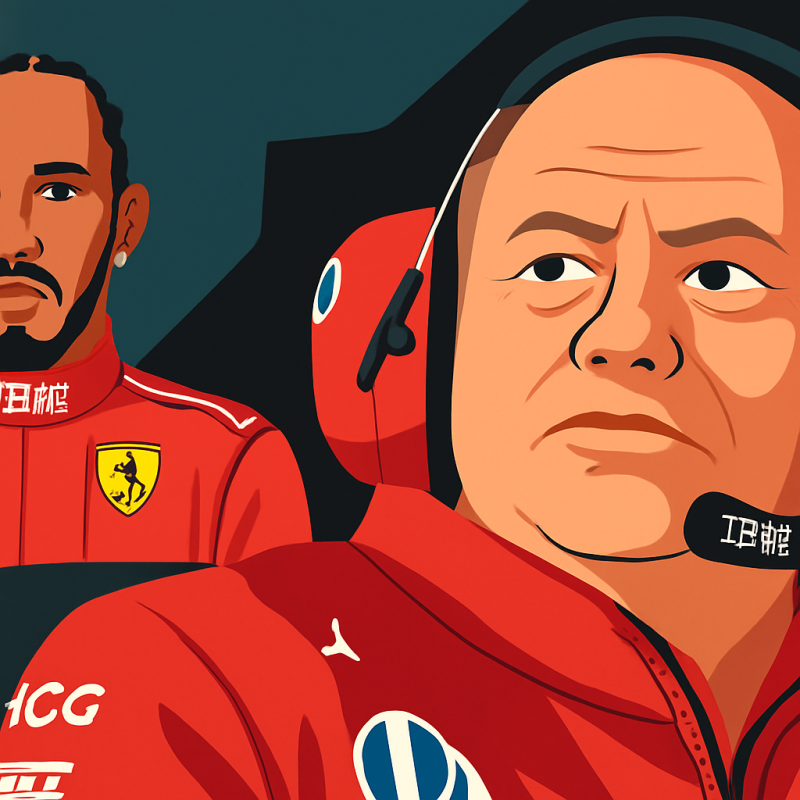
Vasseur hails ‘reset’ as Hamilton steadies Ferrari after Zandvoort flicker
Ferrari boss Fred Vasseur says Lewis Hamilton’s confidence has “come back” after a tidier Dutch Grand Prix weekend that ended in the gravel but hinted at the version of the seven-time champion Maranello thought it was getting.
Hamilton’s first season in red has been a grind by any measure, punctured by back-to-back body blows in Hungary and Belgium before the summer break. He didn’t make Q3 in three qualifying sessions across those two weekends, watched Charles Leclerc stick Ferrari’s first pole of the year in Budapest, and — in a raw, head-spinning burst of self-critique — labeled himself “useless” and even suggested the team should consider replacing him.
Vasseur didn’t let that pass. During the break he publicly urged Hamilton to “stay calm,” calling his reactions “extreme” and warning that magnifying problems only distorts the picture for the team.
Zandvoort didn’t deliver points, but it did offer clarity. Hamilton’s pace was in step with Leclerc’s from the outset and he was locked onto the back of George Russell’s Mercedes for fifth when a damp patch on the banked Turn 3 caught him out on Lap 23. The error ended his race — his first retirement of 2025 — and brings a five-place grid penalty for Monza this weekend. The headline is ugly, the content less so.
Vasseur’s verdict afterwards was measured rather than cold: this wasn’t a crisis of confidence, and it wasn’t the Lewis we saw trudging through July. “The track was in that first drizzle, he was a bit wider than the lap before,” he explained, adding that Ferrari would check the data but saw no fundamental car issue. “Overall, the reaction from Lewis was good. He was into the pace of the car and of Charles from the beginning of the weekend… It was a good recovery after two tough races before the break.”
The nuance matters. For weeks, Hamilton’s mood music had been dark. On Thursday he admitted the season “hasn’t been the most enjoyable,” the pressure of his high‑profile move to Ferrari taking its toll. He called for the team — and himself — to start enjoying the job again, to remember why they do it. That’s not the language of a man who’s lost his edge, but of one wrestling with expectation.
Inside the garage, the tone shifted. Vasseur said both drivers and engineers were “very collaborative” on Friday as they chased Zandvoort’s tricky balance window. Hamilton found a car he could lean on, and once the race settled he was running where Ferrari expected the SF-25 to be. If you’re searching for a turning point, it won’t feature on a highlight reel — it’s tucked away in a sector time, on a tyre run, in a radio exchange that sounded more like Hamilton than the echo of his own frustrations.
That doesn’t mean Monza will be easy. A grid drop at Ferrari’s home race is a lousy party trick, and the Tifosi will come armed with expectations and decibel levels to match. But there’s a path here: if the underlying pace from Zandvoort carries across, Hamilton will have a car capable of moving forward on Sunday, and he’s earned a living on days like that.
It’s also worth noting Vasseur’s pivot. The Frenchman has built his Ferrari on accountability and blunt honesty; publicly challenging Hamilton during the break was a high-wire act that only works if the driver responds. In the Netherlands, Hamilton did. The team boss, in turn, softened the edges: this time there was reassurance and perspective, not needle. For a group still feeling out its internal rhythms with a new superstar alongside Leclerc, that’s the sort of calibration you want to see in early September.
Strip away the noise, and the Dutch GP delivered three truths for Ferrari and Hamilton. One: the raw speed gap to Leclerc is no longer the weekend-destroyer it was in Budapest. Two: the driver’s headspace looks steadier, the overcorrections dialed down. Three: the price of a small mistake in mixed conditions can still be huge.
Monza will test all three. The home crowd doesn’t do half measures. Ferrari can’t, either. But if Zandvoort was the reset Vasseur believes it was, Hamilton arrives in Italy with more than just a point to prove — he’s got a trajectory. And for a team that’s spent too many Sundays firefighting, that’s the most valuable commodity of all.