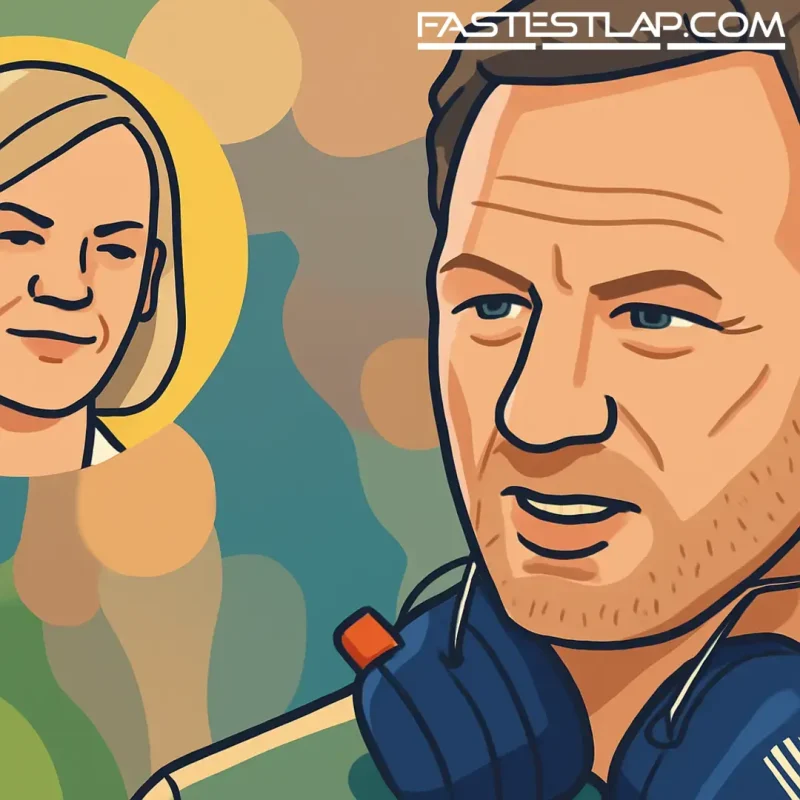
Susie Wolff says Christian Horner “played a character very well” during his long run at Red Bull and admits the 2024 saga that ultimately forced him out was “a real shame for the sport.”
Speaking to The Sunday Times, the F1 Academy managing director reflected on a year when her junior series was gaining momentum, only to be overshadowed by the off‑track drama around one of F1’s most prominent figures.
“Christian was supportive of F1 Academy and for that I’ll always be grateful,” Wolff said. “It was a real shame for the sport — the whole drama that was created with the allegations. We were getting so much positive momentum with F1 Academy and that all kicked off and suddenly everyone wanted to interview me about that. He was someone that played a character very well. But I do think that incident maybe wasn’t the best for the image of the sport and showed that we’ve still got work to do.”
Horner’s exit after the British Grand Prix ended more than two decades in charge at Milton Keynes, an era that brought six constructors’ titles and eight drivers’ crowns split evenly between Sebastian Vettel and Max Verstappen. Racing Bulls boss Laurent Mekies was installed as Red Bull’s chief executive and team principal in the reshuffle that followed.
The 51‑year‑old had been accused of inappropriate behaviour by a Red Bull colleague early in 2024. He was twice cleared — first by an internal investigation conducted by a lawyer, then again when an appeal by the complainant was dismissed. Horner consistently denied the allegations.
PlanetF1 reported last month that Horner had formally cut ties with Red Bull via a settlement in the region of $100 million, and that he’ll be free to return to the paddock at some point during the 2026 season under the terms of his departure. The expectation — again, per those reports — is that he’ll look for an ownership‑style role, a path well-trodden by Toto Wolff, who owns a stake in Mercedes alongside serving as CEO and team principal.
The Horner–Wolff rivalry, the defining off‑track subplot of the Verstappen–Hamilton title fight in 2021, has never really cooled. Toto’s own verdict on his erstwhile counterpart, delivered with trademark bluntness, pulled no punches: “Over the last 12–15 years, he has often behaved like an a**hole,” he said recently, while also acknowledging Horner’s competitive impact. “He was controversial and divisive, but he was one of the main characters here. We can safely say that he was as significant as a great driver… Maybe there aren’t many old‑style team boss dinosaurs left here. Maybe just me. Maybe Fred [Vasseur] is a bit of a dinosaur too!”
Strip away the headlines and there’s a more pragmatic reading of Wolff’s comments. F1’s current ecosystem runs hot on personalities who can sell a fight on Thursday and deliver it on Sunday. Horner did that better than most. But the flip side — when the narrative spills beyond the circuit — frays the sport’s image and, as Wolff notes, hijacks airtime from the very projects aimed at building its future.
The irony is hard to miss: F1 Academy finally stepped out of the shadows in 2024 and 2025, with manufacturer backing and a platform to match, only to be dragged into the same storm the series is trying to rise above. That’s not on Wolff, or the drivers. It’s the cost of doing business in a championship where the political game is part of the show.
Whether Horner reappears in 2026 as a team owner, investor, or something with a more hands‑on brief, one truth remains: the grid’s theatre lost a central character when he exited. The question now is whether F1 prefers the quieter paddock it’s had since, or if it secretly wants the noise back — just with fewer off‑track plot twists.