Silverstone got its chequered flag, Charles Leclerc got the win, and the crowd got… a queue.
Formula 1’s habit of drifting to the finish behind a Safety Car has always been one of those irritants fans tolerate until it lands on a day that matters. This year’s British Grand Prix was exactly that sort of day: late drama, packed grandstands, a race that looked like it had one last sting in it — and then the whole thing was suffocated by procedure.
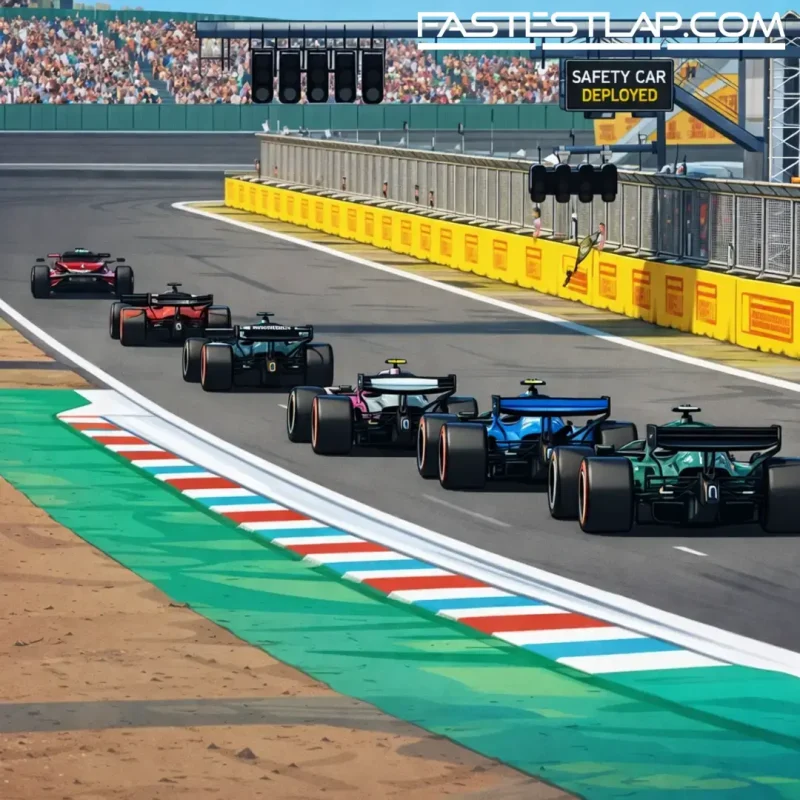
The Safety Car came out on lap 48 of 52 after Max Verstappen spun at Stowe and dropped out, leaving his Red Bull beached and the marshals with work to do. Once the car was being cleared, it briefly felt like the timeline might just about allow a green-flag lap. The confusion was only amplified when “Safety Car in this lap” appeared on lap 51, before the field was ultimately held to the end. The FIA later confirmed that message was shown “erroneously due to a software error”.
That detail matters because the actual trigger for the Safety Car to peel in wasn’t a feeling, or the state of the circuit, or the TV director’s sense of theatre — it was the lapped cars procedure. Under the regulations, once “LAPPED CARS MAY NOW OVERTAKE” is sent, the Safety Car returns to the pits at the end of the following lap. That message only arrived on lap 51, so by the book the Safety Car could only come in on lap 52 — the last lap. Bernd Mayländer duly pulled in, and Leclerc took the flag without the Safety Car physically leading him across the line, which at least spared the optics. But the race was still effectively over long before Vale and Club.
The bigger question is whether F1 has boxed itself into this corner unnecessarily. There were three distinct reactions in the aftermath, and all of them reveal something about how the sport is trying to balance sporting integrity with the simple desire not to send paying fans home feeling short-changed.
Jenson Button, watching it unfold on Sky, reached for an American-style fix: extend the race when a late caution arrives, the way IndyCar and NASCAR can do with their yellow-flag rules. In other words, build in a mechanism that guarantees a proper run to the line. Button was also realistic about the snag F1 can’t hand-wave away: fuel. Without refuelling, teams run tight. You can’t just keep adding laps without forcing a cascade of fuel-saving earlier in the race, or leaving the stewards to adjudicate who “deserved” to run out and who didn’t.
“It would be nice,” Button said, pointing out that other series effectively “push it an extra lap” if a yellow falls at the wrong moment. But he conceded F1’s fuel constraints make it “tricky”.
Martin Brundle, meanwhile, went for a more surgical proposal — one that’s also inspired by IndyCar, but doesn’t ask F1 to rewrite the laws of physics. His point is brutally simple: in a late Safety Car, why are we prioritising the administrative right of backmarkers to unlap themselves over the sporting right of the leaders to actually race?
Brundle’s answer is to send lapped cars down the pit lane instead of letting them perform the wave-by. Let the lead-lap runners line up in correct order immediately, then have the lapped cars rejoin at the back. That removes the lap currently “spent” on unlapping, and gives race control a better chance of restarting with something meaningful left.
“In IndyCar, for example, if it’s within the last 10 laps, instead of a wave-by the lapped cars are made to peel off into the pit lane and rejoin at the back of the field,” Brundle wrote. The subtext wasn’t subtle: if you’re a lap down, your afternoon has already gone wrong — why should you be the reason the front of the field doesn’t get to settle it properly?
He also floated the nuclear option F1 keeps half-flirting with: a red flag and a standing restart. That, at least, guarantees a race finish. But as Brundle noted, it “takes a while”, and in a sport that is forever selling its “flow”, it’s not a decision you take lightly.
And then there’s the view from the pit wall, where the incentives are always more hard-edged. Former team principal Otmar Szafnauer argued the red flag is the cleanest way through this particular mess — not because it’s purer, but because it’s legal and it’s entertaining. He said he spoke to FIA single-seater director Nikolas Tombazis about it and came away convinced the governing body could have stopped the race and restarted it.
“The FIA followed the current rules,” Szafnauer said, “but they have the option to red flag it.” His pitch wasn’t dressed up as a philosophical crusade for racing purity either. It was blunt: “Red flag it for the fans.”
That’s the uncomfortable truth at the heart of this debate. F1 wants to be seen as a sport that doesn’t manufacture outcomes — and it’s still scarred by the mention of Abu Dhabi 2021, which Brundle referenced with a pointed “anybody?” — but it also knows a Safety Car finish is a dead product. A sell-out Silverstone watching cars trundle home is bad television and worse live theatre.
The irony is that F1 already has the tools to avoid the worst version of these endings without resorting to made-for-TV gimmicks. Brundle’s pit-lane peel-off concept would preserve the integrity of the classification, avoid the fuel problem Button flagged, and reduce the risk of race control being trapped by its own timing. The red flag option remains the most dramatic, but also the most disruptive — and it’s easy to imagine teams arguing it turns incidents into opportunistic resets.
Silverstone didn’t end in controversy, exactly. Leclerc still won; the FIA still had the rules on its side. But the sport can’t keep treating these finishes as an unavoidable quirk when they’re often the predictable outcome of procedures written without enough consideration for late-race reality.
If F1 wants fewer processions and more proper conclusions, it doesn’t need to reinvent itself. It just needs to stop letting the back of the queue dictate what the front is allowed to do.