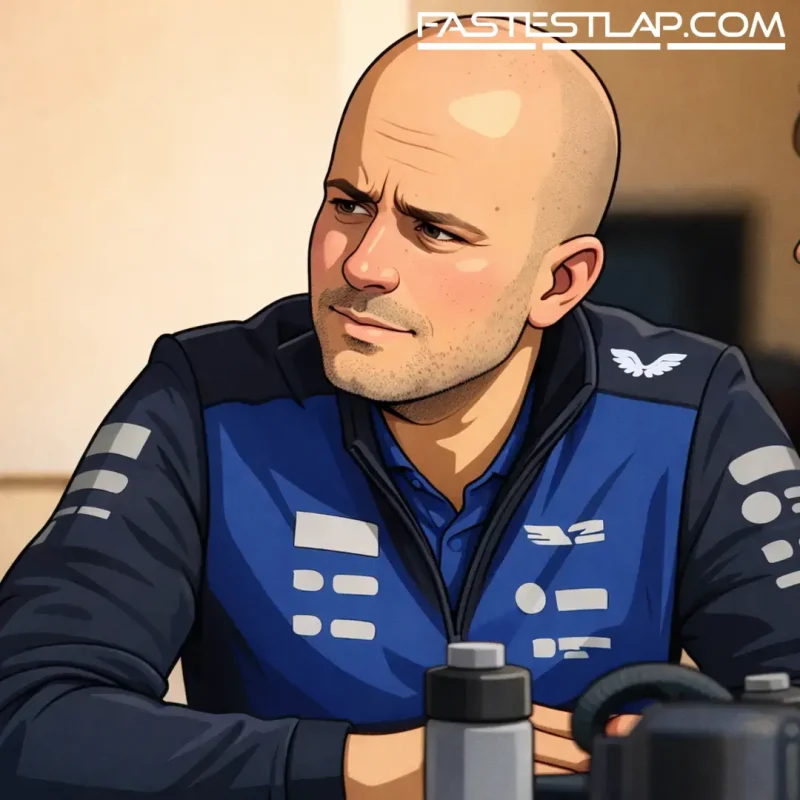
Red Bull and McLaren have both tried to keep the temperature down in public, but the Gianpiero Lambiase situation is exactly the kind of modern F1 staff move that gets awkward long before anyone packs a desk into a cardboard box.
Lambiase is already confirmed to be heading to McLaren to take up a chief racing officer role, reporting to Andrea Stella, with McLaren saying he’ll arrive when his current deal ends — “no later than 2028”. That phrasing matters, because the real story now isn’t the announcement itself, it’s the grey zone it creates inside Red Bull’s walls: what do you do with one of the team’s most trusted voices when you know he’s bound for a direct rival?
David Coulthard, speaking on the *Up To Speed* podcast, put his finger on the tension Red Bull will have to manage. The expectation, he said, is that Lambiase continues to honour his Red Bull contract. But at some point, Red Bull can’t treat him like business as usual if they’re serious about protecting what’s coming next.
“You can’t walk out of the factory with a laptop with all the data at the end of the year,” Coulthard said. “But what’s in your mind, you’re allowed to take with you.”
That’s the core issue. F1’s competitive advantage isn’t just files and CAD models, it’s judgment — the accumulated sense of what worked, what didn’t, and where the car’s weaknesses really live. Lambiase has been embedded at Red Bull since 2015 and has been Verstappen’s race engineer through the defining stretch of the Dutchman’s career there. Even without access to a single document, someone with that history carries an internal map of how a team thinks under pressure and how it solves problems.
Coulthard’s warning was that Red Bull will eventually have to start drawing lines around what Lambiase can touch — particularly anything with a horizon beyond the current season. Not because he’d do anything improper, but because you’d be naïve not to manage the risk.
“There’ll be a point where they’re going to want to say: ‘Look, you can’t really be working on this car. Or you certainly can’t be across any of the discussions about developments going into 2027 and beyond.’ So that becomes an awkward scenario.”
Anyone who’s spent time around teams knows how these things usually go: the minute the next destination is official, every meeting invite and every corridor chat changes tone. People start wondering what can be said in front of whom. A senior figure can still do their job professionally — but the job starts shrinking in subtle ways, and that’s where the relationship erodes.
Coulthard related it to his own experience as a driver when he’d signed to join McLaren while still finishing out his Williams commitments in 1995. You still turn up and do the race weekends properly, he said, but access gets trimmed back. That’s not personal, it’s self-preservation.
The stakes are higher with a senior operator moving across the pitwall ecosystem. Red Bull’s dilemma isn’t simply whether to keep Lambiase working; it’s whether it’s even possible to keep him working at full value once the firewall has to go up. The more you restrict him, the more you’re paying for an increasingly compromised role. The more you don’t restrict him, the more you’re exposing yourself to the kind of competitive leakage that’s impossible to police after the fact.
And then there’s the other side of it: what does McLaren want? It’s not hard to see why Woking would be hoping for an early release. If you’ve agreed a high-profile hire and you believe he’s pivotal to the structure you’re building, waiting until the outer edge of “no later than 2028” is the slowest possible route to benefit.
Coulthard spelled that dynamic out too. McLaren would love Red Bull to release Lambiase early — and release the salary obligation with it — but he also made the obvious point: why would Red Bull do anything that makes a rival stronger sooner?
Will Buxton has already floated the idea that we may not see Lambiase on Red Bull’s pitwall in 2027, suggesting the wording of the statements from both teams left room for manoeuvre. That’s plausible, but it’s also where the politics get messy. Red Bull has to balance competitive protection with not creating a circus around one of the most high-profile engineer-driver pairings of the era. The moment Red Bull is seen to be “phasing out” Verstappen’s long-time voice, you invite speculation about Verstappen’s comfort, influence, and the stability of the operation — even if the reality is far more mundane.
Zak Brown, asked by Sky F1 if there’s any chance of bringing Lambiase in earlier than 2028, left the door open without pretending McLaren is holding the keys.
“There’s always a chance,” Brown said. “But he has a contract, and we’re going to respect that. Obviously, in conversations with Red Bull… We’re prepared to wait until ’28 and that’s what we’ll do if that’s what ends up happening.”
That’s a sensible public posture: respectful, patient, but with just enough acknowledgement of ongoing dialogue to keep the paddock guessing.
What happens next will likely be decided less by grand statements and more by a sequence of quiet decisions: which projects Lambiase is assigned to, what meetings he’s excluded from, and whether Red Bull decides the cleanest solution is simply to agree terms on an earlier departure once it no longer makes sense to keep him fully embedded.
The irony is that the very qualities that make Lambiase so valuable — discretion, clarity under stress, and an insider’s understanding of how to win — are the same reasons Red Bull can’t pretend this is a normal farewell tour. In F1, the future is always being built in parallel with the present. Once your future is elsewhere, the present starts to feel like borrowed time.