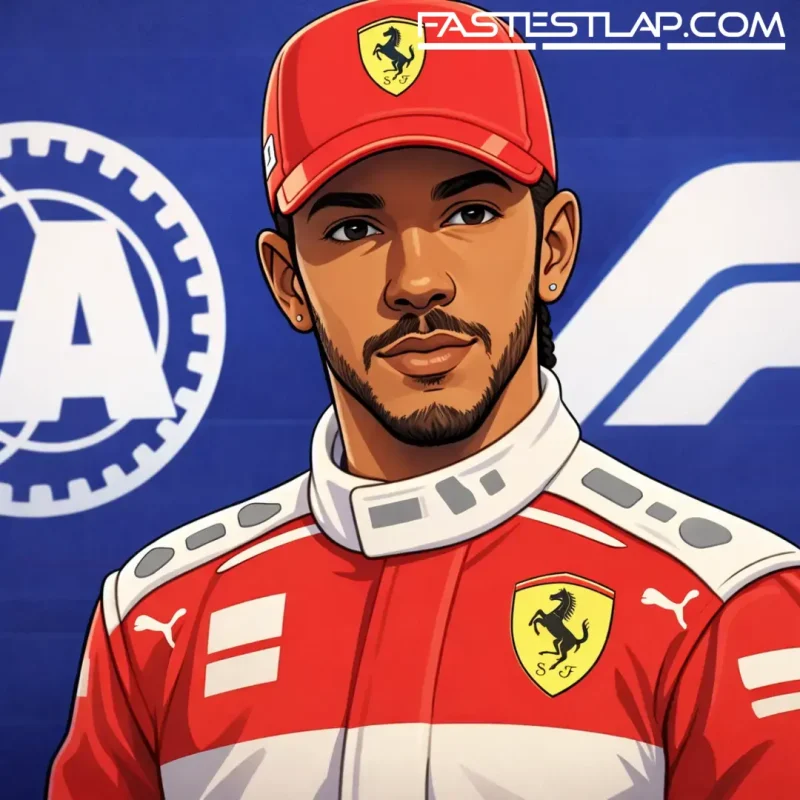
Lewis Hamilton has spent the better part of two decades being the most analysed man in the paddock, yet it’s often the throwaway moments that tell you how a new chapter is really settling in.
On the Red Bull Ring stage ahead of the Austrian Grand Prix weekend, Hamilton was in one of those relaxed, crowd-working moods when he floated an idea that sounded half like a dream and half like a dare: skydiving into the circuit.
“I would love to skydive here. I think it’s a beautiful place,” Hamilton told the fans. “I’d love to skydive into the track one day, that’s what I would like to do.”
Charles Leclerc, standing alongside him, immediately went where any seasoned Ferrari watcher would go: the rulebook. Or rather, the unwritten one.
“Oh, does Ferrari allow you?” Leclerc asked.
“Yeah,” Hamilton replied, without missing a beat.
Leclerc’s face did the rest. “They don’t with me!” he shot back, drawing a proper laugh from the crowd and a grin from both drivers.
“They don’t trust me maybe with a parachute,” Leclerc added, leaning into the joke.
It was a light exchange, but it landed because it hinted at something deeper that’s been easy to miss amid the points tally and the inevitable Hamilton-at-Ferrari noise: this is a team still learning how to manage two lead characters, and two very different profiles.
Leclerc is Ferrari’s long-term investment, the homegrown face who’s carried the “next one” narrative for years. Hamilton is the global institution who arrives with his own orbit. Even in something as trivial as off-track permissions, you can see how the balance of trust, risk and status is being calibrated in real time. Hamilton gets the “yes” on a skydive; Leclerc gets the gentle corporate “not you, mate”.
The timing of it, too, was neat. Ferrari came into Austria with a shot of confidence after Hamilton took his first grand prix win for the team in Barcelona — the kind of result that doesn’t just add a trophy to the cabinet, it adds oxygen to everyone’s mood. But Austria quickly served as a reminder that good vibes don’t always travel.
Tyre degradation and a straight-line speed shortfall blunted Ferrari’s weekend. Hamilton brought it home in fifth; Leclerc was eighth. Not a catastrophe, but the sort of Sunday that makes the debrief room feel smaller than it should.
And it’s that straight-line theme that now hangs over Silverstone. Hamilton left Austria talking openly about the areas that could make the British Grand Prix uncomfortable for Ferrari, especially given how energy deployment and recovery shape lap time at a circuit that doesn’t give you many easy breaths.
“There’s lots of straights at Silverstone,” Hamilton said. “Lots of straights and lots of deployment, and not many places to recover the power.
“Maybe the deficit won’t be as big as here, I don’t know, but there are a lot more straights, so hard to say.
“I hope we’re in a better place. I hope that just by the fans there we get an extra bit of performance.”
Leclerc, unsurprisingly, didn’t sound any more convinced. “I think the power unit will be quite important in Silverstone as well, and so I think we might struggle there as well,” he said.
Underneath the competitive concern sits a subplot Ferrari can’t ignore: the intra-team dynamic is shifting.
This is their second season together and, yes, Leclerc had Hamilton’s number last year. But 2026 so far has tilted Hamilton’s way in the standings — 125 points to Leclerc’s 79 at this stage — and with that comes a subtle change in the air around a team. Ferrari has always been a place where momentum becomes politics. The driver with the points tends to get the benefit of the doubt, the strategic luck, the slightly warmer body language in the corridors. It doesn’t need to be malicious to be real.
So the parachute gag in Austria wasn’t just a cheap laugh. It was a glimpse of two teammates comfortable enough to needle each other in public — and a reminder that Ferrari’s handling of its assets is rarely equal in the fine print.
If Hamilton does end up dropping out of the sky into the Red Bull Ring one day, it’ll make for a great social clip. For now, the more immediate question is whether Ferrari can stop dropping time on the straights before Silverstone turns that weakness into a weekend-long headache — and whether Leclerc can stop watching Hamilton get the “yes” first, on track as well as off it.