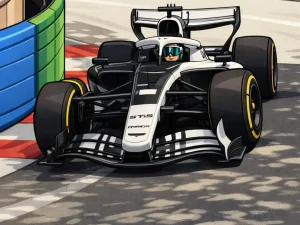
Nikolas Tombazis has pushed back on the idea that Formula 1 has wandered into a regulatory cul-de-sac for 2026, insisting the new rules remain “fundamentally a good package” even after the FIA moved quickly to tweak the framework just three races into the season.
It’s a familiar early-season pattern when the sport rolls out a major technical reset: the regulations are signed off in committee rooms, they meet the letter of the objectives on paper, and then reality arrives at 300km/h. The difference this time is how publicly the sport is litigating its own growing pains — with Max Verstappen front and centre, calling the 2026 concept “fundamentally wrong” despite welcoming the fact changes are being discussed at all.
The FIA’s latest refinements were agreed following a run of April meetings involving the FIA, teams, power unit manufacturers and FOM, and they’re due to be implemented from the Miami Grand Prix weekend (with race start measures to be tested there and potentially adopted after further analysis). The common thread is clear enough: reduce the amount of “management” the rules are forcing on the drivers, take some sting out of the more abrupt performance swings, and add a couple of safety layers where the new systems have thrown up awkward edge cases.
Energy deployment, particularly in qualifying, has been one of the flashpoints. Under the revised parameters, the maximum permitted recharge drops from 8MJ to 7MJ, a deliberate attempt to cut “excessive harvesting” and encourage a more consistent flat-out rhythm. At the same time, peak ‘super clip’ power rises to 350kW from 250kW — an interesting tell, because it’s essentially the FIA acknowledging what’s been obvious since the early rounds: if the car can give the driver more of what they want, when they want it, you reduce the incentive to spend chunks of the lap playing accountant.
Those 350kW figures won’t be confined to qualifying either; the same uplift applies in race conditions. And the number of events where alternative, lower energy limits may be applied has been expanded from eight to 12, giving the rule-makers more flexibility to tailor the approach to circuit characteristics rather than pretending one size fits all.
In the race, the FIA has leaned into two slightly competing goals: keep overtaking plausible while stopping the performance differentials becoming too spiky — especially in the moments when drivers are already dealing with the moving parts of the new energy systems. Boost power in race trim is now capped at +150kW (or the car’s current power level at activation if higher), an attempt to limit the “light switch” effect that can make closing speeds look aggressive even when the intent is to create opportunities.
There’s also a more nuanced change to MGU-K deployment. It stays at 350kW in key acceleration zones — from corner exit to braking point, including overtaking zones — but drops to 250kW elsewhere around the lap. The FIA’s logic is straightforward: keep the bite where racing actually happens, calm the rest.
Race starts, meanwhile, have been treated as a safety problem rather than a sporting one — which is usually the quickest way to get agreement. The governing body has developed a “low power start detection” system that identifies cars with abnormally low acceleration shortly after clutch release, triggering an automatic MGU-K deployment to ensure a minimum level of acceleration. The FIA is adamant it’s designed to mitigate risk “without introducing any sporting advantage”, and it’s paired with an associated visual warning system: flashing rear and lateral lights on affected cars to alert those behind. There’s also a reset of the energy counter at the start of the formation lap to correct a system inconsistency.
In wet conditions, the changes are pitched as much at drivability as at spectacle. Intermediate tyre blanket temperatures have been increased after driver feedback to improve initial grip, and maximum ERS deployment will be reduced to soften torque delivery in low-grip moments. The rear light systems have also been simplified for clearer, more consistent visual cues — a small line in the statement, but one that’s been bubbling away in the background as visibility and signalling remain sensitive topics whenever spray and modern aero collide.
Tombazis, speaking in an FIA-produced interview, tried to steer the conversation away from crisis language. “No one believed the patient, our sport, was in intensive care,” he said, leaning into a slightly folksy analogy about apples, vitamins and exercise. The subtext was more important than the metaphor: this is evolution, not revolution, and the FIA doesn’t accept the premise that the core concept is broken.
That’s where Verstappen’s position becomes more than just another driver grumble. He’s not simply asking for a parameter to be moved; he’s questioning the direction. Speaking at a Viaplay event, Verstappen said the very fact the sport is willing to tweak the rules is “already a step forward”, but added: “You can tweak these regulations a bit, but fundamentally something is wrong. Not everyone will admit that publicly, but it’s true.”
It’s not hard to see why the exchange has bite. Verstappen has been the loudest voice calling the regulations “anti-racing” since pre-season testing, and he’s also hinted that sustained dissatisfaction could push him to look beyond F1. That sort of talk lands differently when it comes from a four-time world champion still in his prime — and from a driver who, in his own words, is trying to “adapt” while also thinking about what kind of sport he’s leaving behind.
He even took the conversation somewhere the FIA has heard before: a return to V10 or V8 engines. Verstappen’s view is uncomplicated: if you’re going to change the feel of F1, make it better, not busier. The idea of V10s running on sustainable fuel has already been floated at governance level, with an FIA working group set up to explore the possibility last year after president Mohammed Ben Sulayem suggested it should be considered for the future.
Ben Sulayem, in a statement accompanying Monday’s announcement, praised the “constructive and collaborative work” of stakeholders and stressed that “safety and sporting fairness” remain the FIA’s priorities. He also noted the sport has faced “an unexpected gap in the calendar due to circumstances beyond the sport,” but that all parties remained committed to acting quickly.
The politics here are as interesting as the engineering. The FIA is trying to keep the 2026 project on the rails without conceding that Verstappen — or any other sceptic in the paddock — has diagnosed a structural flaw. Verstappen, for his part, is applying pressure in the one currency that always counts in F1: credibility earned on-track, deployed off it.
Miami, then, becomes more than just another race weekend. It’s the first live test of whether these adjustments actually make the cars feel less like a compromise between competing objectives — and whether “a good package” can start to look like one.