Alexander Rossi walked away from one of those Indianapolis 500 practice moments that makes even seasoned pitlane veterans go quiet — but not without paying a price.
The former F1 racer suffered injuries to his left hand and right ankle after a heavy, high-speed crash during Monday’s seventh practice session at Indianapolis Motor Speedway. Ed Carpenter Racing says Rossi has already undergone successful outpatient procedures to address what it described as “minor injuries”, yet his participation in Sunday’s race remains a live question mark.
What will worry Rossi’s camp isn’t just the violence of the impact, but the timing. With the field set and the event’s rhythm shifting into its final, detail-obsessed phase — Carb Day and last-minute race preparation — any physical limitation becomes as consequential as any aerodynamic compromise.
Rossi had arrived at this week with genuine momentum. In qualifying last weekend, Chip Ganassi Racing’s Alex Palou claimed pole, with Rossi only 0.258s adrift in second for Ed Carpenter Racing. Pato O’Ward was sixth quickest, while Romain Grosjean slotted in 24th.
Then came Turn 2 on Monday.
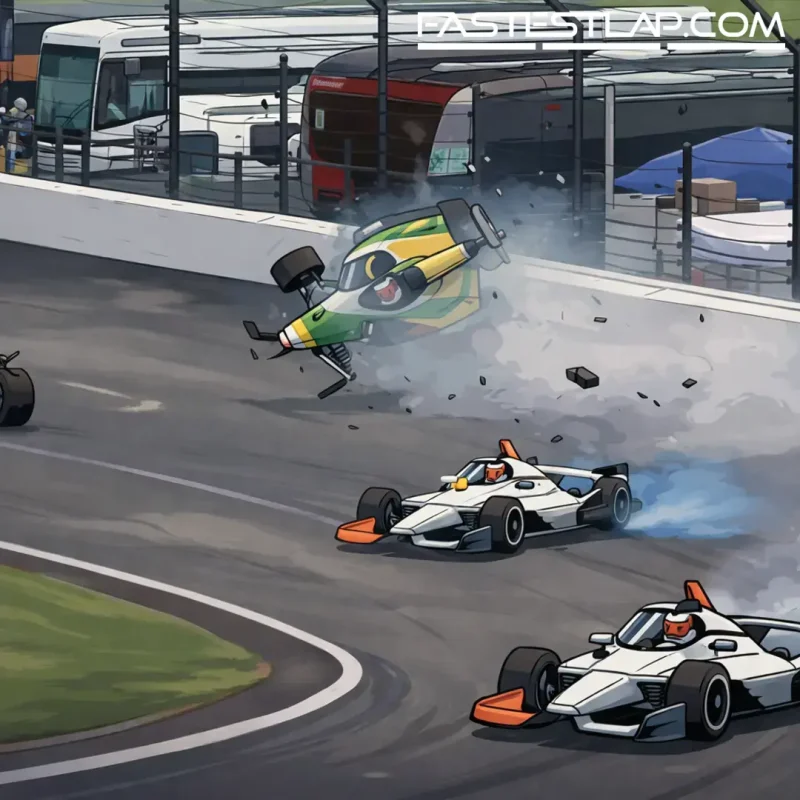
Rossi lost control of his No.20 Chevrolet, spinning off and slamming rear-first into the wall with enough force to pitch the car onto its side before it rotated back onto the racing surface. In the unavoidable chain reaction that follows these incidents at Indy — where closing speeds and sightlines leave drivers with fractions of a second — O’Ward arrived and struck Rossi side-on. Grosjean was also collected in the aftermath.
Alexander Rossi SPINS in Turn 2 😳
Multiple cars are collected as they try to avoid the incident.pic.twitter.com/rOBoa5cERr
— NTT INDYCAR SERIES (@IndyCar)May 18, 2026
The damage to Rossi’s machine told its own story: the left-side sidepod was torn away, and there were visible marks on the aeroscreen around the cockpit. Those are the details that tend to stick with drivers and engineers alike, because they hint at the angles involved and how close the incident came to being far worse.
IndyCar confirmed O’Ward and Grosjean were checked and released without injury. Rossi, initially described as “awake and alert” and “in good spirits”, was sent to a local hospital for further evaluation.
A few hours later, Ed Carpenter Racing issued the more substantive medical update: Rossi had undergone outpatient procedures to repair minor injuries to his left hand and right ankle, and he remained under evaluation “with the intent to compete” in Friday’s Carb Day practice and Sunday’s Indianapolis 500.
It’s a carefully chosen phrasing — optimistic, but leaving the door open. Because in a race like the 500, “minor” can still be decisive. Hand injuries raise practical questions about grip strength, steering corrections in dirty air, and how much pain management is needed over 500 miles. An ankle issue can complicate braking confidence and the sort of constant micro-adjustments drivers make to keep the car balanced on a narrow line at speed.
Rossi’s recovery will be overseen by IndyCar Medical Director Dr. Julia Vaizer and the series’ medical team, with ECR saying his progress will be monitored day-by-day. The team also confirmed it will prepare a backup car ahead of Friday running — an acknowledgement that even if Rossi is cleared, the programme has already been knocked off its planned path.
Whether he takes the start will hinge on what Rossi can physically tolerate and what the medical checks allow. The part that will sting, if he can’t, is that this wasn’t a case of scraping into the show and hoping for chaos: Rossi had put himself right at the sharp end before the crash intervened.
Indy is brutal like that. You can spend weeks building a weekend, then lose it in a half-second you can’t get back. For Rossi, the next few days are now less about set-up trends and race stints — and more about whether he can turn up on Sunday able to do the job at full commitment.