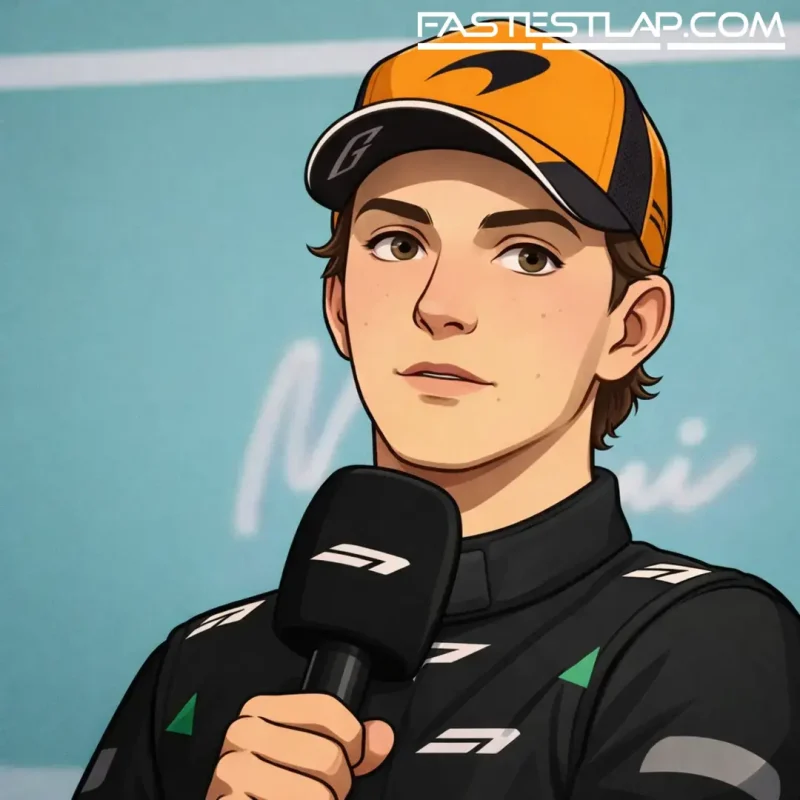
Oscar Piastri isn’t campaigning for drivers to be ignored. He’s making the more uncomfortable point that if you build Formula 1 purely around what drivers want, you risk sanding off the very rough edges that create the spectacle.
With the 2026 rules cycle still being prodded and poked in public more than usual, drivers have found themselves repeatedly invited into the conversation — not just on safety, but on the racing itself. Piastri’s view is that this is where the sport needs to be careful.
“Honestly, probably very little,” he said when asked how much influence drivers should have over regulation changes.
It’s a line that’ll make some fans cheer and some drivers quietly nod, because it speaks to a truth everyone in the paddock understands: a driver’s job is to remove variables. The sport’s job is to create them — within reason.
Piastri drew a firm boundary around where the cockpit perspective should carry real weight. “I think we should be involved to an extent on things like safety, mainly safety,” he said. “But if you give the drivers the best cars, best tyres, the best engines, the best everything, the racing is probably not going to be that entertaining. So, there’s a line somewhere.”
That “line” is the crux of the debate. Drivers will always argue for what makes their lives cleaner: more grip, more consistency, fewer awkward behaviours, fewer compromises. It’s not selfish so much as instinctive. They’re judged, employed, and ultimately rewarded for extracting performance, and performance comes from confidence — which comes from predictability. The problem is that predictability is usually the enemy of compelling racing.
Piastri didn’t pretend drivers don’t have legitimate complaints — he even acknowledged that some have “been very valid, especially this year.” But he was candid about the broader tendency. “From a pure driving, as drivers we’re always going to be complaining about something,” he said.
That’s not a throwaway line; it’s basically the operating system of the modern F1 driver. If the rear’s moving, they want stability. If the front’s sharp, they want it calmer. If the tyres drop off, they want them to last. If the tyres don’t drop off, they complain the race becomes a flat-out procession. The same voices can argue both sides depending on the weekend.
Where Piastri does want drivers listened to is when it comes to the risk envelope: what situations a regulation set might create, and how those situations feel at 300km/h with a helmet on. “Having some level of involvement from us is important, especially on things like safety, because we’re the ones at the end of the day that know the situations the best that we’re going to be in,” he said. “But from an entertainment side of things, I think our input should be considered but not solely taken.”
The key word there is “considered”. Not “followed”.
Piastri’s stance found support in the same press conference from Sergio Perez and Nico Hulkenberg — two drivers who’ve been around long enough to know how rule changes can be sold, mis-sold, and retrofitted.
Perez framed the driver’s role as a feedback loop once the direction is set, rather than a steering wheel on the initial concept. “I think definitely from a safety point of view, we are the ones that are experiencing everything onboard,” he said. “And I think once the rules are set, like they are now, we can give a lot of input into how to make them better, easier.”
There’s a practical subtext in that: drivers can help polish the edges without rewriting the blueprint. They can flag when a seemingly harmless tweak creates a weird racing dynamic, or when a technical philosophy has an unintended consequence in traffic. But if you ask them to help design the whole thing, you’re effectively asking them to vote on what makes their working day simplest — and that rarely aligns with what makes Sunday unpredictable.
Perez also suggested there’s been a healthier collective effort from the grid to engage constructively. “I think we are finding, all the drivers, a really good balance in trying to help our sport and that’s really nice to see amongst all of us,” he said. “So, I think we can really give good input once the rules are set.”
Hulkenberg’s contribution was less philosophical and more cautionary, pointing out that drivers can often “pre-empt what’s coming” with new regulations — not just in terms of lap time, but in how racing situations will unfold.
“Drivers historically haven’t been involved, but often, coming to new regulations, I think we can judge pretty well and pre-empt what’s coming and what kind of situations would be created with that,” he said, adding that the increased dialogue this season “is good and positive.”
It’s an interesting alignment: the younger driver making the most hard-nosed argument for keeping drivers at arm’s length, with two veterans backing the idea that the cockpit view matters most in specific, targeted ways.
Ultimately, Piastri’s point lands because it cuts through the usual PR fog. F1 loves to talk about “listening to the drivers” as if it’s automatically virtuous. Sometimes it is — especially when it’s about safety, visibility, and the kind of close-quarters dynamics that can turn ugly fast. But on the pure product, the drivers are not neutral observers. They are highly motivated participants.
And that’s why the sport can’t simply build the future in their image.