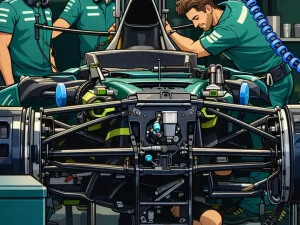
Lewis Hamilton has never been shy about his distrust of simulators, but even by his standards Ferrari’s sim has just been put firmly in the sin bin.
After a British Grand Prix weekend that ended with Charles Leclerc winning at Silverstone and Hamilton salvaging third, the seven-time world champion admitted he won’t be rushing back into Ferrari’s virtual rig — not after watching Leclerc abandon the simulator-led baseline and ultimately converge on Hamilton’s preferred real-world direction.
It’s a telling detail inside a bigger story: Ferrari’s SF-26 may finally have genuine front-running pace, but the team is still wrestling with a familiar modern F1 headache — correlation. And in 2026, with cars, tyres and operational margins all as sensitive as ever, being pointed the wrong way on a Friday can cost you a weekend.
Hamilton had flagged the issue before Silverstone, after a run of results that didn’t build on his first podium in red at the Chinese Grand Prix. Back-to-back sixth places in Japan and Miami were accompanied by a pretty blunt diagnosis: what Ferrari’s simulator was encouraging them to do didn’t translate when the real car hit the track.
“I spend time on the simulator – you know I don’t like simulators in general – but I was at the simulator every week on the build-up to this race, and working on correlation constantly,” Hamilton said in Miami. “You go on it, you prepare for the track, you drive it, and you get the car set up to a certain place, and then you come to the track, and that set-up doesn’t work.”
At some point, you either keep chasing the data or you stop and lean into experience. Hamilton chose the latter. From Barcelona onwards — where he took his first Ferrari win — he and his engineers effectively pivoted away from the simulator as the primary compass and instead interrogated what Hamilton was feeling from the car, the tyres and the balance window. Silverstone, of all places, was the ideal stress test for that approach, and Ferrari had a handy reference point: Hamilton is a nine-time British Grand Prix winner, and he knows exactly what a car needs to do through those sequences where confidence is everything.
Leclerc’s side of the garage, however, started the weekend in a more conventional place: working on the simulator to establish a baseline. The early signal from that work nudged Ferrari towards a different set-up direction — one Hamilton and his engineers decided not to follow. As the weekend unfolded, Leclerc migrated across.
Hamilton described it with the kind of calm satisfaction drivers reserve for moments when they’ve won an internal debate without ever raising their voice.
“Coming into this weekend, the simulator said that we should start in a much different place with the set-up, and my engineers and I decided to stay within the direction that we would normally go,” he said at Silverstone. “Charles started the way it was, that the sim would say to go, and then ended up my philosophy.
“The direction that I was taking was ultimately the right one, and he migrated that way.”
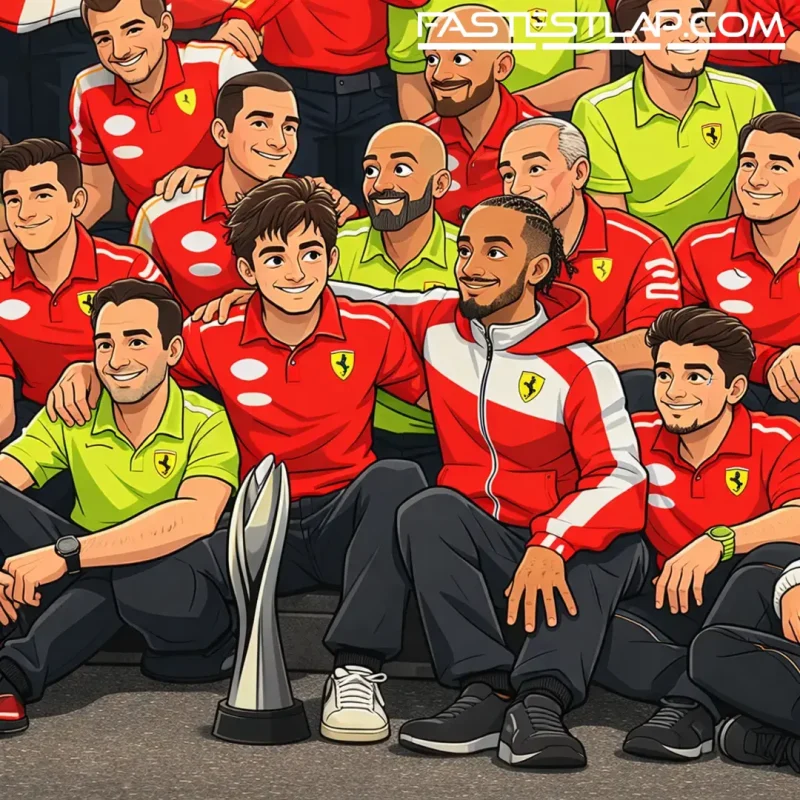
The irony, of course, is that Leclerc is the one who turned that direction into the biggest prize. The Monegasque took victory ahead of George Russell, while Hamilton’s race was dented late when a pit stop behind the Safety Car at the end cost him track position and dropped him to third. In a race defined by fine margins, Ferrari had both drivers on the right page — just not in the order you might’ve expected after Friday.
For Hamilton, the result was less about what might have been and more about what it confirmed. Ferrari didn’t just have pace; it had a workable philosophy. And perhaps more importantly, Hamilton’s influence is beginning to show up not only in lap time but in where the team is choosing to place its trust.
“It’s good to see that direction that I have pushed for is paying off and that we’ve just got to continue to make changes and continue to push,” he added. “We’ve got to continue to bring upgrades.”
Silverstone’s 1-3 marked Ferrari’s first double podium of the 2026 season — a milestone that matters, not simply for optics but because it underlines that this wasn’t a one-off spike. Hamilton remains third in the drivers’ standings, but his deficit to championship leader Kimi Antonelli shrank to 32 points after the Mercedes driver failed to score. In the constructors’ battle, Ferrari is now only 78 points behind Mercedes, and the tone around the team has shifted from “promising” to “properly in it”.
Hamilton also made clear Ferrari didn’t even arrive expecting to be this competitive on a circuit like Silverstone.
“It’s amazing to see the pace that we’ve had this weekend at this sort of circuit,” he said. “We definitely didn’t anticipate it. So just phenomenal to be strong weekend as a team and come away with really good points is really, really special.”
There’s a wider subtext here too. If the simulator is still leading them astray, Ferrari’s performance ceiling might be higher than they’re currently able to access consistently — which is both exciting and slightly alarming, depending on whether you’re wearing red. The front end of this season has shown how quickly the order can tighten and how unforgiving it is when you miss a set-up window. Fix the correlation, and Ferrari’s upgrades become a weapon rather than a gamble.
For now, though, Ferrari will take the uncomfortable truth: at Silverstone, their most valuable piece of technology might not have been a state-of-the-art simulator at all. It might’ve been a 41-year-old driver insisting he knew better — and being proved right, even as his team-mate took the trophy.