
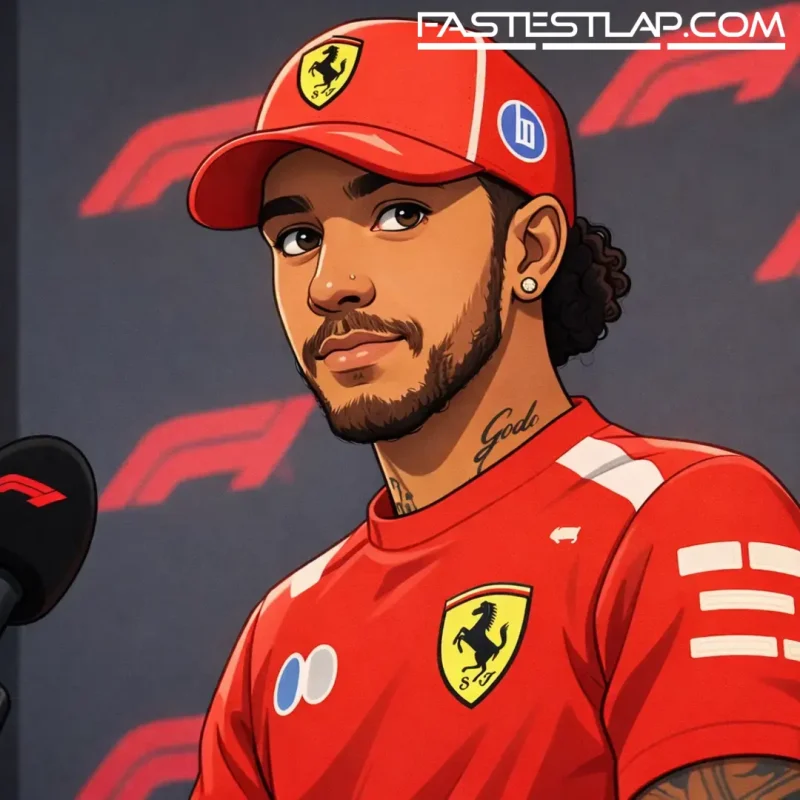
Oliver Bearman’s done the hard part: he’s made himself look like a proper F1 driver rather than a promising name on a spreadsheet.
The awkward part comes next, because in 2026 the driver market is being shaped less by obvious vacancies and more by timing — and Bearman’s timing is tied, whether he likes it or not, to Lewis Hamilton’s appetite for carrying on at Ferrari.
That’s why Karun Chandhok’s advice is so blunt. If Red Bull’s interest ever turns from paddock noise into an actual offer, Chandhok thinks Bearman has to do the grown-up thing and walk straight into Hamilton’s orbit for clarity. Not to lobby for a seat, not to play politics — just to understand the horizon.
Red Bull “keeping very close tabs” on Bearman was the line floated by Sky F1’s David Croft during the British Grand Prix weekend. In a normal season, you’d file that under mid-year chatter. But nothing about this year feels normal in the top teams’ driver calculus. Red Bull’s longer-term picture is being talked about constantly, with speculation continuing around Max Verstappen’s future. And Ferrari, for all its momentum, has locked Charles Leclerc into a new long-term deal — which effectively funnels Bearman’s Ferrari pathway into one obvious destination: Hamilton’s seat, whenever it becomes available.
That “whenever” is the entire problem.
On 2025 form, Hamilton winding down didn’t feel like a controversial read. But 2026 has brought a sharp reversal. Hamilton’s run has been strong enough that the retirement conversation has stopped being a forecast and started being a guess. The implication for Bearman is straightforward: if Hamilton decides he’s enjoying this too much to step away soon, Bearman could spend his prime years being the heir apparent without an inheritance date.
Bearman, speaking at Spa, did what young drivers are trained to do in these moments — keep it respectful, keep it calm, don’t burn any bridges you might need later. Red Bull links, he said, were “quite flattering”, especially given the team’s success, but he framed it as rumours and insisted he’s fully focused on Haas.
That’s sensible public posture. Privately, though, it’s hard to believe any driver in Bearman’s position isn’t mapping out the consequences.
Chandhok’s point is that Bearman is now at an actual crossroads rather than the comfortable illusion of one. If a Red Bull Racing seat opens up, you don’t get to shrug and call it noise — you have to sit down with your management and treat it as a real fork in the road.
And the fork is messy.
Stay on the Ferrari track and you’re in familiar territory: you’re backed, you’re known, and — as Chandhok put it — “loved”. Ferrari’s environment isn’t always forgiving, but it is at least a world Bearman understands. The price is patience, and patience is only a virtue until it becomes inertia.
Take Red Bull, and the opportunity is immediate and high-profile, but so is the risk. It’s not simply a question of whether Red Bull is a faster route to wins; it’s a question of what it does to a driver’s development and reputation to be thrown into that ecosystem with whatever the 2026 pecking order ends up being internally. Chandhok rattled off the obvious unknowns: would Bearman be pitched against Verstappen? Isack Hadjar? A different configuration entirely? Nobody outside the inner circles can answer that, which is precisely why the decision could define Bearman’s career shape rather than just his next contract.
There’s also the subtle career psychology at play. Being “the next Ferrari driver” is a flattering label, but it can become a waiting room if the timeline drifts. Conversely, arriving at Red Bull as the new guy carries its own hazards: the scrutiny is brutal, the bar is immediate, and history suggests the team’s second seat can be the quickest way to become a headline for the wrong reasons.
So Chandhok’s proposed solution is almost disarmingly simple: remove one unknown. Ask Hamilton.
It was delivered with a laugh at first — the kind pundits use when they know they’re straying into what drivers don’t usually say out loud — but Chandhok quickly turned serious. His argument is that Hamilton’s intentions have “a big knock-on effect” on Bearman’s career progression, because Bearman’s “natural career trajectory” is currently built around the day Hamilton stops.
Hamilton, of course, doesn’t owe anyone a retirement schedule. And Ferrari won’t want its internal dynamics turned into a public countdown clock. But the sport runs on informal conversations as much as official announcements, and there’s nothing outrageous about a younger driver wanting to understand whether “not in the immediate future” means a year, two years, or long enough to force a change of plan.
Bearman’s biggest challenge now isn’t proving he’s good enough — he’s already building that case — it’s choosing which kind of risk he can live with.
The safe play is to keep delivering at Haas, keep Ferrari convinced he’s the right successor, and hope Hamilton’s second act doesn’t stretch too far into the future. The ambitious play is to treat Red Bull interest as a potential fast lane and accept all the volatility that comes with it.
Either way, the next few months will tell us a lot about how Bearman sees himself: as Ferrari’s next long-term bet, or as a driver willing to take the first top-team door that opens — even if it leads straight into the sport’s most unforgiving spotlight.









