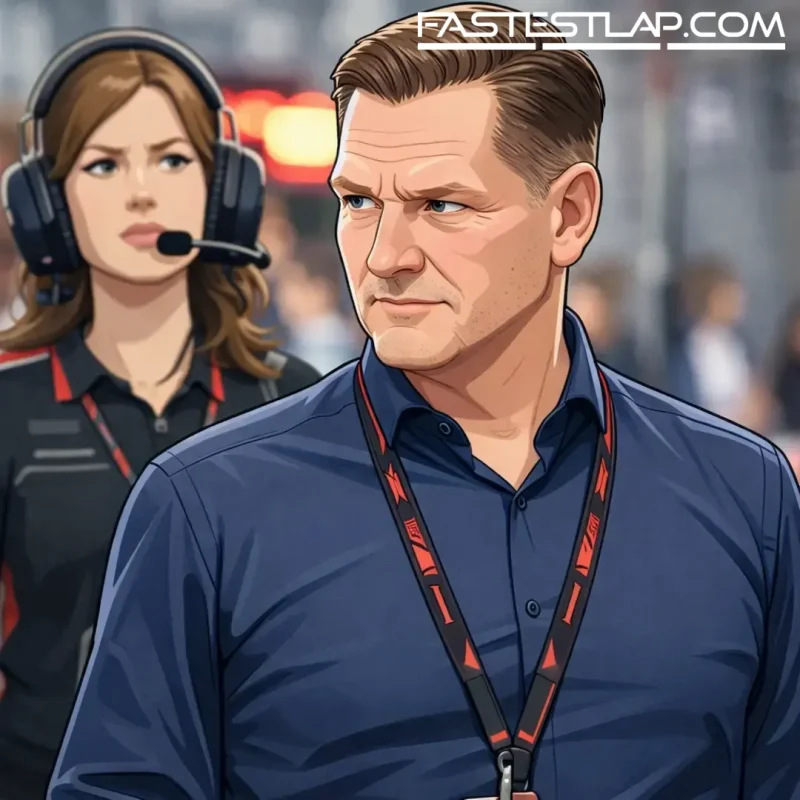
Jos Verstappen has never been one to sit quietly in the background when it comes to his son’s career or the direction of Formula 1, but even by his standards this one lands with a thud: he says he sometimes turns the television off during races because 2026-spec F1 simply doesn’t hold his attention.
It’s a blunt, slightly bruising assessment of a category that has spent the past year selling its new era as a technological leap forward. And it’s also a neat snapshot of the Verstappen household mood right now — with Max still openly irritated by the new regulations and Jos now effectively saying the show isn’t worth watching in full.
Speaking to RaceXpress, the former F1 driver (106 starts between 1994 and 2003) contrasted what he sees as a fading top tier with the kind of racing F1 once looked down on.
“It’s madness to say that GT3 is a better race than Formula 1. It used to be the other way round,” Jos said. “All those GT3 lads were desperate to get a taste of what it’s like in Formula 1, but these days that’s hard to come by.
“As a driver, I find it [2026-spec F1] less enjoyable too. Every now and then I’m watching and I switch the TV off because I’m less interested. It’s not the Formula 1 that Formula 1 stands for.”
Underneath the nostalgia is a specific complaint that’s become increasingly common among drivers and ex-drivers: that the current cars and the way they must be driven under the 2026 rules has narrowed the space for individuality.
“The driver has to rely heavily on the car and can no longer make a difference as a driver. I think that’s a shame in Formula 1,” Jos continued. “Look, you have to brake late, but you can’t brake too late either.
“Yet in fast corners you really need to be able to make a difference, like in the first sector in Japan. You just can’t do that with this car and certainly not with that battery that you have to keep recharging.”
That last line taps directly into Max Verstappen’s own central frustration: the feeling that energy management has become too dominant — not an interesting layer to performance, but the performance. During pre-season testing in Bahrain back in February, Verstappen memorably described the new-look category as “Formula E on steroids”, a line that stuck because it didn’t sound like a throwaway gag. It sounded like a driver realising he didn’t recognise his own sport.
The four-time world champion has kept pressing the point in public. At last month’s Japanese Grand Prix, he warned that his unhappiness could ultimately drive him away from F1 altogether. Verstappen has never hidden his ambition to race elsewhere, and he underlined that again last weekend with another trip to the Nordschleife as he builds towards his Nürburgring 24 Hours debut in May.
In other words: he’s not merely talking about other categories as a hypothetical future. He’s actively walking in that direction in his spare time.
Against that backdrop, the FIA confirmed a series of changes to the 2026 rules on Monday following a high-level meeting with stakeholders, including Formula One Management and representatives of teams and power unit manufacturers. The tweaks — largely centred on energy management and safety — are set to come into effect from the Miami weekend on May 3.
Whether those adjustments calm Verstappen’s dissatisfaction is another matter. Before the FIA’s announcement, he’d already welcomed the fact that the sport was willing to revisit elements of the package, but framed it as something closer to damage limitation than genuine course correction.
Appearing on stage at an event organised by Viaplay last week, Verstappen said: “The fact that we’re talking [about changes to the rules] is already a step forward. The problem is simply that you can tweak these regulations a bit, but fundamentally something is wrong.
“Not everyone will admit that publicly, but it’s true.”
That’s the line the paddock keeps circling back to: are the new rules merely in need of calibration, or has F1 set itself down a path that inevitably produces the kind of racing and driving experience the Verstappens are now deriding?
Max has also tried to steady the more dramatic interpretations of his comments. Despite being officially under contract with Red Bull until the end of 2028, he played down the idea that he might disappear at the end of this season. But even that reassurance came with a sting: he’s talking like someone planning an exit, not someone settling in.
“I’m just trying to adapt to it,” he said. “Even though I’ll be retiring in a few years’ time, I do want it to remain a decent sport. Something has to change. In that case, I would choose to have the V10 or V8 engines brought back.”
That’s not a realistic roadmap for 2026’s immediate problems, but it’s revealing nonetheless. When Verstappen talks about “a decent sport”, he isn’t talking about marketing optics or sustainability slogans. He’s talking about what the cars demand from the driver, and what the racing gives back in return.
Jos switching the TV off might sound like a cheap shot, but it’s also an uncomfortable warning sign. F1 can survive a star driver complaining — it always has. What it can’t afford, in an era built on constant engagement, is the sense that even the people closest to its biggest names are simply bored.
Miami will be the first real test of whether the FIA’s quick-fire revisions change the feel of 2026 in any meaningful way. For the moment, the Verstappens aren’t waiting around for the verdict. They’ve already made up their minds about what this version of Formula 1 is — and, crucially, what it isn’t.