Max Verstappen doesn’t need reminding that Formula 1 has never been a risk-free business. But after a grim couple of weeks in the wider Verstappen orbit, the four-time world champion has been blunt about what the sport can — and can’t — engineer out of existence.
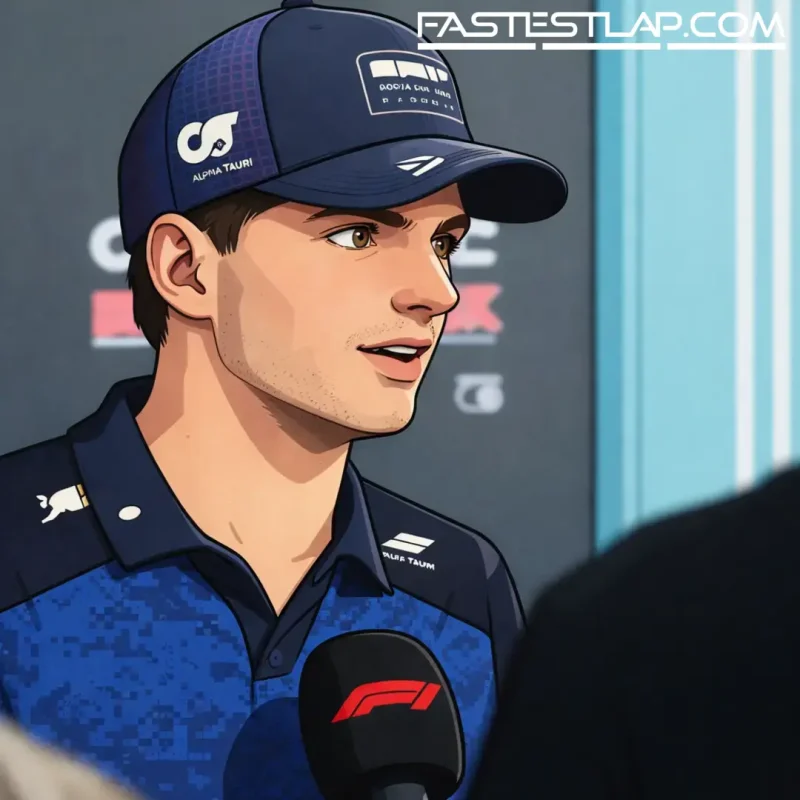
Speaking in Miami, Verstappen cut through the usual platitudes about progress and protection with a simple point: you can build the safest car in the world, but motorsport will always have the capacity to bite.
“Honestly, it doesn’t really matter, because you can just hit something in the wrong angle, and it doesn’t matter how safe cars are,” Verstappen said. “There’s always bad luck sometimes involved.”
The timing of the comments wasn’t abstract. Verstappen was among the competitors at the Nürburgring when Juha Miettinen was killed, a stark reminder that danger isn’t confined to grainy archive footage or eras we like to tell ourselves were uniquely reckless. And last week, his father Jos was involved in a heavy rally crash — another jolt that the margins in any form of racing are thin, no matter how modern the kit looks on paper.
There’s a clear thread in Verstappen’s reasoning, and it’s less about cars and more about randomness. He reached for everyday comparisons — not to trivialise what happens at 300km/h, but to underline how quickly control can disappear.
“I mean, I can go back home to the hotel tonight, I take a shower, but if it’s slippery, I can slip and break my neck,” he said. “There’s always danger in a lot of things that you do.
“I still think that taking a bicycle around Amsterdam can be very tricky as well, getting hit by a bus. Yes, racing is still dangerous, just sometimes you get unlucky. That’s just how racing is. It’s very unfortunate.”
It’s an unromantic way to frame a topic F1 often prefers to package as a victory lap. The sport has, objectively, come a long way — and Verstappen is a product of an era where the worst outcomes have become rarer. He made his F1 debut in 2015, one year after Jules Bianchi’s fatal crash in Japan, and the championship has largely avoided tragedy since.
The most vivid modern reminder of how quickly it can all go wrong remains Romain Grosjean’s Bahrain Grand Prix accident in 2020, when his car speared through the barriers and burst into flames. Grosjean’s escape was rightly celebrated as proof of how far the structures, materials and procedures have evolved, with the halo — introduced in 2018 — a major factor in preventing the crash becoming even worse.
The halo’s value has been reinforced since, notably in Guanyu Zhou’s British Grand Prix crash in 2022. Verstappen himself has had his share of heavy moments too: the high-speed Silverstone impact after contact with Lewis Hamilton in 2021, and then Monza weeks later, when his Red Bull ended up perched on top of Hamilton’s Mercedes — and on the halo that protected it.
Yet Verstappen’s message in Miami wasn’t to dismiss safety work. It was to challenge the comforting idea that safety is a destination. In his view, it’s a moving target, and sometimes the outcome comes down to geometry and fortune more than design intent.
That’s an uncomfortable truth for a sport heading into 2026 with a major rules reset, including changes that will inevitably be sold — in part — through the lens of safety and responsibility. Engineers can shape survival cells, manage impacts, reduce fire risk, improve barriers and medical response, and keep chipping away at exposure. What they can’t do is legislate for every “wrong angle” moment Verstappen is talking about.
It’s also an argument that cuts against the modern tendency to treat danger as an embarrassment F1 should apologise for, rather than an intrinsic cost of doing something extraordinary. There’s a line often attributed to Ernest Hemingway — quoted again in the paddock this week — that there are only three sports: bullfighting, motor racing and mountaineering, and everything else is merely a game. Whether you buy the romance of it or not, Verstappen’s position is essentially the same, just stripped of the poetry.
F1 can make itself better. It has. It must keep doing so. But Verstappen, speaking as someone who’s lived in racing’s bubble since childhood and seen how quickly it can be punctured, isn’t interested in pretending risk can be engineered out completely.
He’s not wrong. And the fact he felt the need to say it out loud — in 2026, in the middle of a championship that routinely celebrates its tech as if it’s invincible — tells you plenty about how close the sport still sits to the edge, even when it’s doing everything it can to stay away from it.