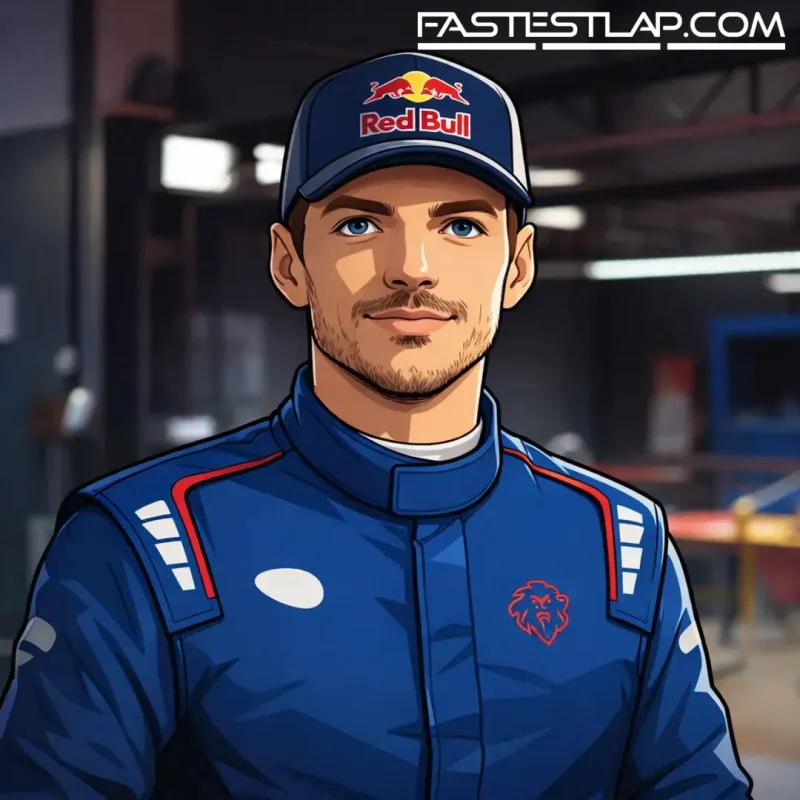
Max Verstappen disappeared off the F1 radar for a moment and reappeared in the last place you’d expect a reigning Grand Prix yardstick to go for a “quiet” weekend: the Nürburgring 24 Hours, in a Mercedes-AMG GT3, running under his own Verstappen Racing banner.
The result was a familiar Verstappen cocktail — speed that didn’t need warming up, a few moments that made seasoned GT hands sit up, and the sort of cruel mechanical punchline endurance racing tends to deliver when you start believing the fairy tale. Somewhere in the middle of it all, his Winward-run team-mates also landed on a nickname for him: “Maxipedia”.
It wasn’t because he turned up and tried to run the show. Quite the opposite, if you listen to the drivers who shared the car. Jules Gounon, Lucas Auer and Dani Juncadella are not short of mileage or confidence, yet they came away sounding mildly stunned at how quickly Verstappen looked like he belonged.
And that’s the bit that’s easy to underestimate. Yes, he’s a four-time F1 world champion and the current grid’s most complete racer. But the Nürburgring 24 is a different kind of exam: traffic that never ends, a track that punishes tiny errors with big consequences, and long stints where you’re managing the car, your tyres, your brakes, your concentration — and the clock. Verstappen didn’t just dip a toe in; he took the calendar gap and went straight into his first 24-hour race at the Nordschleife.
On track, the headlines wrote themselves. The #3 Mercedes was among the front-runners all weekend, and as the race thinned out through the usual blend of incidents and mistakes, it became a fight between two cars from the same stable: Verstappen’s entry versus the sister #80.
Verstappen’s early stints were pivotal in turning promise into position. Two hours in he went around the outside of the #47 Mercedes, and later produced a double pass down the Döttinger Höhe — two cars dispatched within two corners — to put the #3 into the lead. It was the sort of assertiveness you’d expect from him in a Grand Prix, but it looked even more striking in the compressed chaos of GT3 traffic, where the closing speeds and judgement calls come at you differently.
Then came the night-time running, the part of the race where reputations are usually protected rather than risked. Verstappen didn’t drive like a visitor. He went at it with Maro Engel — a specialist, and the current DTM points leader — and their duel featured a door-banging moment that left Engel in the grass. It was feisty, but it also underlined what those around Verstappen keep coming back to: he reads racing quickly, regardless of the machinery, the format, or the setting.
So why “Maxipedia”? Because, as Gounon tells it, Verstappen isn’t just quick — he’s obsessively fluent in motorsport.
“Max is a big motorsport fan,” Gounon said. “When you speak with him about different stuff with Dani, we always have a joke, we call him Maxipedia, because he knows everything about motorsport.
“For me, it’s amazing that he puts himself out there. I think it’s going outside your comfort zone… to come to the craziest race that you can do in endurance, to go out there for your first time, it’s something I have a huge respect for.
“In the end, he came in, and he was straight [on pace] with us.”
That preparation didn’t happen by accident. Verstappen didn’t try to shortcut the entry requirements either, earning his DMSB permit through the proper route via a qualifying race in late 2025. It’s a small detail, but it speaks to the way he seems to treat racing outside F1: not as a brand exercise, but as something you do properly, with the same respect you’d give the job that pays your bills.
Juncadella went a step further, suggesting most current F1 drivers wouldn’t even want the hassle — or the risk — of tackling a race like this.
“I think not many other F1 drivers would have the will, the drive to come and race here,” he said. “He’s been very passionate about this race for many years. He’s followed the race, he’s been watching, he’s been doing it online, and that’s why he’s also very well prepared for that.”
There was also the circus factor. Sharing a car with Verstappen means the cameras, the attention, the extra questions, and the sense that every lap will be clipped and analysed. GT drivers aren’t strangers to pressure, but it’s not normally *that* kind of pressure.
“Especially in the first days… it can be a bit overwhelming, and you can feel the pressure,” Juncadella admitted. “But, after that, you get used to it, he’s such a nice guy and we share a lot of stuff as friends together.”
That theme — approachability rather than ego — kept coming back. Juncadella described Verstappen as having a “non-ego approach” in the GT3 environment, something you don’t always associate with a driver who’s been the gravitational centre of modern F1.
And then endurance racing did what it does. Around the 21-hour mark, Verstappen handed over with a 28-second lead. On the outlap, Juncadella hit an ABS issue, which spiralled into a driveshaft failure and subsequent mechanical damage. The lead disappeared to the #80, and the #3’s victory challenge was effectively over. The car returned for the final two laps to confirm the fix and complete a photo finish, but the win was gone.
It’ll be easy for some to file this away as Verstappen “doing a fun race” during an F1 gap. But the more revealing part wasn’t the cameo, or even the pace. It was how completely he immersed himself — learning, feeding back, integrating — and how quickly his team-mates stopped talking about him like an F1 guest star and started talking about him like one of them. In the Nürburgring paddock, that’s a compliment you don’t get for free.