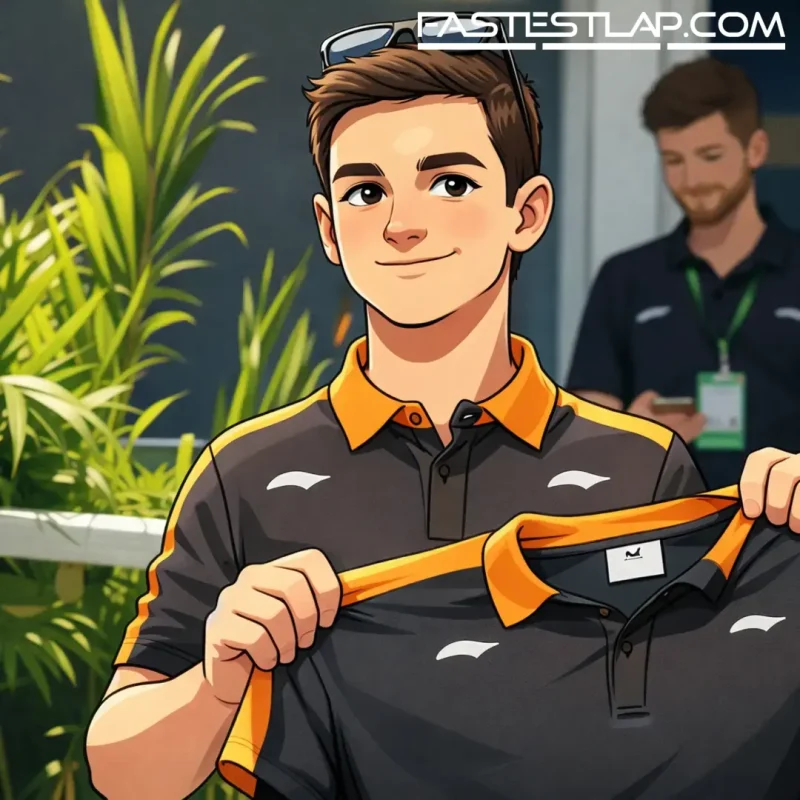
McLaren’s driver pool has never been short of talent, but there’s a particular kind of awkward brilliance sitting in its reserve ranks right now: Leonardo Fornaroli, a back-to-back F3 and F2 champion who did the hardest bit — winning — before he even had an F1 badge on his pass.
In a paddock that loves neat narratives, Fornaroli is the inconvenient one. He’s on the tiny list of drivers who’ve won the Formula 2 title as rookies — alongside Charles Leclerc, George Russell, Oscar Piastri and Gabriel Bortoleto — and yet he’s the only one not currently on the grid. That’s not a minor statistical quirk. It’s the sort of outlier that makes teams look either patient or slow.
James Robinson, who ran Fornaroli at Invicta Racing during that title run, isn’t pretending there’s anything left to “evaluate”. In his view, the Italian has already done enough to justify an F1 seat for 2027, full stop.
“Unquestionably,” Robinson said when asked if Fornaroli belongs on the grid. He pointed to the company Fornaroli keeps on that rookie-champion roll of honour and called him “the anomaly” for not already being in Formula 1.
It’s not hard to see why Fornaroli ended up in this holding pattern. The modern F1 market is clogged: long contracts, teams protecting their own academies, and an increasingly narrow middle class of seats that aren’t either locked down or politically booby-trapped. Even McLaren, which clearly rates him highly enough to bring him in, didn’t have a vacancy for 2026 — and reserve duty is what happens when timing, not talent, is the limiter.
Robinson’s argument is less about raw speed — though you don’t fluke an F2 rookie title — and more about the sort of relentlessness teams claim they want and then sometimes ignore when the silly season starts.
He described Fornaroli as the most complete “under pressure” operator he’s worked with, and offered a very team-boss metric for it: the internal checklist. At the end of the season, Invicta went through its usual list of expectations. Fornaroli, Robinson said, ticked every box — a first for the team.
The detail that stands out is the consistency. Robinson said Fornaroli qualified in the top 10 at every race across the campaign, a level of repeatability that matters in F2 more than people like to admit. The category is chaotic by design; the driver who can keep their weekends clean and bank points when the track doesn’t suit them is usually the one who ends up with the trophy.
Even at Silverstone — cited as one of the tougher rounds for him — Robinson pointed to the way Fornaroli still engineered a productive weekend: reverse-grid pole, sprint win, and then damage-limitation points in the feature race. The championship, Robinson stressed, was wrapped up early, with two races remaining. That’s domination without the optics of domination, the kind that doesn’t always make highlight reels but does make engineers exhale.
There’s an obvious parallel Robinson leaned on: Piastri also spent a year on the sidelines after winning F2, a reminder that the ladder doesn’t always lead straight into a race seat. But the subtext here is sharper — F1 teams are happy to talk about meritocracy right up until the moment it threatens to complicate their existing plans.
For Fornaroli, the frustration is amplified by how he got here. He wasn’t attached to an F1 team when he won the F2 title. No big-brand junior programme shepherding him, no obvious political runway, just results arriving faster than the market could rearrange itself. McLaren moved once it became impossible not to, but a reserve role is still a holding pen.
Robinson’s “hidden gem” label isn’t just flattery; it’s a clue to how late the wider system caught on. In a sport obsessed with spotting talent early, Fornaroli effectively forced his way into the conversation by making the most expensive junior series look routine.
The Invicta story makes the wider point too. Fornaroli is the team’s second rookie F2 champion in three years, following Bortoleto’s 2024 title. Bortoleto, of course, had the cleaner pathway — signed by Sauber on the back of that championship and now continuing with the team through its Audi transition. Robinson spoke just as glowingly about him, describing a driver with the intelligence and bandwidth to race while thinking beyond the immediate job, and with the personality to pull a team into his orbit.
But the contrast is the interesting bit: two rookie champions, two very different trajectories. Bortoleto landed in the right place at the right time. Fornaroli landed in the right conversation at the wrong time.
Invicta, meanwhile, isn’t slowing down. In 2026 it has Ferrari-backed F3 champion Rafael Camara alongside Joshua Durksen in its F2 line-up. Camara sits third in the standings after Miami, just a point off leader Nikola Tsolov — another reminder that while F1 seats are finite, the conveyor belt isn’t.
For Fornaroli, that’s both pressure and opportunity. Every new name coming through is another excuse for an F1 team to convince itself it can wait. But rookie F2 titles don’t come around often, and the list of drivers who’ve done it reads like a promise. If McLaren — or anyone else — is serious about performance first, it’s getting hard to justify why the anomaly should remain an anomaly into 2027.