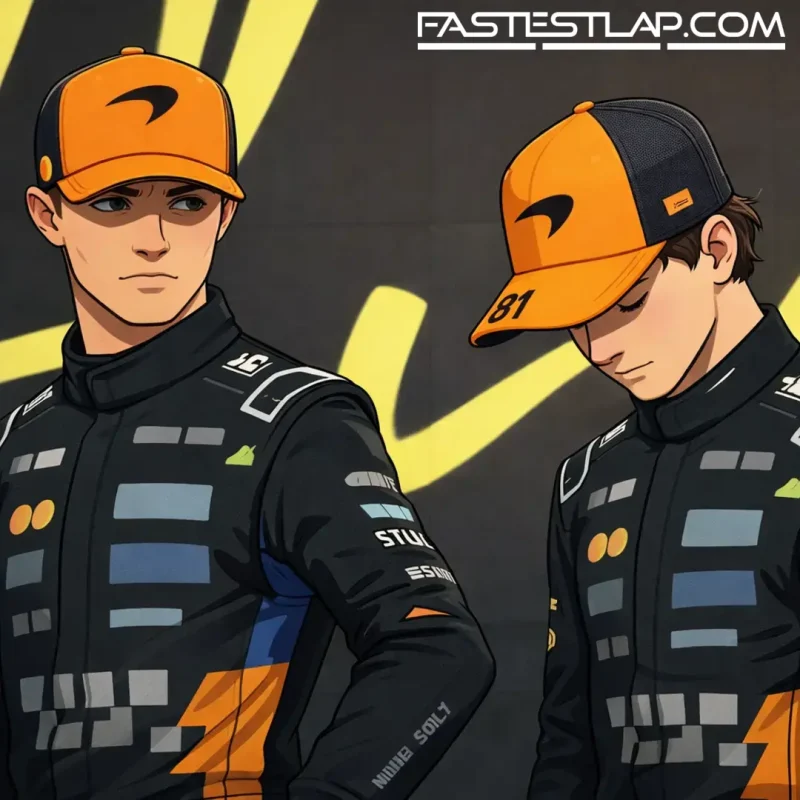
Oscar Piastri has never sounded particularly interested in selling a rivalry, but he’s been candid about what kept McLaren’s all-smiles title fight from curdling last season: self-preservation.
In an era that’s seen championship-winning teams eat themselves from the inside out, McLaren somehow got through a two-car scrap for the biggest prize without the usual collateral damage. There were flashpoints — and not minor ones — yet the relationship between Piastri and Lando Norris stayed notably intact. According to Piastri, that wasn’t just down to good manners or a well-run garage. It was because both drivers understood that if the situation turned poisonous, the consequences could be immediate and brutal.
Had it “really got bad”, Piastri suggested, the conversation could’ve shifted from who gets priority in a strategy call to whether one of them would even be “sat here doing this interview wearing orange” in 2026.
That line lands because everyone in the paddock knows how quickly harmony becomes an organisational priority once performance is on the line — and how often teams decide the easiest fix is to remove the source of tension, even when both drivers are fast enough to win.
Last season’s McLaren dynamic had all the ingredients for something uglier. Norris started the year looking like the lead act, then Piastri seized momentum in Saudi Arabia and it suddenly felt like a straight fight between two drivers in the same car, neither of them a clear number two and neither inclined to accept being managed. The Italian Grand Prix brought one of those moments that would’ve become a season-long grievance in another team: Piastri was asked to hand second place to Norris after a slow stop flipped their order.
Piastri pushed back on the radio — the kind of pushback that can either fizzle out or become a reference point for every argument that follows. In his telling, it fizzled. He finished behind Norris, made his point, and then moved on.
The season’s more physical incidents had even more potential to sour things. Norris and Piastri came together at the start in Singapore; later, in the United States sprint, Piastri ran into Norris and crashed him out. Both times there was heat in the moment, but the post-race temperature dropped quickly. No cold wars, no loaded media lines, no lingering refusal to play the team game.
Even when the pendulum swung again — Mexico being the weekend where fans started loudly accusing McLaren of leaning toward Norris — the drivers kept any frustration from becoming a public tug-of-war. That, more than any polished PR line, is what protected the team: not the absence of disagreement, but the absence of escalation.
Speaking on the High Performance podcast, Piastri framed it as a relationship that actually improved as the year went on. The more time they spent around each other, the less energy was wasted reading intent into every call.
“We get asked about our relationship as team-mates quite a lot,” he said, adding that it was “better at the back end of last year” than earlier, simply because they knew each other better. And crucially, they both understood the equation: two drivers, one title.
What’s revealing is the second part of his explanation — that both sides of the garage continued to share information even when the championship pressure was at its highest. That’s where most intra-team battles quietly turn. Set-up tricks get guarded, data gets selectively interpreted, engineers start speaking in shorter sentences, and suddenly you’re not fighting the opposition so much as the other half of your own operation.
Piastri’s view is pragmatic to the point of being blunt: you can’t really hide anything anymore, and trying to only hurts you later.
“You know if you’re in that position where someone else has done something and you go, I need to work out how to do that, you want as many tools at your disposal as you can get,” he said. There might be “little moments” where a driver thinks about keeping something back, but once you go down that road, “eventually it’ll bite you”.
It’s also hard not to read that as a comment on the wider context of 2026. This season hasn’t started how McLaren wanted — Piastri admitted as much — and when a team is already dealing with early setbacks, the last thing it can afford is an internal split that drains focus and slows development. A fragile car doesn’t need a fragile garage to match.
There’s a quiet edge to Piastri’s comments, too. Beneath the calm delivery is an acknowledgement that driver security is never as solid as it looks. The sport loves to mythologise team-mate battles as inevitable, even healthy — the idea that champions are forged through internal conflict. But teams don’t pay their drivers to create folklore. They pay them to score points, win races, and not torch the infrastructure that makes those results possible.
McLaren got through last year without the scars you’d expect. Whether that remains possible as the pressure builds again — and as 2026 keeps refusing to unfold neatly for them — is the more interesting test. The real trick isn’t being amicable when the car is dominant and the smiles are easy. It’s keeping it together when something starts to slip, and when the temptation to protect yourself starts to look like the only logical move.