Adrian Newey doesn’t do public therapy sessions. So when Aston Martin’s team boss sits down with the team’s own channels and starts describing 2026 as “painful”, you don’t file it under harmless candour. You read it as a message — partly inward, to steady a wobbling organisation, and partly outward, because Newey rarely wastes words unless he thinks the next part of the story is about to change.
Aston Martin’s season has been grim from the moment the AMR26 first ran in anger. Reliability has been fickle, the car’s manners have been worse, and the usual rhythm of trimming problems away with weekly upgrades never arrived. Instead, the team has taken the sort of decision that looks reckless when you’re sliding backwards: stop patching, stop chasing with small steps, and bank everything on one big swing.
“It was a painful decision,” Newey admitted, explaining why Aston Martin effectively froze its normal development cadence. While rivals kept adding performance, Aston Martin — in his words — was “standing still in relative terms”, a brutal way of describing the slow-motion demoralisation that comes from turning up each weekend knowing the field has moved on again.
It’s left them in a place that would’ve sounded unthinkable in the winter: being outpaced, at times, by newcomer Cadillac. At Alonso’s home race in Spain, the performance was so poor that Mike Krack felt compelled to apologise to the fans afterwards. Lance Stroll has spent months doing his best to say as little as possible, and even Alonso — far more restrained these days than the younger version of himself — has allowed the occasional flash of irritation to slip through.
All of that is context for the real point of Newey’s interview: Aston Martin’s long-delayed upgrade package is finally coming, and it’s coming at the Hungarian Grand Prix, on both cars, just before the summer shutdown. Newey framed it as an “investment” — not simply a bundle of new parts, but the product of a broader reset that has been happening out of public view.
The implications are bigger than a single race weekend because the upgrade has become entwined with Alonso’s own horizon. Newey didn’t dance around it. He effectively acknowledged that the package is central to whether Aston Martin can keep Alonso motivated — and whether Alonso even wants to keep going.
“Fernando is really looking forward to the upgrade and, if it performs, we hope he’ll be in the cockpit for another season,” Newey said. It wasn’t dressed up as a long-term vision statement. It was delivered like a hard, practical reality: show progress, keep an all-time great engaged; fail to do so, and risk losing the driver who best compensates for an unruly car and best directs a team trying to climb out of a hole.
Newey’s willingness to speak so plainly is also coloured by his earlier comments at the season-opening weekend in Australia, when he first let on how deep the problems ran. He’s largely kept his head down since, mentioning that illness over the last year has forced a better work-life balance. Which is why this sudden openness lands differently. It doesn’t read like spin. It reads like the preface to a reveal.
Part of that is because Newey has taken responsibility for how Aston Martin got here. He described the aerodynamic direction as “bold”, and admitted it was largely pushed by him, taken without the “luxury of exploring multiple concepts in depth due to timing”. Those are the sorts of words engineers use when they’re owning a call that hasn’t worked — at least not yet.
But the more revealing section wasn’t about aero philosophy. It was about infrastructure and systems: the boring, unglamorous plumbing that dictates whether an F1 team can execute quickly and repeatedly under pressure. Newey said Aston Martin had been relying on tools and processes “patched and bodged for years”, in some cases traceable back to the site’s Jordan-era lineage.
The consequences weren’t abstract. Newey described a “frustrating car build”, parts not being ordered at the right time, and people effectively being set up to fail by the system around them. That’s not a rear-wing problem — that’s an organisation problem.
So Aston Martin has been dragging more work in-house: gearbox casing, floor patterns, floors themselves, and a growing list of components that had previously been outsourced. Newey’s argument is familiar to anyone who’s watched top teams operate: cost control matters, but control of your own destiny matters more. Quality, responsiveness, and a tighter feedback loop — those are the currencies that decide whether a mid-season fix actually arrives when it should, and whether a development plan is real or just PowerPoint.
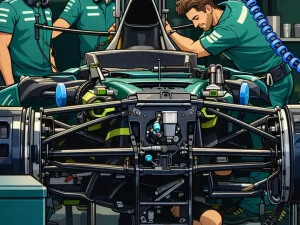
As for the on-track promise, Newey is careful. He says the team is “predicting a large step” but won’t attach numbers until the car runs. What we do know is that the scale of the change is significant: the chassis has been re-homologated and crash-tested again, pointing to something more fundamental than a tweak package. The updated AMR26 is also expected to address weight, with Newey suggesting the car should come down “near the limit” of 768kg. A new nose, refined aero surfaces and revised rear suspension are part of it too.
It’s also notable that Newey is talking about simulation tools — not as a future aspiration, but as an active rebuild. He said Aston Martin historically hadn’t invested enough in engineering simulation and “core physics tools”, and while that investment is now going in, he’s blunt about the timeline: you don’t rewrite and validate those tools overnight, and correlation takes time. In other words: Hungary is meant to be a step, not the finish line.
There’s an old Newey precedent that hangs over this moment, whether he mentions it or not. He’s lived through a high-profile design failure before, and he’s also lived through what can come after one if the underlying direction is right and the operation is capable of extracting it. That history doesn’t guarantee anything in 2026 — different regulations, different people, different competitive landscape — but it explains why the paddock doesn’t dismiss him when he says a difficult period can be turned into an inflection point.
The risk for Aston Martin is obvious: if Hungary arrives and the package doesn’t move the needle, the “investment” argument quickly turns into a story about a team that lost half a season waiting for a miracle. And if Alonso looks at the data and sees the same old problems wearing new bodywork, the consequences won’t be limited to one driver market decision — it’ll cut right into Aston Martin’s credibility during a year they’re supposed to be building momentum.
But Newey isn’t the type to go looking for headlines for morale’s sake. If he’s chosen this moment to put his name, his judgement and his authority behind what’s coming, it suggests Aston Martin believes it’s about to give the grid something it hasn’t had from them all year: a reason to pay attention.