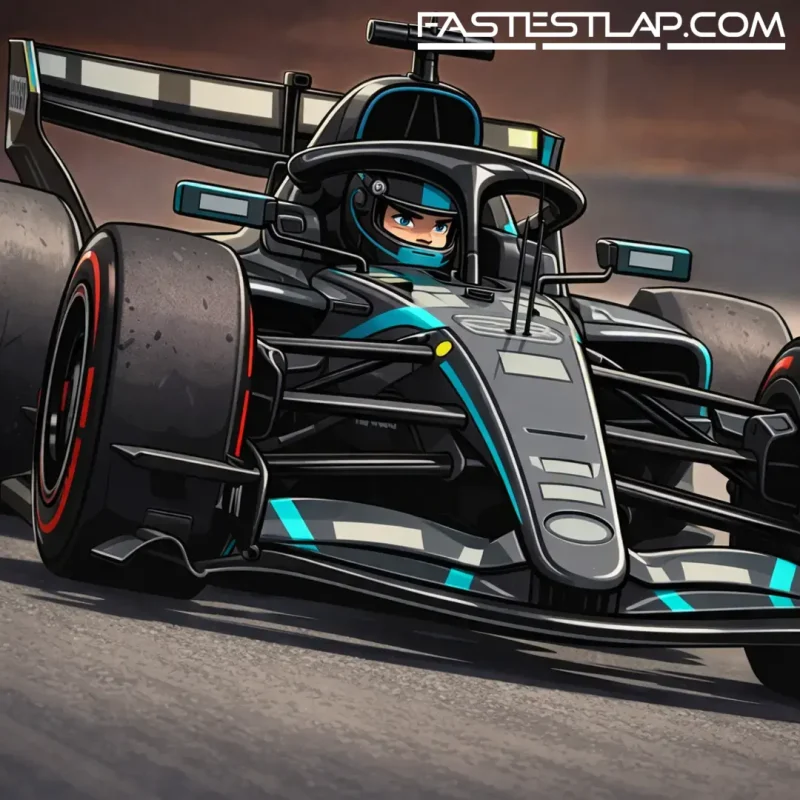
George Russell has made a habit of being at his best when qualifying turns ugly, and Saturday at the Red Bull Ring was a pretty loud reminder. In a session that twisted from one shifting benchmark to the next — and ultimately ended with Max Verstappen in the Turn 9 barriers — Russell kept his head, kept the lap alive, and walked away with Austrian Grand Prix pole for Mercedes.
Behind him, Charles Leclerc and Lewis Hamilton rounded out the top three, but the story of the hour was how quickly the pole fight was ripped away from everyone once Verstappen’s crash triggered yellow flags at exactly the wrong time.
Mercedes arrived in Austria with the kind of questions that only a quick car creates. Kimi Antonelli had looked sharp through practice and had beaten Russell to the top of the times in FP3, yet the final session also hinted that the gap between the two silver cars wasn’t straightforward — Antonelli didn’t improve on his late soft-tyre run, Russell had been searching for a cleaner balance, and the heat made tyre management a central character before qualifying even began.
The opening act in Q1 was messy in its own right. Cadillac’s two cars needed a push from the mechanics to get moving at the pit exit — a small but very visible reminder of the rough edges that can come with a new operation — while the track quickly evolved into the usual Red Bull Ring scramble for clean air and a tow.
Russell initially threw down a 1:07.8, only for the order to churn almost immediately. Norris went quickest, then Antonelli took over with a lap that put him 0.18s clear. Hamilton sat third early doors with Verstappen fourth, and there was enough in those first runs to suggest the front of the field was going to be separated by margins rather than tenths.
Russell, though, wasn’t happy. After the leading group boxed, he went again and could only sit eighth, reporting “four wheel sliding” — not the sort of phrase you want in a qualifying session that punishes the slightest hesitation. The casualties at the end of Q1 were significant: both Aston Martins went out with Fernando Alonso and Lance Stroll, while Williams endured a painful double elimination with Alex Albon and Carlos Sainz also falling at the first hurdle. Cadillac’s day didn’t improve either, as Valtteri Bottas and Sergio Perez joined the list.
Q2 settled into a more recognisable rhythm, if not a calmer one. Norris posted first with a 1:07.321 on used softs. Verstappen nudged ahead by just over a tenth — also on used tyres — and Isack Hadjar briefly insinuated himself near the top. Then the new-soft runners arrived and the times properly dropped.
Leclerc’s 1:07.030 put Ferrari on top, Hamilton was essentially glued to him within a hundredth, and then Antonelli did what he’d been threatening to do all weekend: he cracked into the 1:06s and cleared the Ferrari by a quarter of a second. Oscar Piastri slotted into second, close enough to keep McLaren’s hand in.
Russell’s Q2, meanwhile, nearly unravelled. He went in far too deep at Turn 3 and ended up P16 with no representative lap on the board — a self-inflicted problem on a track where you don’t get many freebies. Over the radio, Toto Wolff cut through the noise with a blunt instruction: “George, just drive.” It wasn’t poetry, but it did the job. Russell responded with a lap good enough for fourth and hauled himself safely into Q3.
Verstappen, for all the pace in the car, only just scraped through — 0.04s the right side of elimination. It was tight enough to raise eyebrows, but there was a sting in the tail for everyone else: it left Verstappen with two sets of new softs for the shootout.
Those who didn’t make it included Franco Colapinto, Esteban Ocon, Nico Hulkenberg, Oliver Bearman, Gabriel Bortoleto and Pierre Gasly.
Q3 began like a straight fight between the usual suspects and the emerging new order. Norris set the first marker at 1:06.900, and Verstappen replied with a hammer blow: 1:06.475, the best lap of the weekend to that point, and the sort of statement that normally ends the conversation.
Antonelli didn’t quite agree. He found just enough — six hundredths — to snatch provisional pole, with Russell sliding into second. The top three were split by 0.061s, the kind of margin that turns every traffic encounter and every micro-mistake into a headline.
Hamilton’s first effort was compromised by running wide at Turn 3, and he was surprised to be told he couldn’t go again on that particular set of softs. Still, Ferrari’s pace was real, and when the final runs began the order flipped again: Hamilton briefly took provisional pole, then Leclerc beat him to it.
And then the whole thing detonated.
Verstappen lost the rear of the Red Bull on exit of Turn 9 and spun hard into the barriers. He climbed out unhurt, but the incident brought out yellow flags that froze the session. In the sudden uncertainty — who was improving, who had backed out, whose lap would stand — Russell was the one who benefited. He’d done enough before the interruption, and with the field unable to complete their last-ditch improvements, that was that: pole position for Mercedes, taken in the most unglamorous way qualifying can deliver it.
For Mercedes, it’s another marker in what’s becoming an intriguing internal story: Antonelli has had genuine one-lap bite all weekend, Russell has shown the resilience and timing that separate front-runners from quick drivers, and Austria has handed them track position at a circuit where clean air and control of the opening stint can shape the whole afternoon.
For Red Bull, the questions are immediate. The pace was clearly there, perhaps the pace to make pole academic, but qualifying doesn’t pay out for “almost” — and a crash at the end of Q3 is the sort of error that changes the entire weekend’s trajectory in an instant.