Qualifying 1 at the Nürburgring 24 Hours barely had time to settle into rhythm before it detonated into one of those bleak, avoidable moments the Nordschleife can serve up when procedure and instinct drift apart.
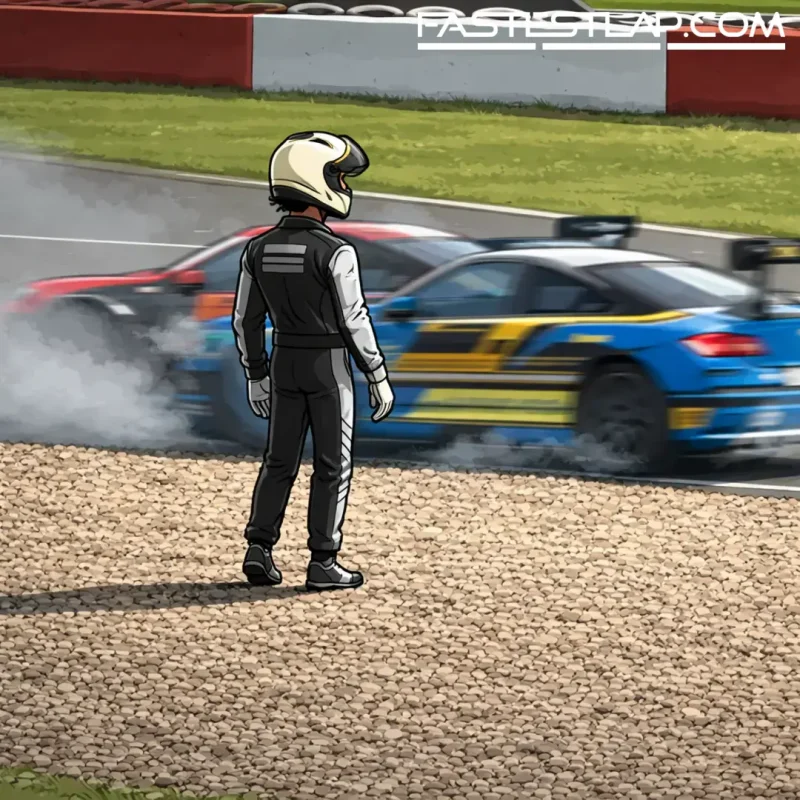
Just 18 minutes into the opening session, the #900 Porsche 911 GT3, driven by Alexander Hardt, slowed and stopped on the Grand Prix loop section at Xiaomi Corner with a fire developing under the car. Hardt pulled to the side and, with his Porsche stationary, stood trackside attempting to warn oncoming traffic.
Seconds later the situation escalated violently: the #146 Porsche, with Janina Schall at the wheel, arrived on the scene and drove straight into the rear of the stricken #900. The impact destroyed the front of Schall’s car and shoved Hardt’s Porsche across the circuit, where it came to rest on the opposite side. Schall’s Porsche ended up in the grass a short distance away.
Both drivers were able to get out unaided, and TV cameras later picked up the pair in conversation, shaken but apparently unhurt. The bigger story now sits with the officials: eight minutes after the crash, race control confirmed the incident will be investigated, and the focus is likely to fall on what happened in the seconds after Hardt stopped.
Nürburgring briefings are explicit on this point for good reason — once you’ve brought a car to a halt in a live session, the priority is getting yourself behind the barriers rather than attempting to act as a human warning flag. It’s a rule born of grim experience, especially at a venue where sightlines are compromised, closing speeds are high, and drivers are threading through traffic that can range wildly in pace even within the same class. Hardt remaining in the gravel trap area, rather than retreating to safety as outlined, is understood to be central to what stewards will now examine.
There’s an uncomfortable tension in all of this: drivers are conditioned to help, to signal, to do something useful in the moment — but modern safety doctrine is built around removing people from the track environment entirely, because good intentions don’t stop a 1,300-kilo GT3 car arriving on line with nowhere to go. If the investigation turns into a cautionary tale, it’ll be because the sport can’t afford to keep re-learning the same lesson.
The crash arrived on a day that already carried an extra layer of attention, with Max Verstappen making his first Nürburgring 24 Hours appearance as part of a four-driver Winward Team line-up in a Mercedes-AMG GT3, running in the top SP9 class. Verstappen was first out for his crew and, at the time of writing, had gone quickest in SP9 with an 8:18.539.
That lap time also matters in a very Nürburgring-specific way: qualifying isn’t simply about headline position here, it’s about earning the right to fight for it. Teams must hit a minimum performance threshold to progress into Friday’s more decisive Top Qualifying sessions, with the 120 per cent rule applying across classes. In other words, Q1 is part speed test, part eligibility exam — and any significant disruption has knock-on consequences for teams trying to tick boxes cleanly before the weekend properly ramps up.
For the moment, though, the session’s defining image isn’t a lap chart. It’s a burning Porsche, a driver standing exposed beside it, and another car arriving with catastrophic inevitability. The stewards’ findings will be important, but the message is already loud enough: at the Nürburgring, the margin between “I’m helping” and “I’m in danger” is about as thin as the white line at the edge of the track.