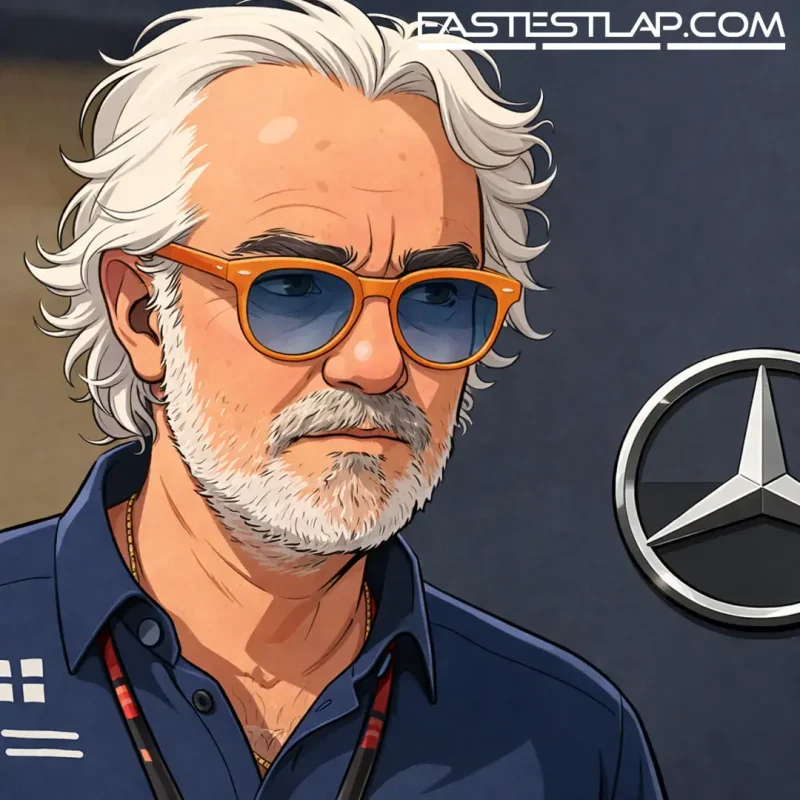
Flavio Briatore has never been a man for half-measures, and he’s now made it clear his return to Enstone came with a single non-negotiable: Mercedes power.
Briatore, back inside the Alpine set-up since mid-2024 as an “executive advisor” and now effectively running the operation day-to-day, says he told Renault CEO Luca de Meo there was only one way he was signing up again. Not a reshuffle. Not another internal “reset”. Not a promise that the next in-house engine would finally land.
A Mercedes engine deal for 2026. Full stop.
“The moment when Luca de Meo was talking about joining the team, [there was] only one condition for me to join the team, which was to have a Mercedes-Benz engine. There was no plan B, it was only one plan,” Briatore said, in comments carried by Motorsport.com. “I wanted a Mercedes-Benz engine completely.
“There was only one way to come back, because in this moment, you need to be with the best people… I wanted to have the discussion with the best. With the second best, no interest.”
That bluntness will either be applauded inside Alpine as the kind of clarity the organisation has too often lacked, or it’ll be seen as Briatore steamrolling a manufacturer identity that was central to the team’s modern branding. In reality it’s probably both. Alpine, after all, has spent years trying to fight its way out of the midfield while carrying a power-unit deficit that became part of the team’s weekly vocabulary.
Briatore’s comments also underline something else: his reappearance at Enstone didn’t trigger Renault’s eventual decision to close its Formula 1 power unit department at the end of 2025 — that process was already in motion, discussions already happening — but he clearly wasn’t going to hitch his reputation to another long, uncertain engine rebuild. He wanted certainty, and he wanted it from the paddock’s benchmark supplier.
Alpine subsequently confirmed it will become a Mercedes customer from 2026, timed with Formula 1’s new engine formula. Briatore, for his part, sounds almost relieved that the conversation has shifted away from the same recurring problem.
“At every race, I asked [how much our deficit would be],” he said. “This race? Four tenths. This race? 3.5 tenths, This race? Five tenths. And last year in three tenths we had 14 cars.
“At least when I arrive to the race, I will not ask anymore how many tenths we have in disadvantage. Nobody is talking about engine anymore. Nobody is talking about gearbox anymore. At least we have two issues we don’t need to care about.”
It’s classic Briatore: a little theatrical, but rooted in a truth anyone around Enstone would recognise. When you’re constantly starting the weekend with a known shortfall, everything else becomes compromise — strategy, qualifying approach, even how hard you can lean on the tyres in battle because you’re defending too often and from too early.
What makes the Mercedes tie-up particularly pointed is the timing. Mercedes comes into 2026 with the glow of recent success and the weight of expectation that always follows the sport’s best-resourced engine group. The company’s power units powered McLaren to a championship double last year, and the Mercedes works team’s hybrid-era record still casts a long shadow across the grid: seven drivers’ titles and eight constructors’ crowns during the turbo V6 era, before adding more success via McLaren and the 2025 drivers’ title.
That history matters because Alpine isn’t just buying an engine; it’s buying into a culture. Briatore says the early collaboration has already been striking.
“And the people of Mercedes, we started working together and it was promising,” he said. “It’s surprising, the ways that the people [at Mercedes] are collaborating with us. It’s a super, super relationship.”
There’s an edge to that line too, because it hints at what he believes Enstone has been missing: not effort, necessarily, but the right partnerships and the right leverage at the right moments. The paddock has long known how much modern performance is shaped long before the car hits the track — how tightly the PU installation, cooling demands, packaging and gearbox integration align with aerodynamic targets. A customer deal done early, with proper engineering buy-in, can be a competitive tool in itself.
And in the background sits the talk that Mercedes’ 2026 unit could again be the reference. The sport has been buzzing with claims that Mercedes — and also Red Bull-Ford — has interpreted a quirk in the regulations around compression ratio, allegedly allowing a higher ratio in running conditions than the 16:1 limit measured in ambient conditions. The suggestion is it could be worth a significant lap-time swing, with figures in the paddock being thrown around in tenths rather than hundredths.
None of that is confirmed, and regulation grey areas have a way of getting messy once rivals start asking the FIA pointed questions. But it does explain why Briatore framed this as a “best or nothing” decision. In a major rules reset, you don’t want to be the team discovering you picked the wrong engine six months too late.
Of course, a Mercedes badge on the cam cover won’t magically fix Alpine’s wider problems. It removes one variable, but it also raises the stakes everywhere else: if the power unit is strong, the excuses evaporate. Briatore seems perfectly comfortable with that trade. In fact, it reads like the point.
The message to his own factory is hard to miss: the safety net is gone. From 2026, Enstone will either build a car worthy of a front-running engine — or it’ll be exposed by it.