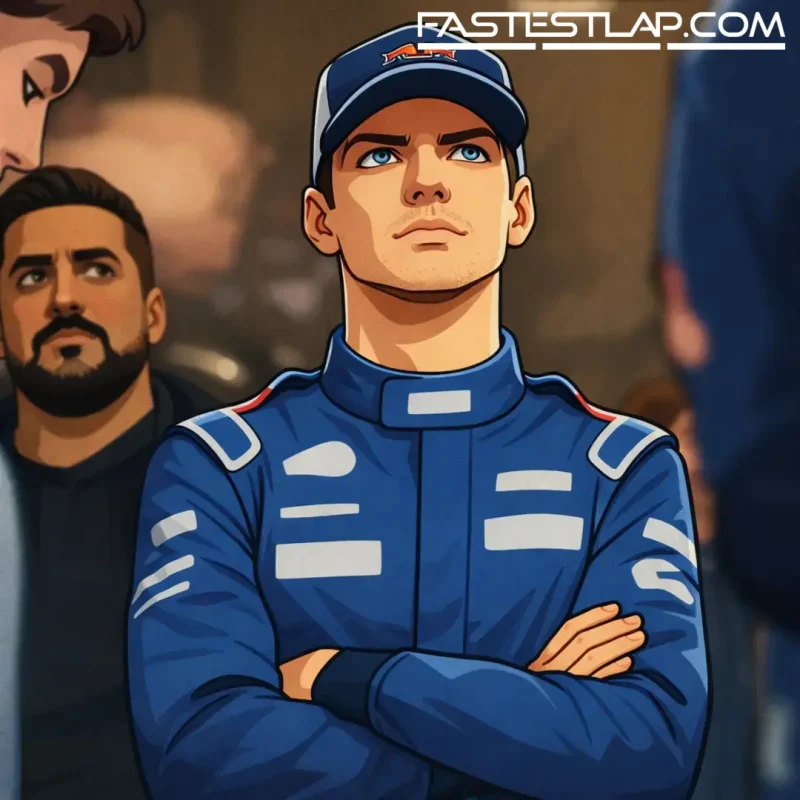
Max Verstappen didn’t need a trophy from his first Nürburgring 24 Hours to look like he belonged there. He just needed the chequered flag to fall without a mechanical footnote — and that, in the end, is what he didn’t get.
The Red Bull driver has confirmed he wants another shot in 2027 after the Verstappen Racing Mercedes-AMG GT3 entry he shared with Jules Gounon, Lucas Auer and Daniel Juncadella had its race turned inside-out by a driveshaft problem. With around four hours remaining, the #3 car had the sort of buffer that usually invites teams to start thinking about risk management rather than lap time. Then the hardware decided otherwise.
They did get the car back out, but only late enough to be classified 38th — a line in the results that doesn’t come close to reflecting how sharp that programme looked when it was alive.
Verstappen’s interest in returning sounded less like a polite “maybe” and more like a driver who’s already replayed the key moments and doesn’t want that to be his last memory of the Nordschleife.
“Of course, I will for sure try,” he said when asked about coming back in 2027. “It always depends a bit on my schedule.”
That’s the practical caveat, and it’s a real one. The Nürburgring 24 Hours traditionally sits in May or June, and this year it landed neatly in a rare pocket of air between the Miami and Canadian grands prix — the kind of gap that barely exists in modern Formula 1. Even with the championship now normalised around a 24-race calendar, clashes with other marquee events have become almost routine: Canada running on the same day as the Indianapolis 500, Barcelona-Catalunya falling alongside Le Mans.
And yet Verstappen’s explanation wasn’t about brand-building or ticking boxes. It was about the stuff that’s hard to find in the F1 bubble.
“I enjoy the competition, the endurance-style racing where you share with teammates, the 24-hour race here, the track is super challenging,” he said. “It’s just the whole combo.”
There’s a telling subtext there. Verstappen has never hidden that he likes racing as an activity, not just as a job title. The Nürburgring offers consequences and variables in bulk — traffic, changing conditions, rhythm over a full day — and it rewards a kind of adaptability that F1’s increasingly managed weekends can sometimes iron out.
He also hinted at unfinished business in the immediate aftermath, replying to an emotional message from Gounon — who admitted he’d “need time” to process the defeat — with a simple promise: “We will be back mate.”
All of this lands in an interesting place given Verstappen’s broader mood in 2026. He’s under contract with Red Bull until the end of 2028, but he’s also been unusually open this year about not loving where Formula 1 is headed under the new rules cycle. During pre-season testing in Bahrain, he delivered the line that stuck — likening the 2026-spec cars to “Formula E on steroids” — and in Japan he admitted he had “a lot of stuff to figure out” regarding his future.
The FIA has since confirmed tweaks to the power unit regulations for next season, including a revision to the 50:50 split between internal combustion and electrical power after sustained grumbling from drivers and fans. Whether that meaningfully changes Verstappen’s relationship with the direction of travel is another matter — but it’s hard not to read his Nürburgring enthusiasm as a reminder that, for all the noise about contracts and politics, the guy still lights up when the racing feels raw.
Back in F1, the immediate problem is far more basic: points. Verstappen heads to Montreal for this weekend’s Canadian Grand Prix sitting seventh in the drivers’ standings on 26 points, a staggering 74 behind championship leader Kimi Antonelli after a start to the season that has rarely looked comfortable.
Red Bull did at least show signs of waking up in Miami, where its first major upgrade of the year moved the needle. Verstappen qualified on the front row for the first time this season, only for a messy opening-lap spin to dump him into recovery mode. Fifth at the flag was still his best result of 2026 so far, but it underlined where Red Bull is right now: better, not back.
That’s why the Nürburgring subplot matters. It isn’t an escape plan or a threat — not yet, anyway. It’s a glimpse at what motivates Verstappen when the usual F1 levers aren’t doing it: a shared cockpit, a track that bites, and a race long enough that you can’t simply outsmart it with a perfect run plan.
He went to the Nordschleife once and left without the win. The point is he’s already talking like someone who expects to return and finish the job.