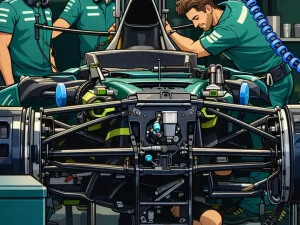
Williams has spent the first third of 2026 trying to fix problems it didn’t want to have in the first place. Now James Vowles is effectively conceding the FW48 story doesn’t really begin until late summer — and that everything before then is triage.
Speaking to Sky Deutschland, Vowles laid out an upgrade schedule that reads less like a conventional development plan and more like a staged rebuild. Silverstone will bring what he called a “medium-sized” package — Williams’ first genuinely notable step after a run of smaller changes across the opening eight race weekends — but it’s Baku that’s being framed internally as the real reset point.
“Our upgrade plans… we’ve got what I call a medium-sized for Silverstone, and then there’ll be small bits for Spa. Budapest, small bits as well,” Vowles said. “Then slightly bigger elements, including weight reduction, to Zandvoort. Then really for us, it’s almost a completely new car for Baku.”
That’s a striking admission for a team trying to climb back towards relevance in the new regulatory cycle. But it also matches what anyone in the paddock has been able to see: Williams hasn’t had the bandwidth to chase lap time properly because it started the year on the back foot.
The early months were defined by the sort of issues that kill momentum before the season even properly starts. Williams missed the opening pre-season outing in Barcelona due to chassis problems, and the FW48 arrived overweight — a basic, brutal handicap in this generation of cars. When you’re carrying kilos you shouldn’t, your “upgrade path” is often just a series of expensive apologies: shave mass here, rework parts there, and only then start attacking performance.
That reality explains why Silverstone matters, even if nobody at Grove is dressing it up as a miracle cure. It’s the first upgrade that sounds like it’s intended to move the needle, rather than simply stop the bleeding. The uncomfortable part is what follows: incremental pieces for Spa and Budapest, a more meaningful step at Zandvoort that still includes weight reduction as a core deliverable, then the big swing at Baku — the point Vowles describes as “almost a completely new car”.
In other words, Williams is openly running two seasons in one: survival mode through the first half, then a late-year car that’s closer to what it should’ve been at launch.
The sporting context isn’t flattering. Williams has 11 points and sits eighth in the constructors’ championship, 10 behind Haas. That’s close enough on paper to keep the accountants calm, but the bigger concern is how distant the car can look on track.
Alex Albon didn’t bother trying to spin it after Austria, where he finished 17th and two laps down on race winner George Russell. The line that will have stung inside Williams wasn’t even about Russell disappearing up the road — it was the fact the Racing Bulls pair lapped him.
“I think it’s not going to get us to the midfield,” Albon said of the Silverstone package. “But it will get us maybe closer to the Haas. I think that’s maybe a sensible first step this year to get a little bit closer to the midfield cars. We’ve got lapped by the RBs [in Austria], so we’re quite far away.”
That’s the kind of realism drivers resort to when they’ve already tried optimism and it didn’t survive contact with the stopwatch. Albon’s framing is telling, too: he’s not talking about beating a direct rival this weekend, he’s talking about “getting a bit closer” to Haas as a “first step”. It’s an acknowledgement that Williams’ current baseline is so compromised that even modest progress needs to be banked and protected.
The fascinating thing about Vowles’ Baku promise is what it implies technically without ever getting into specifics: if the car is going to be “almost completely new” by September, then the team believes its current architecture — not just individual components — is holding it hostage. That sort of language tends to come when you’ve learned enough from the first iteration to justify a deeper rethink, and when the early constraints (weight, chassis issues) have forced you into compromises you can’t upgrade your way out of.
It also sets a tight psychological timeline. Silverstone has to show something tangible, because otherwise “wait for Baku” becomes a dangerous mantra — especially in a season where points are precious, and where being lapped by cars you’re supposed to be racing is corrosive for everyone from the cockpit to the factory floor.
There’s another edge to all of this, too. Williams is currently under a double FIA stewards investigation after the Barcelona Grand Prix. That’s an unwanted sideshow at exactly the moment the team needs calm execution: clean weekends, clean data, clean development correlation. When your big plan is to rebuild a car in-season, the last thing you need is noise — or any distraction that risks turning a tough year into a messy one.
For now, the message from within Williams is consistent, if not exactly comforting: Silverstone starts the process, Zandvoort accelerates it, Baku is the reveal. Whether that timeline looks brave or bleak will depend on one simple thing — whether the first “medium-sized” step actually pulls Williams back into the same fight as Haas, rather than just making the gap look slightly more respectable on a timing screen.